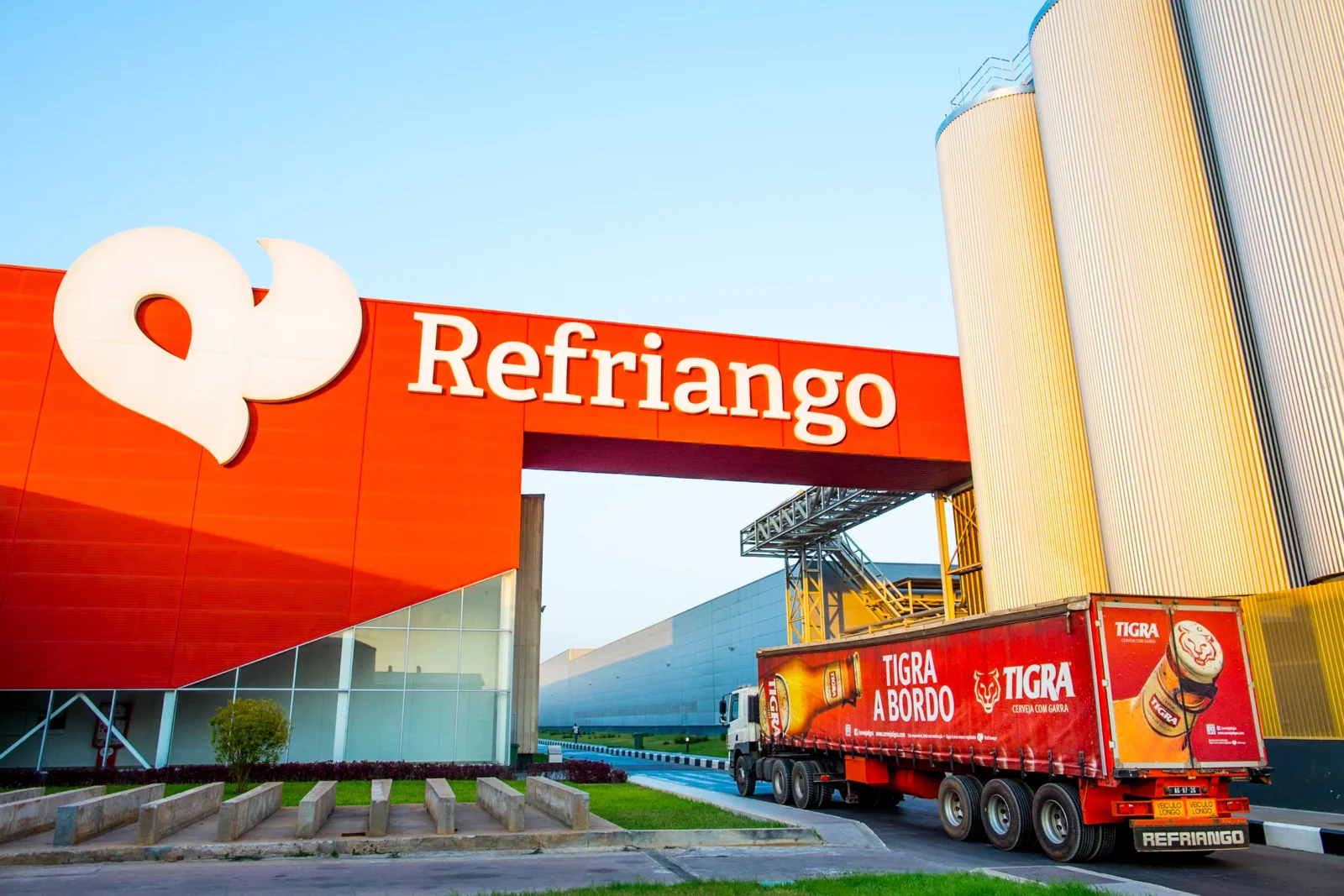
In a market where Heineken bottles Coca-Cola and PepsiCo just planted its own flag, a Portuguese-Angolan giant just drew its own battle lines.
Refriango, Angola’s exclusive Coca-Cola bottler and the country’s dominant beverage manufacturer, has officially inaugurated a new production facility in the Democratic Republic of Congo, completing a $75 million bet on one of Africa’s most populous and commercially complex markets, and positioning itself as the only local producer of 100% fruit juice in the country.
The factory sits inside the Maluku Special Economic Zone along the Congo River, just outside Kinshasa off Route Nationale 1, on the site of a former steel plant once owned by Société d’Exploitation Sidérurgique (SOSIDER). The $75 million investment was announced by Refriango’s chairman Diogo Caldas in July 2024, with production originally targeting a January 2025 start. The formal inauguration this month marks the project’s full commercial arrival.
Refriango belongs to the Nutrigroup and is part of the broader Nuvi Group, the family conglomerate of Portuguese businessman Luís Manuel Vicente, whose activities in Angola date back to the 1990s. The company’s first specialist soft drinks production plant opened in 2005, and it has since grown into one of the largest beverage operations on the African continent.
The DRC entry is no sudden pivot. Caldas has said Refriango established operations in Kinshasa as far back as 2021, building local teams before committing to bricks and mortar. “A key lesson has been balancing our brand DNA with local realities, logistics, regulations, and consumer preferences,” he noted. “Exporting water was unfeasible, so we are building a factory in Congo while continuing to export other beverages.”
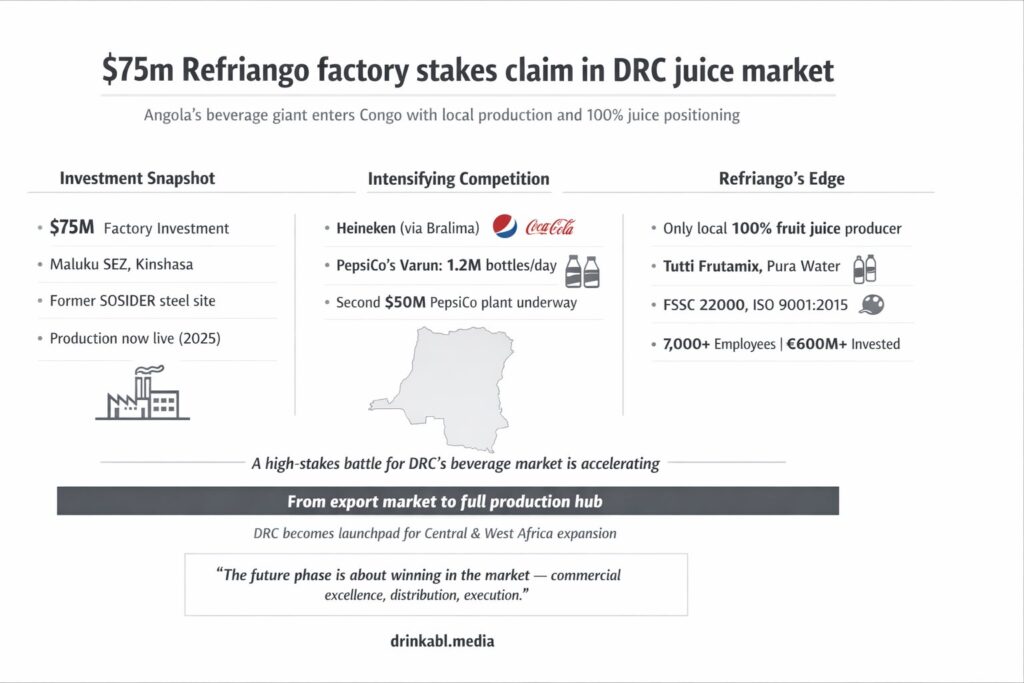
With the factory now live, Refriango has launched new products into the Congolese market, including Tutti Frutamix in Orange and Mango variants, and Pura Water in two formats. More innovations are already in the pipeline, the company says.
“But this is only the beginning. With more than a handful of brands and dozens of SKUs, Refriango RDC is proud to be the only local producer of 100% fruit juice in the country. And this platform will continue to grow, with new innovations already on the way.” , Tânia Sousa Jardim, Chief Marketing Officer, Refriango
The launch lands in the middle of a fierce new contest for the DRC’s beverage market. In the DRC, Coca-Cola is bottled by Bralima, owned by Heineken, while Hyper Psaro handles the brand in Lubumbashi. That means Refriango enters the DRC not as a Coca-Cola partner but as an independent challenger, competing on its own brands in a market already crowded by global giants. Meanwhile, PepsiCo’s bottler Varun Beverages has operated a production site in Maluku since August 2024, producing up to 1.2 million bottles daily, and has since announced a second $50 million facility at the Kiswishi City SEZ near Lubumbashi, doubling down on the DRC opportunity.
Refriango was the first Angolan FMCG company to achieve FSSC 22000 food safety and ISO 9001:2015 certifications, a credential edge that matters in markets where supply-chain trust is hard to build. The group has invested more than €600 million in Angola, employs over 7,000 people, and exports to regional markets including Namibia, South Africa, Guinea-Conakry, São Tomé and Príncipe, and Cape Verde, with the DRC now graduating from export destination to full production territory.
Jardim was direct about what this moment demands:
“Until now, our focus has been on building the industrial foundation and developing great products. Now, we enter a new phase, winning in the market. A phase defined by commercial excellence, distribution strength and disciplined execution.”
That execution challenge is formidable. The DRC is notoriously difficult to operate in, with fragmented logistics, currency volatility, and a vast informal trade sector presenting structural hurdles any manufacturer must navigate. But Caldas has made clear the ambition runs beyond the DRC. “While Congo is the focus, we are also exploring Central and West African markets.”
For Refriango, the Kinshasa factory is not a satellite. It is the foundation of a continental play.
Read more on Drinkabl.media: