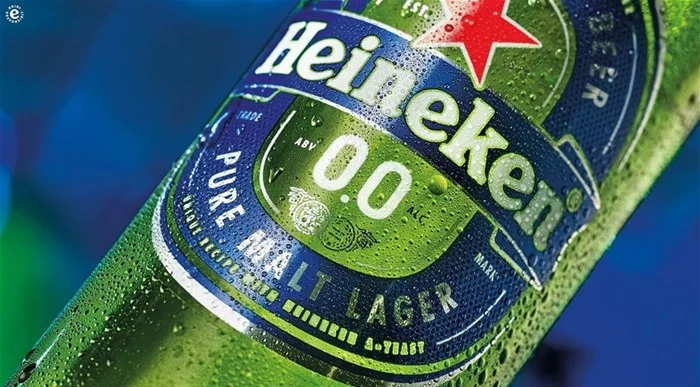
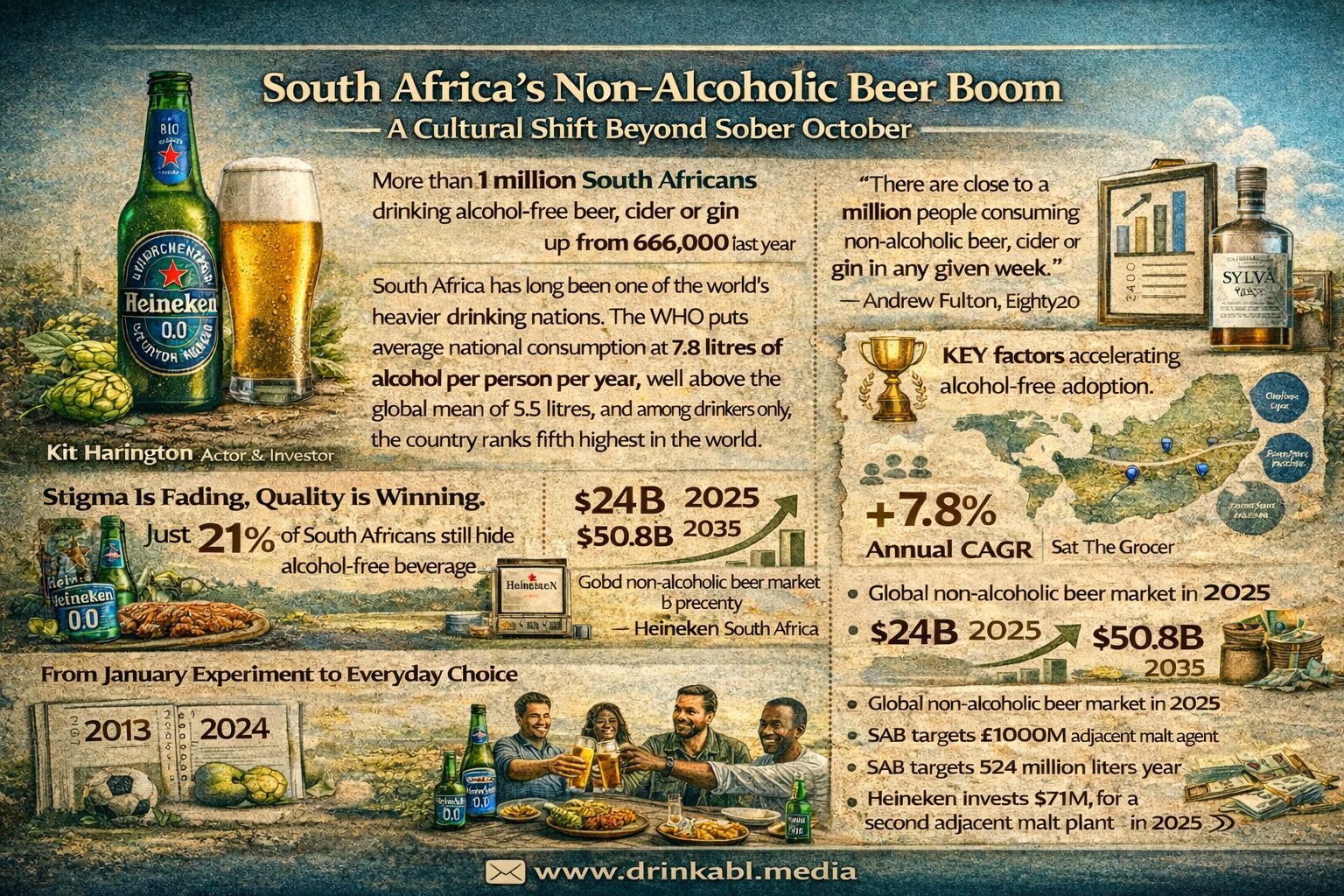
Close to a million South Africans now reach for a non-alcoholic beer, cider or gin in any given week. That number was 666,000 just a year ago. The glass, it turns out, is more than half full.
South Africa has long been one of the world’s heavier-drinking nations. The WHO puts average national consumption at 7.8 litres of alcohol per person per year, well above the global mean of 5.5 litres , and among drinkers only, the country ranks fifth highest in the world. Against that backdrop, the quiet surge of alcohol-free beer looks less like a niche trend and more like a genuine cultural shift.
Consumer insights firm Eighty20 confirms the momentum. “Whether it is enjoying the refreshing taste of beer without the effects of alcohol, or alternating a non-alcoholic option when you are out drinking, there are close to a million people consuming non-alcoholic beer, cider or gin in any given week,” says Andrew Fulton, director at Eighty20. Crucially, fewer than 5% of this group abstain entirely. Most are “alternators” , people swapping out every second or third drink for a non-alcoholic version.
That pattern is exactly what Chaen Lew, Growth & Innovation Manager at Heineken South Africa, has been watching. Writing for Bizcommunity’s BizTrends 2026, she identifies six forces accelerating what she calls “the normalisation of alcohol-free consumption” , and the data backs her up.
From January experiment to everyday choice
What began as a UK public health initiative in 2013, Dry January has grown into a global lifestyle marker. By 2024, 215,000 people worldwide had formally signed up, while millions more participated informally. Sober October, known locally as Ocsober, has followed suit, embedding itself in South African culture alongside braai season.
The social permission these campaigns have provided is hard to overstate. As Lew puts it:
“Choosing not to consume alcohol has shifted from ‘being good’ or being an exception to the norm, to being choiceful. Choice is the new responsibility.”
That said, the picture is not without nuance. International data from the IWSR shows Gen Z interest in month-long abstinence challenges has actually dipped slightly across 15 markets between 2024 and 2025, from 30% to 28% participation. South Africa was one of the markets surveyed. The implication: rather than confining alcohol-free choices to dedicated calendar events, younger consumers may be integrating moderation into everyday drinking habits instead. Lew’s thesis, if anything, is stronger for it.
The stigma is fading, but 21% still hide their drinks
Research by Heineken in collaboration with Professor Charles Spence, an experimental psychologist at Oxford, found that 21% of Gen Z drinkers in markets from the UK to Brazil admitted to hiding their non-alcoholic drinks to avoid social pressure. In South Africa, a country where drinking culture is deeply embedded in braai and social life, that pressure has historically been particularly acute.
That stigma, Lew argues, is receding:
“Drinking alcohol-free beverages is simply another choice. There’s something empowering about choosing an alcohol-free beverage — confidence has replaced compromise.”
Quality is closing the gap
For years, the practical barrier to alcohol-free adoption was taste. That objection is weakening. Heineken 0.0 won the BASA No Alcohol Trophy at the 2025 South African National Beer Trophy, the country’s largest beer competition, featuring 160+ entries judged by BJCP-certified experts and international sommeliers. It competed directly against traditional beers, without a separate or lesser standard applied to it.
Heineken South Africa’s Marketing Director, Andrea Quaye, was direct about what the award signals:
“This recognition confirms what South Africans already know: you don’t have to compromise on taste to choose alcohol-free.”
The market is following the mood
The commercial opportunity is significant. The global non-alcoholic beer market was valued at $24 billion in 2025 and is projected to reach $50.8 billion by 2035, growing at a CAGR of 7.8%. South Africa is explicitly flagged as a high-growth market within that forecast, driven by health-conscious consumers, an expanding middle class, and modern retail channels increasingly stocking premium alcohol-free options.
South African Breweries, meanwhile, has set a target of alcohol-free and low-alcohol beers accounting for 20% of its total production. The industry’s broader investment trajectory, including a €100 million malting facility investment by Soufflet Malt adjacent to Heineken’s Sedibeng Brewery in 2025 , underscores that producers are treating this as a structural shift, not a marketing moment.
Lew frames the opportunity plainly: “When brands continuously invest in availability, innovation and taste, they build long-term credibility and trust with consumers.”
A more inclusive table
Perhaps the most understated dimension of alcohol-free beer’s rise is its social one. South Africa is a country where seven in ten people do not drink alcohol at all. For that majority, the lack of appealing non-alcoholic options at social occasions has long been a quiet form of exclusion.
Heineken’s “Always a Choice” principle, ensuring Heineken 0.0 is available wherever Heineken Original is stocked, is a direct response to that gap. The logic is simple and its social implications are broad: when non-alcoholic beer earns its place beside its alcoholic counterpart rather than being offered apologetically as an afterthought, the table genuinely becomes more inclusive.
The numbers, the awards and the cultural signals are all pointing the same way. Alcohol-free beer has stopped asking for permission.