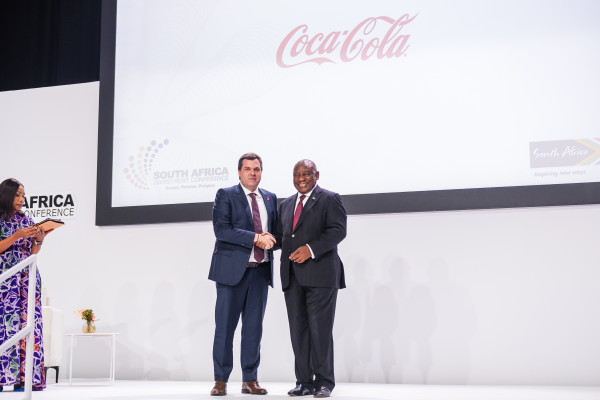
A billion dollars doesn’t flow into a market without a reason. For Coca-Cola, the reason is South Africa, and the soft drinks giant is making its confidence official.
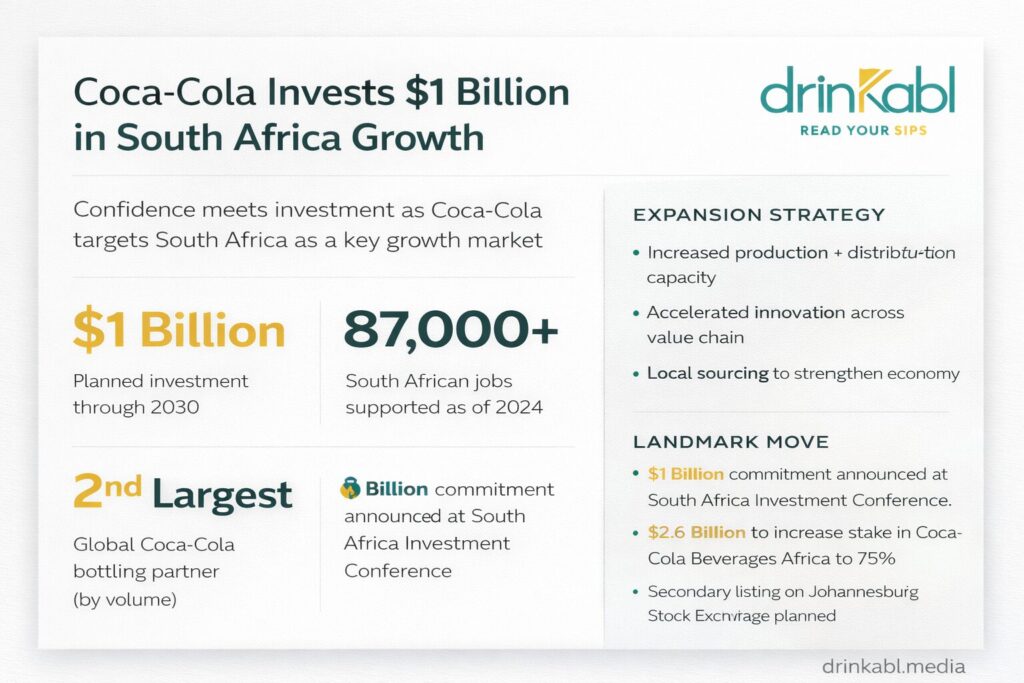
The Coca-Cola Company and its two authorised bottlers, Coca-Cola Beverages South Africa and Coca-Cola Peninsula Beverages, announced plans to invest R17.6 billion ($1.05 billion) in South Africa through 2030, with funds directed at expanded production capacity, stronger distribution, and accelerated innovation across the system’s value chain. The announcement was made by Luis Felipe Avellar, president of The Coca-Cola Company’s Africa operating unit, at the sixth South Africa Investment Conference in Johannesburg, the same forum where President Cyril Ramaphosa set an ambitious target of attracting two trillion rand in new investments over the next five years.
The timing is deliberate. It signals that even as Africa’s macroeconomic conditions remain testing, the world’s most valuable non-alcoholic drinks brand is doubling down on the continent’s anchor economy.
“Our R17.6 billion investment reflects our strong belief in South Africa’s potential and our commitment to growing alongside the communities we serve. We hire locally, produce locally, distribute locally and, where possible, source locally, helping to build a stronger, more integrated economy in South Africa.” , Luis Felipe Avellar, President, Coca-Cola Africa
The Numbers Behind the Bottle
The investment announcement was backed by independent data. A comprehensive socio-economic impact study found that the Coca-Cola system in South Africa contributed R51.2 billion in value-added economic activity in 2024, supporting over 87,000 jobs across sectors including retail, agriculture, manufacturing, transport and services.
Of those, 7,822 were direct jobs within the system, with an estimated 79,300 jobs supported through suppliers, partners and customers, meaning every direct role created supports roughly ten more across the broader economy.
Local sourcing tells an equally compelling story. The system spent R25.6 billion procuring goods and services from South African suppliers in 2024, spanning industries as varied as sugar production, packaging, transportation and marketing, reinforcing Coca-Cola’s role as a deeply integrated economic partner, not merely a market participant.
A Bottling Shakeup That Changes Everything
This investment doesn’t arrive in isolation. It comes on the heels of a seismic structural shift across the Coca-Cola Africa bottling system. Coca-Cola HBC agreed to acquire a 75 percent stake in Coca-Cola Beverages Africa for $2.6 billion, a deal that creates the world’s second-largest Coca-Cola bottling partner by beverage volume. The transaction values CCBA at $3.4 billion and is targeted for completion by the end of 2026, pending regulatory approvals from the Competition Commission of South Africa, COMESA, and national regulators in Kenya and Ethiopia.
Crucially, Coca-Cola HBC also intends to pursue a secondary listing on the Johannesburg Stock Exchange, further underlining its commitment to South Africa and the broader African continent.
Zoran Bogdanovic, CEO of Coca-Cola HBC, backed the investment momentum directly:
“Congratulations to the Coca-Cola system on this investment announcement. After the transaction completes, we look forward to continuing the great work of Coca-Cola Beverages South Africa in the years to come.”
For context on why the stakes are so high, South Africa commands 24.7% of Africa’s continental beer market share, and the continent’s non-alcoholic beverage sector alone is projected at $124 billion. Africa’s broader beverages market is projected to grow at a compound annual rate of over 6 percent through 2030, driven by urbanisation, rising incomes, and favourable demographic trends, all factors that make South Africa’s established infrastructure and relatively high per capita consumption particularly attractive to global beverage capital.
Legacy, Water, and What Comes Next
Beyond the production and distribution play, South Africa is one of the beneficiaries of the Coca-Cola system’s Africa Water Stewardship Initiative, a nearly $25 million investment through 2030 aimed at addressing critical water-related challenges in local communities across 20 African countries.
Sunil Gupta, CEO of Coca-Cola Beverages Africa, framed the announcement within a near-century of continental presence:
“South Africa remains one of our most strategic markets in Africa, the beginning of a legacy that dates back to Coca-Cola’s first entry on the continent in 1928. These findings reaffirm the Coca-Cola system’s role as a key driver of shared value and sustainable growth within the South African economy.”
Coca-Cola has operated in South Africa since 1928, building its presence through a franchise model and maintaining local bottling through periods of political and economic pressure. After 1994, the company restructured its operations and positioned the country as a base for African growth, a strategic logic that this latest commitment only reinforces.
Charl Goncalves, MD of Coca-Cola Peninsula Beverages, offered the clearest signal of intent: “We are optimistic about South Africa’s future, with a continued focus on investing in our business and in initiatives that support economic inclusion and lasting local prosperity.”
For a beverage industry watching every rand and every margin, a $1 billion commitment from the continent’s most embedded soft drinks system is not just a headline, it’s a structural statement.
Further Reading