What began as a niche seasonal release is now drawing broader scrutiny around sweeteners and formulation choices.
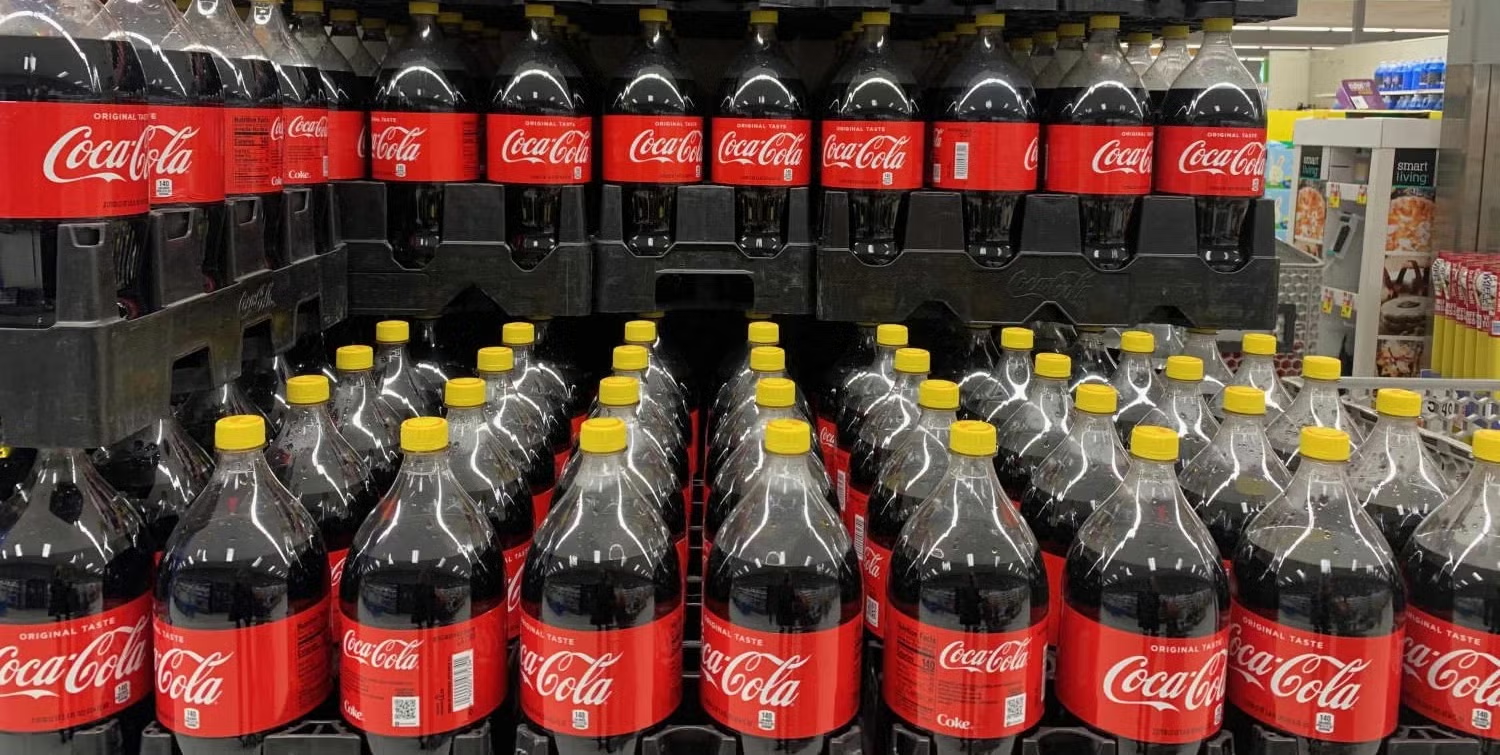
Walk into any American grocery store in the weeks before Passover and something subtle catches the eye, a bright yellow cap where Coca-Cola’s signature red usually sits. Most shoppers scroll past it. Beverage industry watchers do not.
The yellow-capped bottles, stamped with a Hebrew “Kosher for Passover” seal and the Orthodox Union’s O-U-P certification mark, signal that the Coke inside is sweetened with cane sugar rather than high-fructose corn syrup (HFCS), a seasonal reformulation with roots nearly a century deep in religious dietary law that has, in 2026, become a flashpoint for one of the most consequential sweetener debates in carbonated soft drink history.
The tradition traces back to 1935, when Rabbi Tobias Geffen, who led Atlanta’s Congregation Shearith Israel for sixty years, from 1910 until his death in 1970, was granted rare access to Coca-Cola’s closely guarded ingredient list, without the proportions, to determine whether the beverage met Jewish dietary law. He found two distinct concerns. First, glycerin sourced from non-kosher beef tallow. Second, for the stricter Passover period specifically, traces of alcohol derived from fermented grain, classified as chametz, forbidden during the holiday. The corn syrup in the formula also qualified as kitniyot, which Ashkenazi Jews avoid at Passover, compounding the problem.
The Coca-Cola Company’s scientists resolved both issues methodically. Plant-derived glycerin from cottonseed and coconut oil, supplied by Procter & Gamble, replaced the tallow-based version. For Passover, grain-derived ingredients were swapped for cane and beet sugars. Rabbi Geffen published his ruling, and Coca-Cola has manufactured yellow-cap bottles for Passover every year since. The yellow cap with its Kosher for Passover logo in Hebrew and the O-U-P mark became the signal to observant consumers that the product inside met the stricter holiday requirements.
For decades, this remained a niche seasonal story. Then the soft drink industry shifted, and the yellow cap found a much wider audience.
“If you look at the success of Mexican Coke in the United States, it’s a combination of the product and the package, and we’re very keen to offer that same combination using American cane sugar.” — John Murphy, Coca-Cola CFO, to Bloomberg News, October 2025
That quote captures exactly why Passover-season shelves are drawing far more than religious attention in 2026. Social media communities, particularly food-focused accounts, have spent recent Passover seasons urging followers to stock up on yellow-cap Coke as a budget-friendly alternative to Mexican Coke, which commands a premium of up to $5 per half-litre bottle at retailers like Costco and Target. The Passover version delivers the identical cane-sugar taste without the markup, typically in 2-litre bottles at standard Coke pricing.
The industry subtext here is significant. Coca-Cola’s broader push to bring cane sugar into its standard US portfolio has been slowed by supply chain constraints, with CFO Murphy confirming to Bloomberg that the rollout would be measured, noting there is only a limited amount of cane sugar available domestically, and that the company faces a separate challenge in scaling up glass bottle production capacity.
That constraint makes the Passover window, with its established yellow-cap supply chain, existing ingredient sourcing infrastructure, and proven consumer trust, a quietly strategic annual rehearsal for cane sugar Coke at scale.
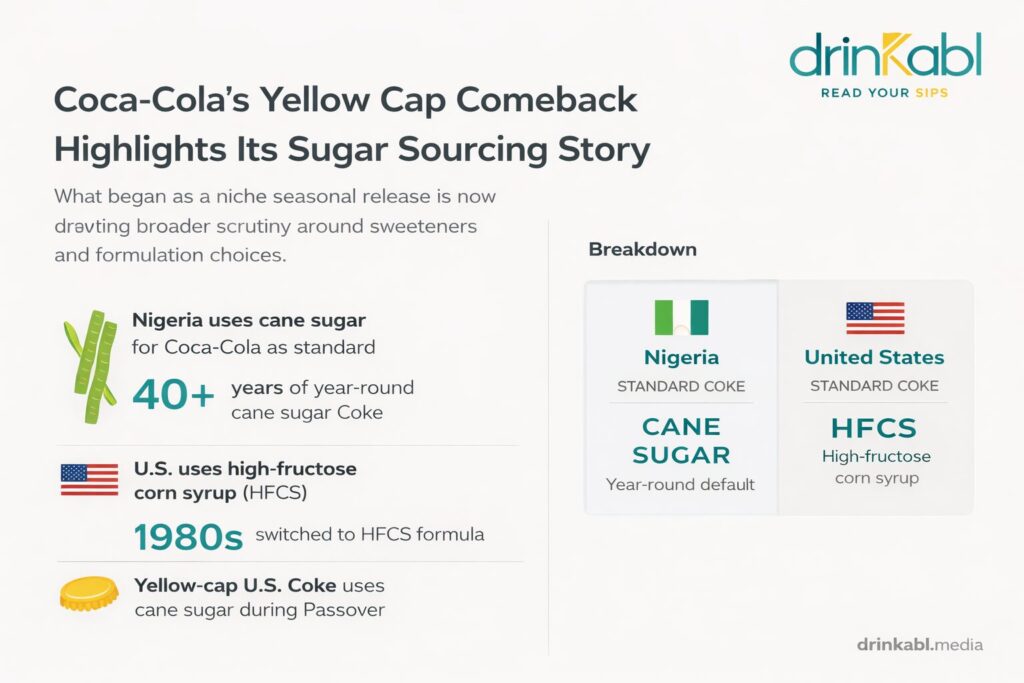
Coke has sweetened its flagship US formula with high-fructose corn syrup since the 1980s, though it has continued using cane sugar in markets like Mexico, giving rise to “Mexican Coke,” which gained mainstream US popularity over the past decade through retailers and restaurants serving Hispanic communities. Notably, competitors PepsiCo and Dr Pepper have been distributing cane sugar versions of their signature colas in the US since 2009, making Coca-Cola a late mover in its own home market, a fact not lost on industry analysts watching the yellow cap conversation unfold each spring.
The political dimension adds another layer of commercial urgency. The cane sugar push sits within broader US policy momentum against ultra-processed ingredients, including HFCS, as part of the “Make America Healthy Again” initiative, driving shifts toward what regulators and consumers alike frame as more natural products. President Trump publicly backed the cane sugar transition last year, calling it simply “better.” Coca-Cola CEO James Quincey confirmed the company’s direction on an earnings call, framing the new offering as meeting “consumer interest in differentiated experiences,” carefully positioned as an addition to, not a replacement of, the HFCS formula.
For the non-alcoholic beverage sector, the yellow cap now carries a dual message: a century-old commitment to religious consumer inclusion that reshaped how America’s biggest company formulates its most iconic product, and an emerging commercial reality that cane sugar Coke has a proven, vocal, and growing market willing to pay attention to what’s under the lid.
As Drinkabl reported, Coca-Cola has been deepening its consumer engagement investments across markets, signalling confidence in the brand’s portfolio at a moment of ingredient scrutiny and shifting preferences globally. The company also recently extended the trademark on its iconic contour bottle through 2035, reinforcing its long-game packaging strategy and the enduring commercial value it places on the physical vessel, not just what’s inside it.
The yellow cap will disappear from shelves once Passover ends. But the conversation it’s sparking, about sweeteners, supply chains, religious accommodation as corporate strategy, and what consumers actually want in their soda, is not going anywhere.
Further reading on Drinkabl.media: Coca-Cola Nigeria Bets Big on Consumer Rewards as Economy Shows Signs of Recovery Coca-Cola Extends Iconic Bottle Trademark Through 2035 Industry Fires Back at Push to Spike Sugar Drink Tax by 1,200% The Thirst Crisis That Could Break the Beverage Industry