The world’s biggest beer makers are no longer betting on their traditional strongholds. A seismic shift in where growth comes from is now reshaping the global brewing map, and Africa, Latin America, and Asia are at the centre of it.
When drinkabl.media reported in March on Asahi’s landmark $4.8 billion acquisition of East African Breweries Limited, it was more than a deal story. It was a signal, perhaps the clearest yet, that the global brewing industry’s centre of gravity is shifting, decisively, away from the West.
Because while Asahi was moving into Nairobi, the traditional powerhouses of global beer were quietly falling apart.
The global beer industry has entered what analysts at Scope Ratings now describe as a phase of “long-term structural stagnation,” driven by persistent volume declines across the US and Western Europe. Consumers are turning away from beer in favour of canned cocktails, moderating their alcohol intake altogether, or simply pulling back on spending. For market leaders AB InBev and Heineken, 2025 volumes sat at or below pre-Covid levels, a sobering milestone for an industry that once seemed bulletproof.
The numbers are unambiguous. AB InBev’s full-year 2025 volumes fell 2.0% globally, with North America down 3.0% and Asia Pacific, once a reliable growth engine, declining by a steep 6.4%. As Scope Ratings’ Carlos Munoz bluntly put it: “Even with favourable weather conditions or major sporting events, volumes remain persistently below historical baselines.”
Analysts see no signs of revival. So where do the big brewers go from here?
Latin America: The Profit Pool
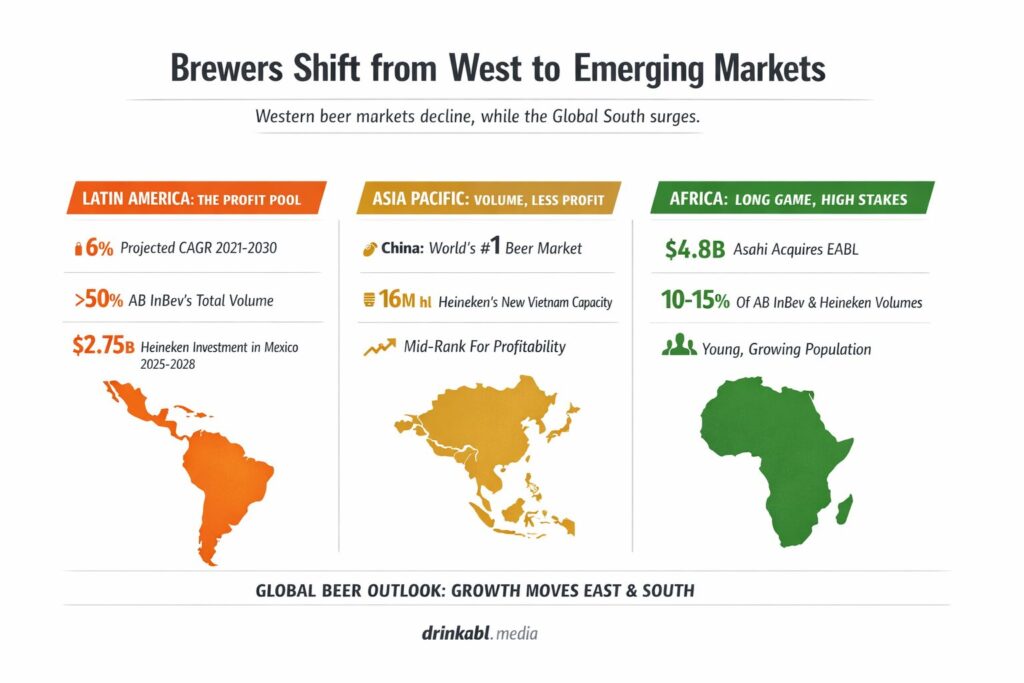
The answer, for many, starts in the south. Latin America’s beer market is projected to grow at a 6% CAGR from 2021 to 2030, according to Grand View Research. For AB InBev, the region already accounts for more than half of total volumes, 27% from Middle Americas and 28% from South America. Crucially, Middle Americas continued its momentum through 2025 with EBITDA growth led by Mexico and Colombia, even as South America faced headwinds from Brazil’s soft industry environment.
Munoz is direct on why the continent matters:
“Latin America is the largest emerging market profit pool. Mexico and Brazil are two of the largest beer markets globally, consolidated markets supporting pricing and stable margins.”
Mexico operates as an effective duopoly, with AB InBev and Heineken controlling almost the entire market between them. In Brazil, their combined share sits at approximately 80%. Heineken has pledged $2.75 billion in Mexico between 2025 and 2028, including a new brewery in Yucatán with an initial 4-million-hectoliter capacity, a vote of confidence in a market it clearly intends to dominate for decades. Colombia and Argentina round out a continent that continues to punch well above its weight in global beer revenues.
Asia Pacific: Volume Without Margins
In Asia, the story is more nuanced. China is the world’s largest beer market, dominated by domestic heavyweights CR Beer Snow and Tsingtao, though global players are staking their claims. AB InBev holds the #3 position in the country, while Carlsberg has been expanding its Chinese presence, inaugurating its 27th brewery in Foshan in 2024 with a 5-million-hectoliter annual capacity.
In Vietnam, Heineken has already cemented its position. Its Vung Tau brewery, covering 40 hectares in Ba Ria Vung Tau with an annual capacity of 11 million hectolitres, officially became the largest brewery in Southeast Asia when it was unveiled in September 2022. Since then, Heineken Vietnam has committed a further $142 million to expand that facility’s capacity to 16 million hectolitres, a bet on a country where it already leads the market with a 37% share.
Munoz frames the region’s trade-off plainly:
“Asia Pacific is the largest market by volume, but mid-rank by profit. China is the largest beer market in the world, and in the region there are several fast-growing markets such as Vietnam and the Philippines.”
Africa: Long Game, High Stakes
Africa is the frontier story, and Asahi’s acquisition of EABL is the clearest signal yet that serious, patient capital is arriving. The deal was struck at a 17x EBITDA multiple, well above the global brewing sector average of 9 to 11x, a deliberate, long-term wager on a continent the rest of the world is only beginning to price correctly.
As drinkabl.media has previously explored, Africa’s drinks industry carries both a sober problem and a much bigger opportunity. A fast-growing young population, rapid urbanisation, rising disposable incomes and expanding middle-class aspirations are all converging. Yet infrastructure gaps, fragmented distribution and regulatory complexity still temper the near-term picture.
Munoz keeps expectations measured:
“Africa is more a long-term growth option as it offers strong demographic tailwinds, but currently accounts for just around 10 to 15% of AB InBev and Heineken volumes.”
Steady Hands, Not Big Swings
For the industry’s biggest players, the broader strategic posture has shifted. With core Western markets offering little hope for volume recovery, stability now rests on conservative leverage, strict cost discipline, and targeted M&A in markets that still believe in beer, rather than the expansive growth narrative that once defined the industry.
The beer map is being redrawn in real time. The question is no longer whether the West can be revived. The question is who plants the best flags in the markets that are still growing.
📖 Further reading on drinkabl.media:
Japan’s Asahi Cracks Africa Wide Open With Landmark $4.8bn EABL Deal | Africa’s Drinks Industry Has a Sober Problem, and a Bigger Opportunity | Nigerian Breweries Is Back!