

A booming global green tea market, now valued at over $17 billion and growing, has been built on one premise: that green tea is the smarter, healthier cup. But a wave of peer-reviewed research published through 2025 tells a far more nuanced story, one that may vindicate the world’s coffee drinkers just as much as it celebrates tea.
The green-tea-is-better narrative has persisted for years. Yet when clinicians and registered dietitians are pressed to give a straight answer, the consensus is consistent: both beverages have exceptional health credentials, both carry risks when consumed recklessly, and neither deserves the crown.
The Caffeine Gap, and Why It’s Been Misquoted
One of the most repeated claims in the green tea vs. coffee debate involves caffeine, and it is routinely overstated. According to FDA estimates, an 8-ounce cup of coffee typically contains 80 to 100mg of caffeine, while the same size cup of brewed green tea delivers just 30 to 50mg. That is a meaningful difference, not a minor one. Varieties like matcha, where the entire leaf is consumed in powdered form, can push caffeine levels beyond 70mg per serving. But standard brewed green tea sits well below coffee at its baseline.
Dr. Neha Pathak, an Atlanta-based primary care physician, frames the clinical relevance plainly:
“The choice depends on personal preference and how your body responds to each drink.”
As public health guidance consistently notes, a total daily caffeine intake of up to 400mg is considered safe for most adults, with most studies examining caffeine and health outcomes suggesting 300mg daily as the optimal level. Even smaller amounts, however, make some people jittery, anxious, or disrupt sleep.
What Green Tea Actually Does Inside Your Body
Green tea’s scientific case rests heavily on its catechin content, particularly a compound called epigallocatechin gallate (EGCG). Among green tea’s bioactive compounds, catechins, particularly EGCG, play a key role in regulating cell signalling pathways associated with cardiovascular diseases, neurodegenerative disorders, metabolic diseases, and cancer. A 2025 systematic review of clinical trials concluded that the health benefits of green tea catechins outweigh potential risks, though researchers stress the need for further work on dosage and individual metabolism.
Dr. Brynna Connor, a board-certified family medicine physician, is among those who cite green tea’s breadth of action:
“Green tea has lots of catechins, an antioxidant that helps fight arthritis, inflammation and cancer. Beyond its ability to help protect skin cells from UV damage, this superfood has amino acids that are beneficial for boosting brain health, improving mood and reducing stress.”
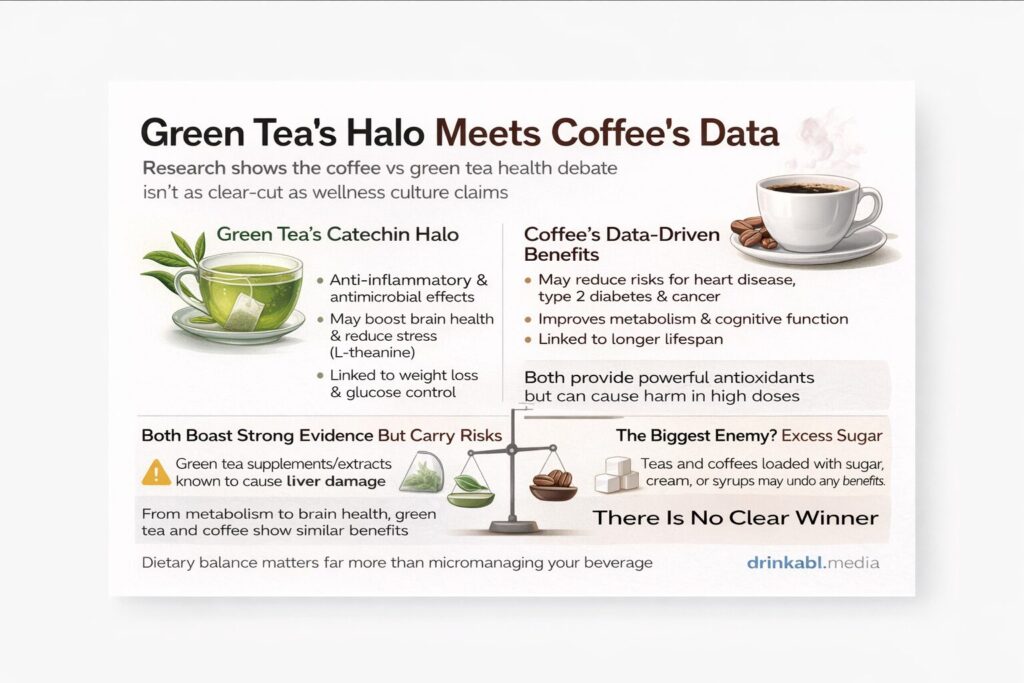
There is also a growing body of evidence around green tea’s metabolic benefits. Research shows that green tea possesses anti-inflammatory, anticancer and antimicrobial activity, reduces body weight, and slows aging, effects primarily attributed to catechins contained in the leaves, particularly EGCG. Alyssa Pacheco, a Registered Dietitian based in Boston, adds that research studies have linked green tea to lowering glucose and insulin levels, a significant benefit for those managing insulin resistance or excess body weight.
Green Tea’s Secret Weapon: L-Theanine
Green tea’s defining edge over coffee may lie not in what it contains more of, but in what coffee entirely lacks: L-theanine. This unique amino acid has attracted substantial clinical attention. Accumulating clinical and preclinical data indicate that L-theanine can reduce stress and subjective anxiety without causing sedation or serious adverse events, positioning it as a safe and mild anxiolytic. A randomised controlled trial found that 200mg of L-theanine daily over four weeks measurably reduced depression, anxiety and sleep disturbance scores in adults with psychiatric illness.
However, a 2025 review urges measured expectations: some studies suggest L-theanine may increase alpha waves in the brain associated with relaxation and selective attention, reduce stress and anxiety, and improve sleep quality, though findings are often inconsistent, and the evidence supporting many health claims remains limited, especially due to the lack of rigorous human clinical trials. In short: promising, not yet conclusive.
A Critical Caveat: Green Tea Is Not Risk-Free
This is where wellness culture typically goes quiet. Long-term administration of high doses of antioxidants may result in a pro-oxidant effect and promote cell damage. Consumption of large quantities of green tea beverages, or high doses of green tea catechin extracts, does not guarantee health benefits and may lead to adverse effects. Hepatotoxicity linked to concentrated green tea catechin supplements is well documented in the literature.
This is not a reason to abandon your cup. It is a reason not to treat green tea as a supplement to be consumed in mass quantities or in concentrated extract form without medical guidance.
Coffee Is Not the Villain
Here is what the wellness industry quietly sidesteps: coffee’s health record is formidable. Coffee has been found to support metabolic health by improving insulin sensitivity and reducing the risk of type 2 diabetes, while studies have associated regular consumption with a reduced risk of neurodegenerative diseases like Alzheimer’s and Parkinson’s.
A 2025 peer-reviewed paper described coffee as a complex matrix of bioactive compounds that contribute to multifaceted health benefits — highlighting extensive scientific evidence supporting coffee’s ability to combat oxidative stress, enhance cognitive function, and improve metabolic and cardiovascular health. Epidemiological studies have consistently shown that regular coffee consumption significantly reduces the incidence of various chronic diseases, including type 2 diabetes, Alzheimer’s disease, cardiovascular disorders, and kidney disease.
An analysis of nearly 220 studies found that coffee drinkers were 17% less likely to die early from any cause, 19% less likely to die of heart disease, and 18% less likely to develop cancer than non-drinkers, findings that sit comfortably alongside the strongest evidence produced for green tea.
Dr. Pathak is direct on coffee’s standalone value:
“Coffee is also high in antioxidants, which have been linked with better glucose metabolism and lower inflammation. It can improve energy levels, mental alertness and physical performance, and may lower the risk of certain diseases like type 2 diabetes and Alzheimer’s.”
The risk, as with green tea, comes with excess. Moderation matters, particularly for people with insomnia, hypertension, acid reflux, or those who are pregnant.
The Real Enemy in Your Cup
Both physicians and dietitians are increasingly pointing not at coffee or green tea themselves, but at what gets added to them. Registered Dietitian Catherine Rall is emphatic:
“People commonly take coffee with cream, sugar, and/or flavor syrups, which can add a lot of calories and jack up its glycemic index, especially when people drink it before they’ve had anything to eat.”
The same principle applies to bottled and processed green teas, which are often loaded with added sugars that negate the very antioxidant benefits that make the leaf worth drinking. The processing question is one the beverage industry is being forced to answer more urgently, as our investigation into how pasteurisation affects functional beverages explored in detail.
The Verdict
From a strict health standpoint, there is no compelling reason to switch from coffee to tea, or vice versa. Both beverages are rich in antioxidants and polyphenols, and both have been associated with meaningful health benefits compared to non-drinkers.
Dr. Soma Mandal, a board-certified internist and women’s health specialist, offers the clearest summary:
“It’s important to remember that maintaining a balanced diet and regular exercise is more beneficial for overall health than relying solely on the benefits of green tea or coffee.”
The beverage industry has spent years selling the idea that what’s in your cup determines your health destiny. The science says it is far more complicated, and far more forgiving, than that.
Further Reading on drinkabl.media: