As TikTok’s warm-water wellness trend sweeps into 2026, nutrition experts say the temperature of your H₂O matters far less than how much of it you’re actually drinking , and one popular assumption about cold water and weight loss turns out to be more complicated than it seems
A wellness debate as old as the thermos itself has reignited across social media this year, with millions of users swearing by warm water on an empty stomach each morning for everything from a flatter stomach to clearer skin. Hashtags around “hot water detox” and “morning warm water” are now pulling hundreds of millions of views. But as the trend scales, nutrition scientists are pushing back with data that both validates and punctures the hype.
The verdict? Water temperature is real science. But it is probably not the health lever most people think it is.
The Cold Water Calorie Myth, More Complicated Than You Think
Start with the most viral claim: that ice-cold water forces the body to burn extra calories warming it to core temperature. This is technically true. In the 90 minutes after drinking cold water, energy expenditure increases by approximately 2.9%, compared to 2.3% for room-temperature water. As registered dietitian and diabetes specialist Tanya Freirich puts it plainly:
“It’s not significant enough to make it worthwhile” for weight loss.
But there is a counter-intuitive wrinkle the trend rarely mentions. Multiple studies have found that cold water consumed during or after exercise can significantly increase appetite in the hours that follow, in one study, participants ate over 40% more calories after cold-water exercise sessions compared to those done in neutral-temperature water. For anyone using cold water as a weight-loss tool, that appetite effect may quietly cancel out any marginal calorie burn advantage.
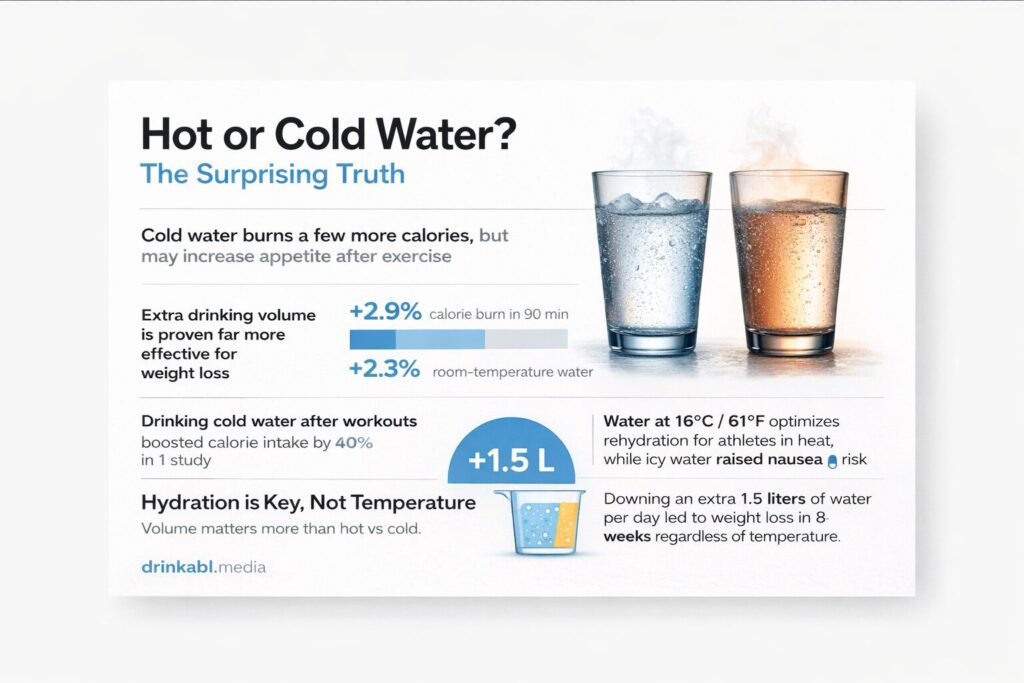
What actually moves the weight-loss needle, Freirich argues, is volume, not temperature. Women who added an extra 1.5 litres of water to their daily intake recorded measurable weight loss over eight weeks, independent of whether that water was hot, cold, or room temperature.
“The extra water may suppress the appetite or may play a part in energy production and expenditure.”
The Athlete’s Sweet Spot: 16°C, Specifically
For those training in heat and humidity, temperature stops being a lifestyle preference and becomes a documented performance variable. Multiple peer-reviewed studies, including one on Taekwondo athletes published in the National Institutes of Health database, have identified a specific sweet spot: water at 16°C (60.8°F), roughly the temperature of cool tap water, produces the greatest voluntary fluid intake and the lowest fluid deficit after exercise in the heat.
At this temperature, the body replenishes fluids efficiently without triggering the sweating reflex that wastes what you have just consumed. Freirich’s guidance, backed by this research, is deceptively simple:
“Cool, but not cold.”
Ice-cold water during intense physical activity can shock the gastrointestinal tract, causing cramping or nausea. For anyone training in humid tropical conditions , where heat stress compounds dehydration risk, the 16°C window is not a minor preference detail. It is a critical, evidence-based hydration strategy, and one the functional beverage industry would do well to build into its product positioning.
Warm Water’s Quiet, Real Case
The case for warm water is less dramatic than TikTok suggests, but it is not without substance. Warmer liquids have been shown to accelerate gastric emptying, essentially stimulating the gut and easing the passage of food. For people dealing with sluggish digestion, bloating, or constipation, a warm drink in the morning may offer genuine, if modest, relief.
The benefits extend beyond the stomach. Research on hot black tea consumption is associated with lower post-stress cortisol levels, the body’s primary stress hormone, and measurably greater feelings of relaxation after mentally demanding tasks. Whether the effect is attributable to the warmth, the ritual, or the tea compounds themselves is still debated, but the data is directionally consistent.
This intersection of warmth, mood, and gut health is precisely where the functional beverage industry is placing its biggest bets, from adaptogenic hot tonics to digestion-targeted herbal infusions positioned as evening wind-down rituals.
Where the Science Draws a Hard, Specific Line
Not all temperature choices are equivalent at the extremes, and here the science is unusually precise. In 2016, the International Agency for Research on Cancer, the cancer arm of the World Health Organisation, formally classified beverages consumed above 65°C (149°F) as “probably carcinogenic to humans,” specifically linking them to oesophageal squamous cell carcinoma. This classification, Group 2A, is based on a growing body of epidemiological evidence, including a major 2025 study of nearly half a million adults in the UK Biobank which found that habitual consumption of very hot beverages was associated with a significantly elevated risk of oesophageal cancer, independent of the type of drink.
To be clear: this is not a risk associated with warm or comfortably hot beverages. Temperatures above 65°C are above the normal human pain threshold, most people cannot comfortably drink at that temperature without scalding their mouth. The risk is primarily relevant in cultures where beverages like maté and tea are traditionally consumed at near-boiling temperatures.
At the other extreme, very cold water poses its own specific concerns. For people with swallowing disorders such as achalasia, cold water is a documented trigger. For those prone to migraines, the rapid thermal change can activate the trigeminal nerve response responsible for brain freeze. And for a significant portion of the population managing irritable bowel syndrome (IBS), ice-cold drinks are a well-established trigger for abdominal cramping and urgency.
The Bottom Line: How Much, Not How Cold
The current scientific consensus, from the NHS to Harvard Medical School, has moved away from the blunt “eight glasses a day” rule, recognising that fluid needs vary substantially by body weight, activity level, climate, and diet. What remains consistent across all guidance is the core message: most people are not drinking enough, regardless of temperature.
Freirich’s conclusion cuts through the noise:
“Most importantly, it is important for everyone to stay adequately hydrated.”
The best water temperature is ultimately whichever one makes a person most likely to reach for the glass. The wellness industry will keep selling the temperature story, it photographs well and generates engagement. But the science is unambiguous: hydration is the headline, and temperature is, at most, a contextual footnote.
More from drinkabl.media: