Nigeria’s beverage sector is fighting back, and one of the country’s most influential economic think-tanks has just drawn its line in the sand.
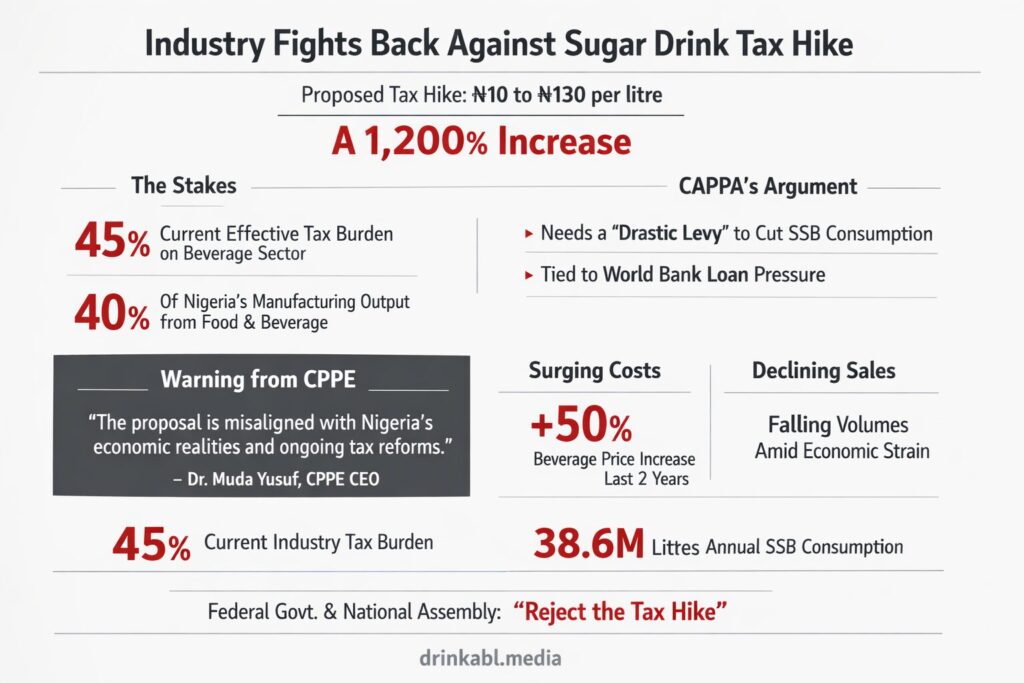
The Centre for the Promotion of Private Enterprise (CPPE) fired a pointed broadside this week against calls to dramatically raise taxes on sugar-sweetened beverages (SSBs), describing the proposal as “ill-conceived and poorly timed,” warning that it contradicts the Federal Government’s tax reform agenda. The pushback targets a sustained campaign by public health advocacy group CAPPA, which has been pressing the National Assembly to raise Nigeria’s SSB excise from ₦10 to at least ₦130 per litre, arguing it would reduce consumption and push manufacturers to reformulate their products. That is a 1,200% jump, one that industry insiders say would shatter an already fragile sector.
The debate has been brewing for months. In November 2025, Nigeria’s Minister of Health backed a Senate Joint Committee hearing on the proposed amendment to the Customs and Excise Tariff Act, urging lawmakers to set the SSB levy at no less than 20% of retail price and earmark at least 40% of revenue for public health programmes. Now, with the Senate still deliberating and the World Bank adding external pressure, linking part of its $750 million Accelerating Resource Mobilisation Reforms loan disbursement to a presidential order raising excise duties on sugary drinks, the stakes have never been higher for Nigeria’s most-watched beverage companies.
CPPE chief executive Dr Muda Yusuf is unequivocal.
“The proposal for additional taxation on sugar-sweetened beverages is misaligned with Nigeria’s current economic realities, inconsistent with ongoing tax reforms, and particularly unjustifiable given the extraordinary energy cost pressures confronting the industry.”
Dr Muda Yusuf, CPPE CEO
The numbers back his alarm. Beverage prices have already surged over 50% in the past two years while sales volumes have declined, driven by a brutal combination of naira devaluation, diesel price spikes, and collapsed consumer purchasing power. The effective tax burden on Nigeria’s non-alcoholic beverage sector already sits at 45%, before any new levy is even considered. Manufacturers already carry a stack of fiscal obligations: 30% Company Income Tax, 7.5% VAT, the existing ₦10/litre excise, a 4% National Development Levy, import duties of up to 15%, and multiple state and local government charges.
Beyond factory economics, the stakes cascade across Nigeria’s entire food economy. Industry data shows the food and beverage sector accounts for approximately 40% of total manufacturing output, with supply chains stretching from farmers and agro-input suppliers through to logistics, retail, and hospitality, collectively supporting millions of livelihoods nationwide.
CAPPA is not backing down. Its executive director argues that Nigeria’s ₦10/litre tax, which now amounts to barely 1% of a bottle’s retail price, is far too weak to shift consumer behaviour or improve public health outcomes. Nigeria currently ranks 4th globally in SSB consumption, with annual sales of approximately 38.6 million litres. The advocacy group points to South Africa, where the volume of taxable beverages purchased fell by 29% in urban households nationally following introduction of a health promotion levy in 2018, alongside significant reductions in the sugar content of beverage purchases.
Yet critics note that South Africa’s results are not a clean template for Nigeria. The government has yet to release any figures on how much has been collected from the existing ₦10/litre tax, introduced in 2021, or how those funds have been used to support public health, making it difficult to assess the policy’s baseline effectiveness before proposing a 13-fold increase.
“At this critical stage of Nigeria’s economic recovery, the policy imperative should be to support businesses, protect jobs, and strengthen growth, not impose additional tax burdens on an already strained sector.” , Dr Muda Yusuf, CPPE CEO
CPPE is calling on both the Federal Government and the National Assembly to reject the proposal and redirect the public health conversation toward education, prevention programmes, and lifestyle interventions. Whether Abuja agrees, especially with the World Bank watching from the sidelines, will define the next chapter for an industry that has only just begun to find its footing.