With nearly one in five bottles sold in South Africa outside the law, the Drinks Federation is bringing the crisis to an international security stage and launching a united industry task force to fight back.
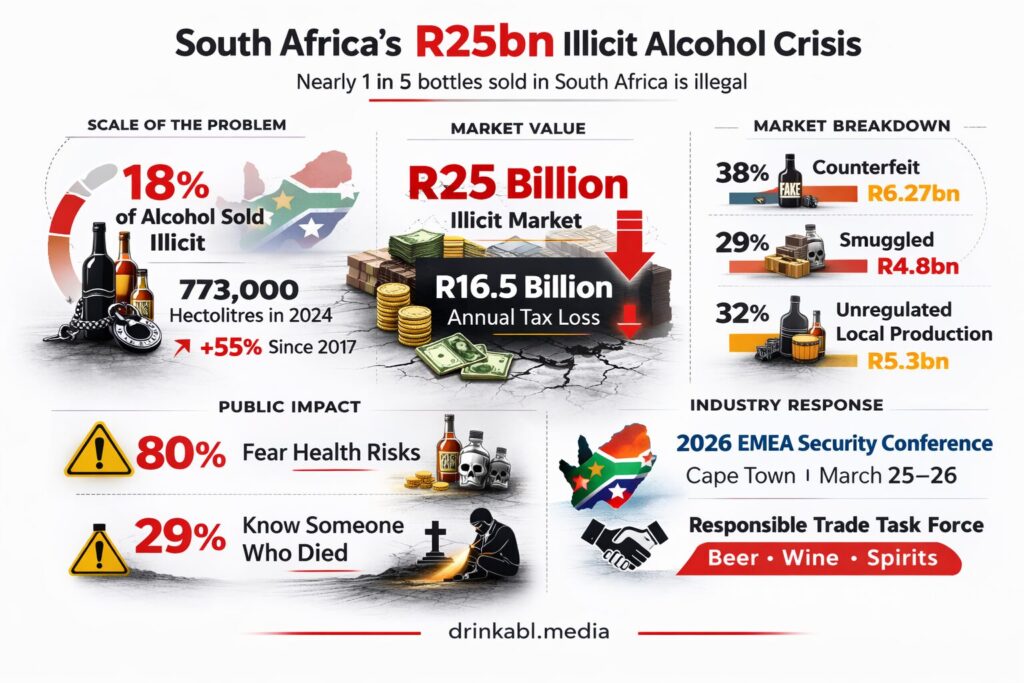
Two weeks before Cape Town hosts the continent’s most significant anti-illicit trade gathering, South Africa’s alcohol industry is walking in with a damning dossier: the volume of illegal alcohol has surged 55% since 2017, rising from 498,000 hectolitres to 773,000 hectolitres in 2024 and now accounting for 18% of all alcohol sold in the country. The market is worth R25 billion a year. And the state is losing R16.5 billion in taxes to it annually.
The Drinks Federation of South Africa has confirmed it will serve as an industry partner at the 2026 EMEA Security Conference, taking place at the Cape Town Marriott Hotel Crystal Towers on 25 and 26 March, marking the first time the series, which has previously convened in Amsterdam, London, Dubai and Istanbul, lands on African soil. The conference, held under the theme “Building Regional Capacity, Strengthening Global Impact: Africa and the Middle East United Against Illicit Trade,” will bring together brand owners, law enforcement agencies, customs authorities, and policymakers to strengthen cross-border enforcement.
The timing is pointed. South Africa is not just hosting; it is arriving with a crisis in hand.
“Illicit alcohol must be understood within a broader security context. When organised illicit trade entrenches itself, the implications for revenue systems, fair competition, and enforcement capacity are significant. Acting early and collectively is critical.” , Angela Russell, CEO, Drinks Federation of South Africa
A 2025 Euromonitor International study commissioned by DF,SA found that 80% of South Africans worry about the health risks of unregulated alcohol, while 29% report knowing someone who has died from drinking it. The breakdown of the illicit market is sobering: 38% is counterfeit product worth R6.27bn, 29% is smuggled goods worth R4.8bn, and 32% is tax leakage from unregulated local production representing R5.3bn in losses. Many of these unregulated products contain dangerous substances, including methanol, which the University of KwaZulu-Natal has confirmed through independent testing.
At the conference, DF,SA Head of Research Dr. Shamal Ramesar will present independent data on the scale and structural drivers of the problem.
“Effective intervention begins with clarity. Independent research shows that illicit alcohol accounts for 18% of total market volume, with an estimated R16.5bn in annual fiscal losses.” , Dr. Shamal Ramesar, Head of Research, DF,SA
Euromonitor consultant Benjamin Rideout, who led the study, warned that South Africa faces large-scale counterfeiting at industrial levels, particularly in white spirits, with counterfeit products appearing in both formal and informal retail channels. The crisis is compounded by aggressive pricing: illicit alcohol is often sold at between 37% and 70% below the cost of legitimate products, making it attractive to cost,pressured consumers.
The crisis is not unique to South Africa. As Drinkabl.media has documented across the continent, illicit trade is undermining the legal alcohol industry from Lagos to Nairobi. Nigeria’s beverage sector is simultaneously battling organised packaging theft networks that feed into the same informal economy. The EMEA conference is arriving at a moment when the entire African drinks industry is drawing a harder line.
DF,SA Deputy Chairperson Sola Oke, also Managing Director of Pernod Ricard Africa, will address the governance and economic stakes at the conference.
“Criminal networks that evade tax and regulatory obligations put compliant businesses and jobs at a structural disadvantage. Protecting legitimate enterprise requires coordinated, collective action across industry and government.” , Sola Oke, DF,SA Deputy Chairperson
The stakes are considerable. The legal alcohol industry contributed R226.3bn, or 3.6%, to South Africa’s GDP in 2022, sustained nearly 499,000 jobs and generated R96.9bn in tax revenue, representing 6.7% of the country’s total tax collection. Illicit trade threatens that foundation directly.
The political moment is also shifting. In his State of the Nation Address on 12 February 2026, President Cyril Ramaphosa announced a National Illicit Economy Disruption Programme, using data analytics and artificial intelligence to target high-risk sectors including tobacco, fuel and alcohol. Describing organised crime as “the most immediate threat to our democracy, our society and our economic development,” Ramaphosa framed the crackdown not just as a revenue issue but as a defence of South Africa’s democratic foundations. The liquor industry has publicly backed the programme, calling it the first time the issue has been recognised at the highest level of government.
On the industry side, DF,SA has launched a Responsible Trade Task Force, bringing beer, wine and spirits producers under one coordination umbrella, currently in its foundational phase, formalising governance structures and aligning intelligence across categories.
As Cape Town prepares to host brand protection experts, enforcement officials and policymakers from across Europe, the Middle East and Africa, South Africa’s alcohol sector arrives not merely as a case study, but as a combatant.
Further Reading on Drinkabl.media: Beverage Industry Tightens the Noose on Bottle-Theft Networks , Champion Breweries Drops Its Compliance Flag, Completes a Pan-African Power Play , Japan’s Asahi Cracks Africa Wide Open With Landmark $4.8bn EABL Deal