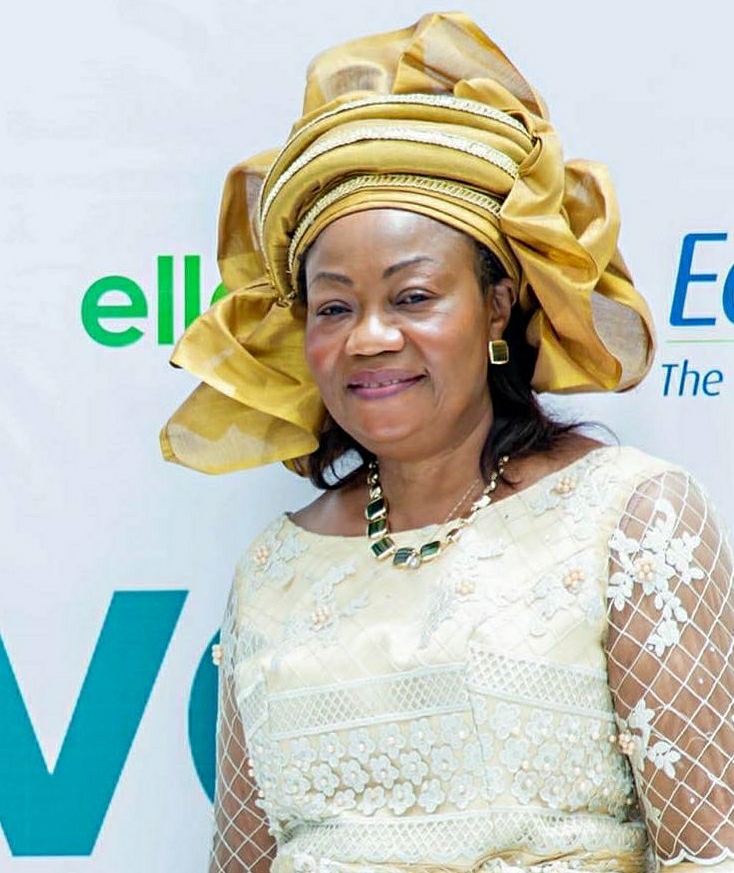
When French conglomerate Castel ended its 59-year Coca-Cola partnership across more than a dozen African markets in July 2022, a split triggered by its own competing cola brand, it left a gaping hole in Cameroon’s soft drink supply chain. The woman who stepped into it had spent three decades in logistics. Nobody in the beverage world saw her coming.
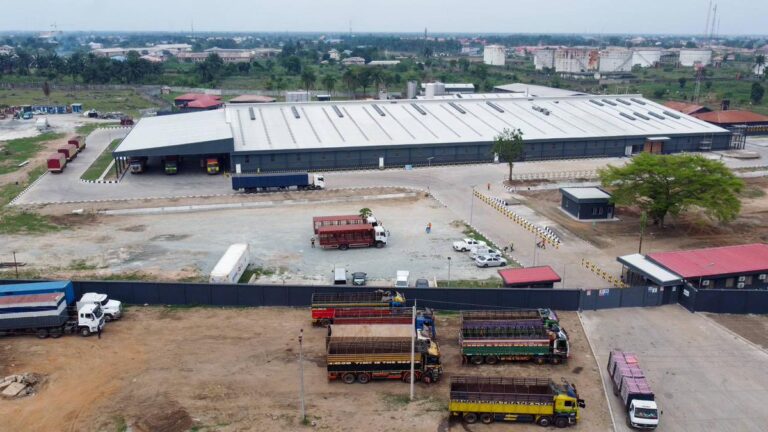
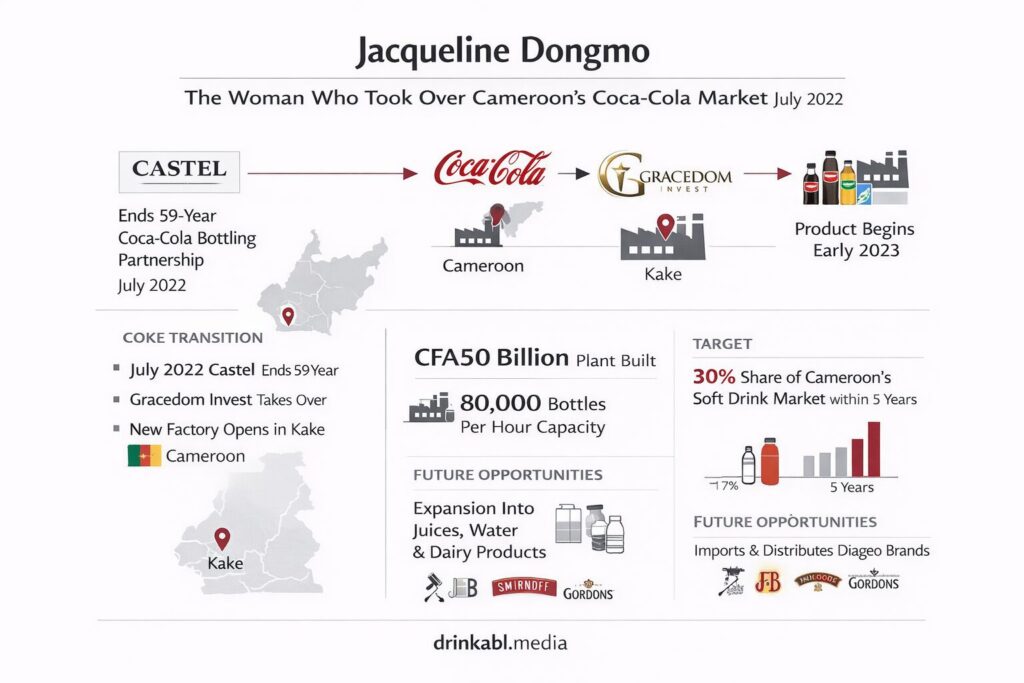
Jacqueline Dongmo, founder of Gracedom Invest, is now Cameroon’s Coca-Cola bottler. Within weeks of SABC’s announcement, made in a May 27, 2022 statement that declared the split “by mutual agreement”, her group was named as the replacement, tasked with producing and distributing Coca-Cola, Coca-Cola Zero, Sprite, Fanta and Schweppes across the entire country from a greenfield factory in Kake, 30 kilometres west of Douala in the Mungo department.
The numbers escalated fast. What began as a CFA25 billion factory designed for 20,000 bottles per hour became an 80,000-bottle-per-hour facility requiring CFA50 billion, approximately $80 million, once the Coca-Cola mandate was formalised. The upward revision was not hesitation. It was acceleration.
“We made CFA20.5 billion available for the project overall, CFA15.5 billion in March and the remaining CFA5 billion in September.” — BGFIBank Cameroon senior official
The financing came through a combination of shareholder equity and syndicated banking credit anchored by two institutions. BGFIBank Cameroon provided CFA20.5 billion in two tranches. Commercial Bank Cameroon, which cited professional confidentiality but confirmed its involvement, brought a relationship stretching back more than 20 years.
“CBC has had a business relationship with the promoter of Gracedom Invest for over 20 years. It is as part of this relationship that we have helped the company set up a production and marketing unit for juices and mineral water under its own brand.” — Commercial Bank Cameroon
That two-decade relationship is worth pausing on. When Dongmo needed to mobilise capital on a compressed timeline for a project with no operational precedent, the bank already knew her credit history, her management style, and her ability to execute.
Dongmo, 62, is not a household name , and that appears entirely deliberate. Her conglomerate spans transport, import logistics, civil engineering, and beverage distribution, and was generating annual revenues of around CFA29 billion before the Coca-Cola deal. Her subsidiary, JD Distribution and Services (JDDS), had distributed Guinness products in Douala for roughly 15 years before Diageo sold Guinness Cameroon to Castel, a transaction that formally closed in May 2023. That track record gave her not just credibility with lenders, but a direct education in what it takes to move premium drinks through West and Central African trade channels.
Coca-Cola’s choice of Dongmo also reflected a deliberate strategic pivot. Having watched Castel launch World Cola in direct competition with its licensed products, Atlanta moved continent-wide toward locally owned partners who posed no such commercial threat, a strategy playing out across 12 African markets simultaneously.
Production of Coca-Cola products, including Fanta and Sprite, resumed from the Kake plant in early 2023. Market targets were set at 7% of Cameroon’s carbonated soft drink market in year one, rising to 30% within five years — ambitious in a market where, as recently as 2022, Coca-Cola ranked fifth among preferred soft drinks nationally.
Before the plant reached full utilisation, Dongmo moved again. From 13 April 2023, JD Distribution and Services became the official importer and distributor of Diageo’s spirits portfolio in Cameroon, including Johnnie Walker, J&B, Gordon’s Gin, Baileys and Smirnoff. It was not a cold call. The Diageo relationship dated back to the early 2000s through Guinness distribution, and this was its logical continuation into premium spirits.
The Kake facility was always conceived as more than a cola plant. Civil works anticipated future production lines for fruit juices, mineral water and dairy products. Dongmo’s in-house civil engineering and transport operations mean expansion costs are partially internalised and supply chains aren’t fully exposed to third-party risk.
She rarely speaks to the press beyond what is strictly necessary. A married mother of six, a Catholic, and president of the Women’s Peace Initiative, she has given one major profile interview. The products, not the founder, are meant to be famous.
What she is building looks less like a company and more like beverage infrastructure for an entire country, assembled quietly over decades, now positioned to grow into juice, water, dairy and premium spirits simultaneously.
“Discipline applied consistently, over a long enough time horizon to become a structural advantage.”
In a region where soft drink markets remain fiercely competitive and distribution costs devour margins, that may be the most bankable beverage strategy on the continent.
Further Reading from Drinkabl.media: