Kenya’s anti-drug authority has put nearly every retail channel for alcohol on notice, and the industry says the cure could be worse than the disease. This comes on the heels of a report we published showing illicit alcohol already accounts for six in ten drinks consumed in the country, casting doubt on whether tighter rules on legal sellers will move the needle at all.
If Kenya’s alcohol regulator gets its way, the bottle of wine in your supermarket trolley, the beer delivered to your door, and the sundowner at the beach could all become relics of a more permissive past.
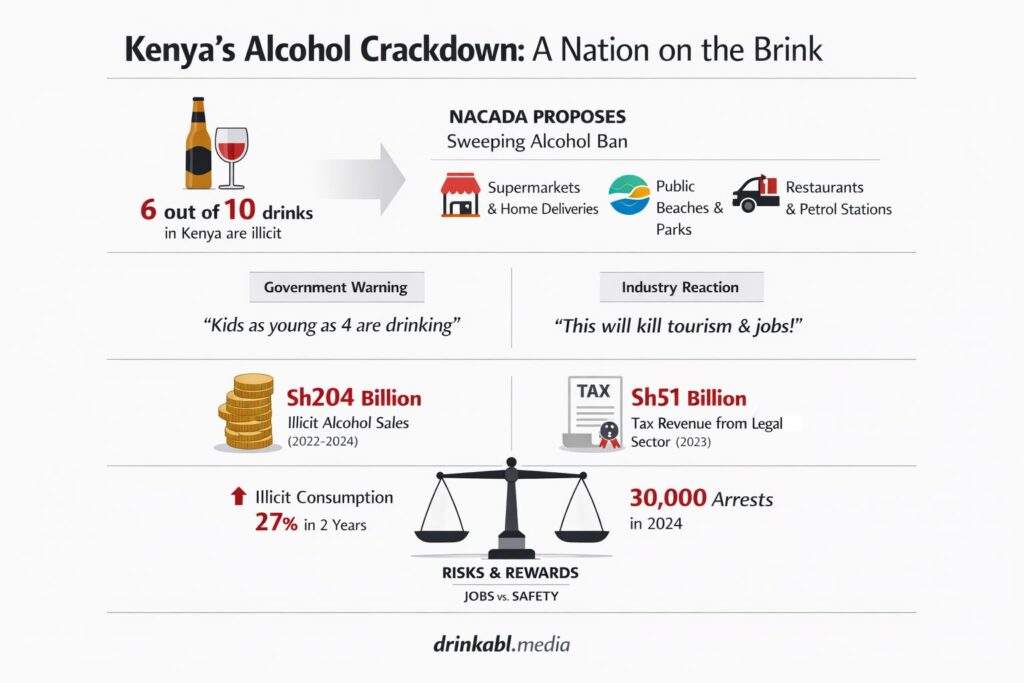
The National Authority for the Campaign Against Alcohol and Drug Abuse (NACADA) has proposed banning the sale of alcohol through vending machines, hawking, online platforms, home deliveries, supermarkets, and in residential premises. The ban would also cover public beaches, public parks, amusement parks, petrol stations, dining areas in members’ clubs and hotels, and near all educational institutions. If the proposals are enacted, alcohol would be legally available only in licensed bars, pubs, and designated liquor stores.
The policy, formally titled the National Policy for the Prevention, Management and Control of Alcohol, Drugs and Substance Abuse (2025), was approved by Cabinet on June 24, 2025, before Interior Cabinet Secretary Kipchumba Murkomen publicly launched it on July 30.
Murkomen was emphatic at the launch: “This is not a mere policy document. It is a renewed commitment by the Government of Kenya to secure the health, safety, and future of every citizen, particularly our vibrant youth.”
NACADA CEO Dr. Anthony Omerikwa, appearing before the Senate Devolution and Intergovernmental Relations Committee chaired by Sheikh Abbas, laid out the authority’s core concern bluntly: “Data shows that children are starting to consume alcohol as early as four to seven years old.”
“The sale of alcoholic products in residential areas and near schools exposes them to early initiation, which we must prevent.”
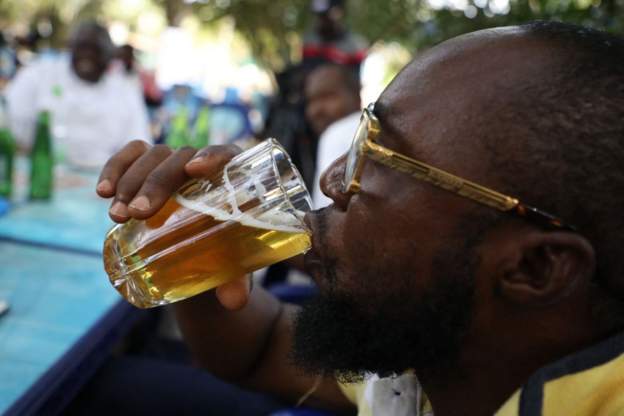
A NACADA survey of 15,678 undergraduate students, released in February 2025, found that 87.3 per cent consumed alcohol, with the highest use concentrated among those aged 18 to 24.
The proposed measures also include restricting alcohol sales to a 6 a.m. to 6 p.m. window and banning online and social media promotions between 5:00 a.m. and 10:00 p.m. The legal drinking age, currently 18, would be raised to 21. NACADA’s Deputy Director of Legal and Regulatory Services, Daniel Konyango, grounded the proposal in neuroscience: “It is scientifically stated and proven that the human brain fully develops at age 25. So, at age 21, we are dealing with young populations that are still quite vulnerable and still developing.”
NACADA was quick to clarify, on the same day of the launch, that none of these measures are yet enforceable. CEO Omerikwa stated: “Any proposal that requires legal backing will undergo a thorough law review process, which will be transparent and inclusive,” stressing that public participation would be central to shaping the final framework. “These are recommendations, not rulings. We want a healthy, safe Kenya, but that requires inclusive, informed debate, not fear or misinformation.”
The industry is not waiting for Parliament to weigh in before raising the alarm. The Alcoholic Beverages Association of Kenya ABAK said NACADA had developed the draft without consulting manufacturers, calling it exclusionary and unrealistic, and warning that the measures would lead to widespread job losses and push consumers toward the illicit alcohol market.
Prominent lawyer Donald Kipkorir posted a withering assessment on X, directly targeting the proposed ban on alcohol in hospitality settings: “The ban on the sale of alcohol in supermarkets, restaurants, public beaches, recreational facilities and petrol stations will kill the hospitality sector in Kenya. Tourism is driven by good food, alcohol, wine, beer and spirits, and leisure.”
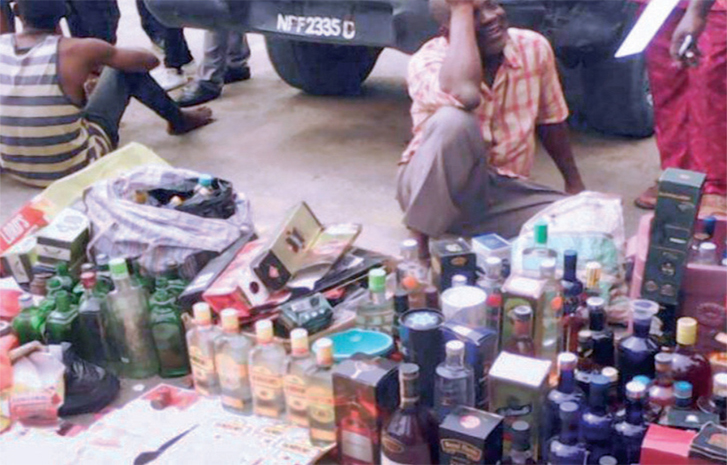
The illicit alcohol problem casts a long shadow over the entire debate. A Euromonitor International report commissioned by ABAK found that 60 percent of all alcohol consumed in Kenya between 2022 and 2024 was illicit, generating an estimated Sh204 billion in sales that never touched a tax register, a health inspector, or a licensed retailer. Illicit consumption rose 27 percent over the same period, outpacing growth in the legal market on every metric. Industry analysts have long warned that restricting legitimate channels does not suppress demand, it redirects it into darker, more dangerous markets.
Kenya’s formal alcohol sector generated Sh51 billion in excise duty in 2023 and Sh366 billion in total revenue, a fiscal base that analysts warn could erode sharply if NACADA’s proposals pass into binding law. Despite seizing 2.8 million litres of illicit alcohol and making 30,000 arrests in 2024, drug-related court cases rose 44 per cent between 2016 and 2018, and substance abuse remains stubbornly high, a track record that critics say undermines confidence in the authority’s approach. As EABL’s Corporate Relations Director Eric Kiniti warned: “There is no way to collect tax from illicit traders. This policy will drive more people towards illicit alcohol.”
The public reaction has also carried a pointed edge. Civil society activist Hussein Khalid publicly called on NACADA to expand the proposed ban to Parliament and police station canteens: “We urge NACADA to expand the list and include Parliament and police station canteens. This will ensure Kenyans are better served with sober minds.”
The proposals are now with both Houses of Parliament and county assemblies, where the real battle begins. The debate is only getting started, and the stakes extend far beyond last orders.
Read More on Drinkabl.media
Crackdown fears grow as illicit alcohol hits 60% in Kenya, Global Brewers Pivot South and East as Beer’s Western Dream Fades, NAFDAC Begins Enforcement of Ban on Alcoholic Beverages in Sachets, Small Bottles, When Will Enough Finally Be Enough on Counterfeit Drinks in Nigeria?, Canned Convenience: How RTDs and Hard Seltzers Are Reshaping Alcohol Consumption in Africa