A last-minute legal challenge has failed. A half-century of British dominance over East Africa’s beer industry is now drawing to a close, and Japan is stepping in with $2.3 billion and a continental ambition.
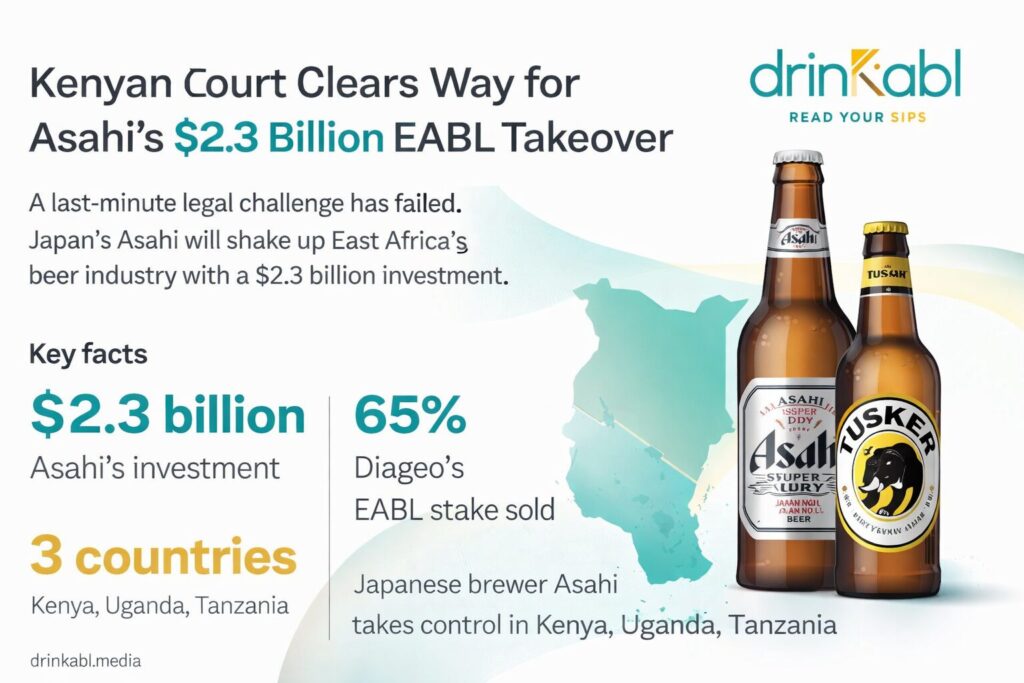
Kenya’s High Court on April 9 dismissed a bid by local beer distributor Bia Tosha to block the landmark sale of Diageo’s 65% stake in East African Breweries Limited (EABL) to Japan’s Asahi Group Holdings. The ruling swept away all outstanding interim orders freezing the deal, restoring momentum to one of the largest consumer transactions East Africa has seen in years.
“The petitioner’s notice of motion dated January 5, 2026 is hereby dismissed,” ruled High Court Judge Bahati Mwamuye, adding that any remaining orders capable of impeding the transaction were lifted in full.
The decision ends months of legal uncertainty that had shadowed the deal since December, when Diageo first announced its agreement to exit the region.
A Strategic Retreat, a Strategic Advance
For Diageo, the sale is the culmination of a deliberate restructuring. Facing net debt of $21.8 billion, the London-listed spirits giant has been systematically divesting African assets, having already offloaded stakes in Guinness Nigeria, Guinness Ghana Breweries, and Seychelles Breweries. Africa has ranked among its lowest-performing regions by sales, and the EABL divestment, priced at a 17x adjusted EBITDA multiple, is expected to reduce Diageo’s net debt to adjusted EBITDA ratio by approximately 0.25 times.
For Asahi, the calculus runs in the opposite direction. The Japanese beverage group, expanding into Africa for the first time, expects high profitability across Kenya, Uganda, and Tanzania to continue on the back of population growth and economic development. It marks the first time a Japanese brewer has made an investment of this scale on the continent.
Beer and spirits sales across the three markets are expanding at 5 to 6 percent a year, driven by youthful demographics and upwardly mobile urban incomes, making East Africa one of the most compelling untapped frontiers in global beverages.
The Challenge That Failed
Bia Tosha petitioned the High Court in January to block the deal over pending litigation dating back to 2016. The distributor’s legal team argued that if Diageo proceeded with the sale of its only Kenyan asset, the firm would be unable to enforce any future judgment against the company.
The court was unconvinced. In dismissing the application, the judge found that the issues raised were contractual in nature and could be addressed through separate legal proceedings without affecting the ownership transaction, noting that a commercial dispute between private parties does not automatically justify the suspension of a major corporate deal.
What Changes, and What Stays
Crucially for consumers and trade partners, continuity is the watchword. Diageo has committed to long-term licensing agreements with EABL to secure the continued production and distribution of Guinness, local spirits, and ready-to-drink brands, while locally owned brands such as Tusker and Kenya Cane will remain with EABL.
Asahi has pledged to keep EABL listed on the Nairobi, Uganda, and Tanzania stock exchanges and retain existing management. The Japanese group has committed to increased capital expenditure and new product development, with EABL’s local brands including Tusker, Serengeti, and Bell expected to provide immediate scale, while Asahi sees an opportunity to introduce its global portfolio, including Asahi Super Dry, at a later stage.
Asahi President and CEO Atsushi Katsuki was direct about his ambitions. “This business is a high-quality, leading company in Kenya, Uganda and Tanzania, with an unrivalled brand portfolio and marketing capabilities, state-of-the-art production facilities and strong market shares. Together with its management team and employees, we will pursue sustainable growth and long-term enhancement of corporate value, while contributing positively to the development of local economies.”
The Outlook
Analysts say Asahi’s entry signals growing global interest in Africa’s consumer sector, particularly in beverages, where rising urban populations, a youthful demographic, and changing consumption habits are driving demand. Market watchers expect the Japanese group to introduce new brands, improve supply chains, and invest in local production capacity once it takes control.
The transaction remains subject to regulatory approvals across Kenya, Uganda, and Tanzania, with completion expected in the second half of 2026. When it closes, East Africa’s largest brewer will have a new Japanese parent, and the continent’s most consequential beverage handover in a generation will be complete.
Read More
For further context on the forces reshaping global beverage ownership, the rise of Asian brewers in emerging markets, and Diageo’s broader Africa strategy, visit Drinkabl.media.