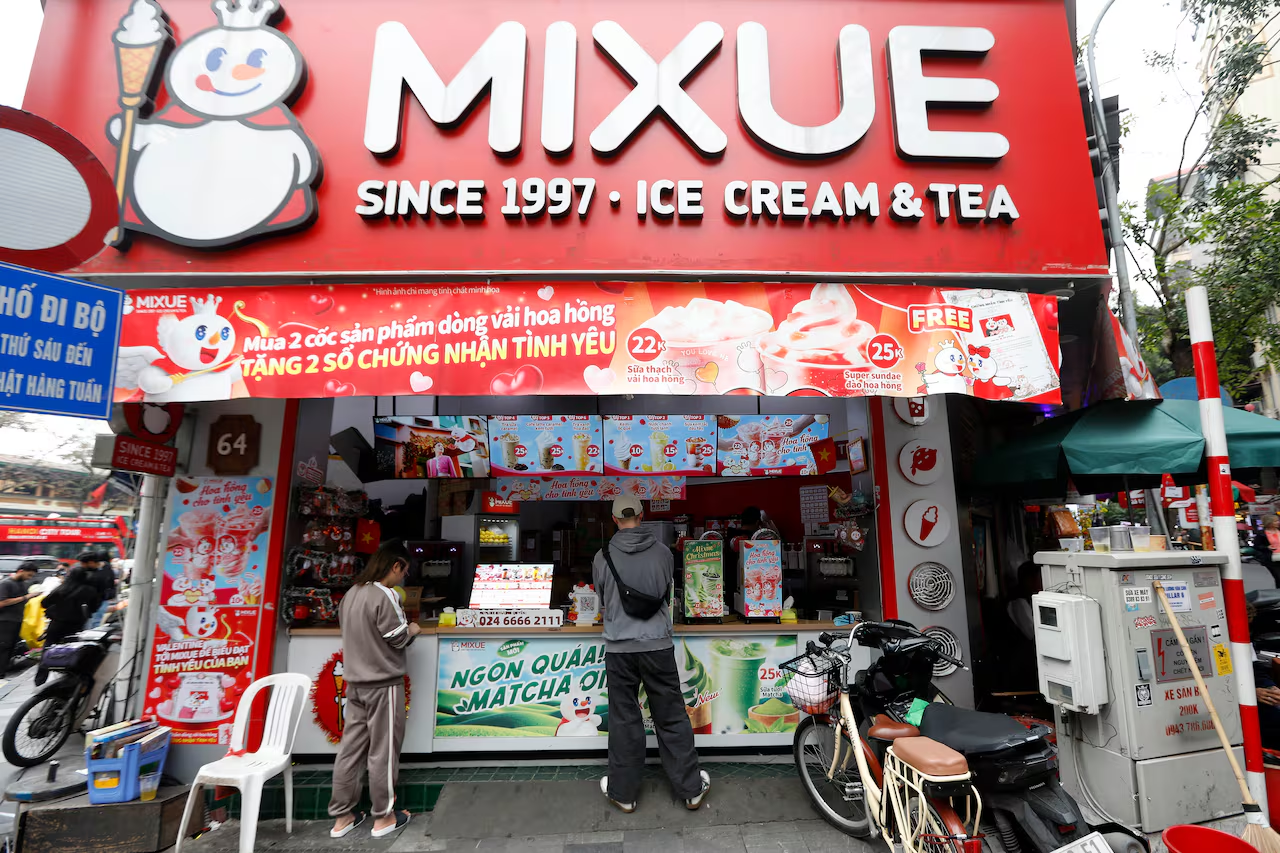
At every street in Ho Chi Minh City or Hanoi, you will find the unmistakable red-and-white signage of Mixue, the Chinese beverage giant whose cheerful Snow King mascot became a fixture of Vietnamese youth culture almost overnight. But look a little closer and some of those storefronts are dark, replaced by rival brands or simply shuttered, a signal that the world’s largest food and beverage chain by store count is discovering that scale alone cannot guarantee success.
China’s Mixue posted strong headline numbers in its latest earnings report, with revenue of CNY33.56 billion ($4.81 billion) in 2025, up 35 percent from a year earlier, and net profit rising 33 percent to CNY5.98 billion. The results reflect the enduring strength of a low-cost, vertically integrated model that controls supply chains from raw ingredients to logistics. The chain was founded in 1997 by Zhang Hongchao, a college freshman who spent his summer break in Zhengzhou selling homemade shaved ice from a makeshift stall. It has since grown into the largest food and beverage chain in the world by store count, surpassing Starbucks in store count at the end of 2024 and McDonald’s in early 2025.
Globally, Mixue now operates more than 55,000 stores in China and around 4,500 outlets overseas. But that international footprint has begun to contract. As of December 2024, the company operated approximately 4,895 international stores, with store counts moderating to roughly 4,700 in 2025, reflecting what the company describes as a move into “Phase 3.0” defined by disciplined expansion, stronger operational foundations, and long-term profitability.
Vietnam sits at the centre of that reckoning. Mixue first entered Vietnam in 2018, drawn by the country’s low labor costs, a large young population and a beverage market still in its early stages of development. Vietnam has grown to around 1,300 stores, helped in part by a zero-franchise-fee policy, making it the company’s third-largest market globally. But that rapid rollout has come at a cost. Mixue has acknowledged in its 2025 interim report that in Vietnam and Indonesia it is “focused on optimizing existing stores’ operations to support their long-term, sustainable, and stable operations,” and that the number of stores in both countries has declined.
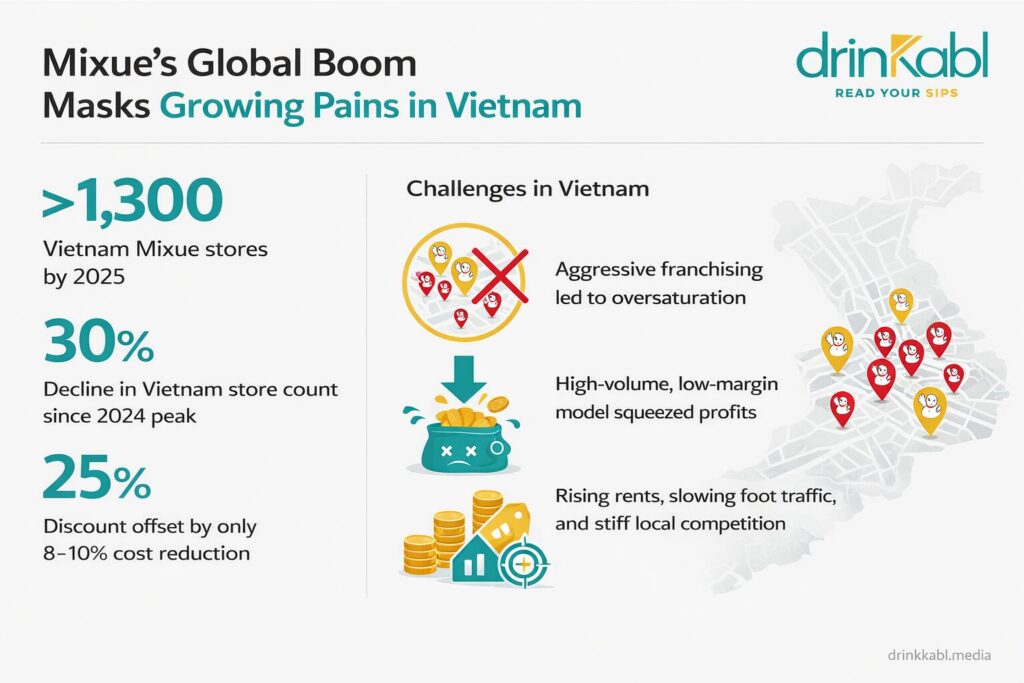
The problems are structural. In its early overseas push, Mixue adopted aggressive franchising strategies, including reduced entry thresholds and relaxed site-approval standards. In markets such as Indonesia, this resulted in dense clustering, with as many as three or four stores within a 500-meter radius. A similar dynamic played out in Vietnam, where franchise saturation pitted store owners against one another and dragged down average revenue per outlet. A 25 percent discount on products, offset by only an 8 to 10 percent reduction in raw material prices, created a significant financial gap that put many Vietnamese franchisees at serious risk.
Rising costs are compounding the squeeze. Rents have remained flat without falling, consumers have tightened their spending, and foot traffic has softened as prime locations no longer guarantee revenue, with younger consumers increasingly prioritizing experience over convenience. Yet Mixue’s ultra-low price positioning leaves little room to pass those costs on to customers.
At the same time, the competitive landscape has shifted beneath the brand’s feet. Vietnam’s food and beverage sector is intensely competitive, with local brands leveraging greater flexibility, stronger cultural resonance and Instagram-worthy environments to attract consumers. Mixue’s reliance on a high-volume, low-margin model exposes it to particular risk during inflationary periods or supply chain disruptions, when ingredient and labor costs can put pressure on franchisees and limit the company’s ability to hold its pricing strategy.
Mixue is attempting to adapt. The company has secured 93 new Vietnam store contracts at its 2025 franchisee conferences in Ho Chi Minh City and Hanoi, entering what it describes as a mature expansion phase focused on larger store formats, stronger locations, and improved consumer experience. The pivot from speed-driven growth to quality-driven operations marks a philosophical shift for a brand that built its reputation on saturating markets as quickly as possible.
Further Reading
- Mixue’s bubble tea boom cools down in Vietnam — VietnamNet’s ground-level look at the store closures, franchisee losses, and the social media resale listings reflecting the cost of overexpansion.
- Mixue’s Low-Cost Business Model & Strategy — Cheung Kong Graduate School of Business breaks down the supply chain architecture, pricing logic, and overseas growth strategy behind Mixue’s rise.
- Mixue Ice Cream & Tea’s Global Expansion: Supply Chain Strategy — ARC Advisory Group on the structural challenges of replicating Mixue’s domestic model in Southeast Asia.
- Café Amazon retreats, Mixue scales down in Vietnam — The Investor on the broader wave of F&B exits from Vietnam’s increasingly crowded market.
- Mixue trims abroad, doubles down at home — KrAsia on Mixue’s mid-2025 financials, the Lucky Cup coffee play, and what its Hainan production hub means for Southeast Asia supply chains.
- Global Bubble Tea Market Trends & Forecasts — Mordor Intelligence on where the broader bubble tea industry is heading through 2030, including Asia Pacific franchise dynamics.