For over a century, Nigeria’s original spirit survived colonial bans, police raids, and deep social stigma, yet it still cannot get a seat at its own table. This is the story of ògógóró, and the shame that was never ours to carry.
A man walks into a riverside bar in Warri.., raising a plastic cup to his lips, already tasting it before it arrives. He doesn’t ask for gin. He doesn’t ask for beer. He says three words, “Give me water,” and everyone in earshot knows exactly what he means. It isn’t water. It has never been water. But for generations of Nigerians, “Sapele water” has been the coded language of defiance, identity, and survival, rolled into a single, clear, combustible pour.
That drink is ògógóró, Nigeria’s national spirit in all but official recognition, palm-born and colonial-scarred, and it may be the most culturally loaded liquid in West Africa. Today, as premium versions quietly conquer shelves in London, Nairobi, and Lagos alike, and as Nigeria’s alcohol regulatory landscape remains a live and contested battleground, the question this drink forces is one that goes far beyond what’s in the cup: why does Nigeria celebrate what the world gave it, while dismissing what it gave the world?
The Name That Survived a Ban
The name “Sapele water” was not born in wit, it was born in necessity. Sapele, a historic port town in Delta State, was a thriving centre for ògógóró production and trade. The Niger Delta’s web of waterways made it ideal for illicit distillation, difficult to access and hard to police for those unfamiliar with its creeks and marshland. When colonial authorities declared local distillation illegal, sellers needed cover. Calling the drink “water” was plain-sight protection in a climate of raids, arrests, and fines. The code held. The name outlasted the ban.
Today, “Sapele water” carries both humour and warning depending entirely on who says it and where. But to understand the stigma that still trails it, you have to trace it back to where it was manufactured, not in any distillery, but in the administrative offices of British colonial rule.
The Colonial Crime That Wasn’t
The word ògógóró itself is Urhobo in origin, a linguistic clue to where this spirit took deepest root, in the Niger Delta communities of the Ijaw, Urhobo, Efik, and Ibibio peoples. According to the Oxford Companion to Spirits and Cocktails, ògógóró’s commercial origins lie in the early 1930s, when the deepening Great Depression, compounded by colonial restrictions on cheap imported spirits, caused Nigerian gin imports to collapse, falling from approximately 1.3 million litres in 1930 to just 223,000 litres by 1934. Into that vacuum, Nigerian ingenuity stepped decisively. Locals, many of whom had learned distillation techniques from returning travellers and through contact with European firms, began producing a spirit from fermented raffia palm sap. They were remarkably good at it.
But the groundwork for suppression had already been laid. As early as 1910, British authorities launched a smear campaign characterising ògógóró as dangerous, harmful, and an illicit knockoff of proper gin. The colonial state then deployed propaganda, courts, and police raids against distillers. The 1919 Saint-Germain-en-Laye Treaty, which included provisions banning trade spirits and local distillation across sub-Saharan colonial holdings, gave those crackdowns legal armature. But the real motive was never public health. As documented by historian Simon Heap, for the colonialists, ògógóró’s success as import substitution was the problem: an untaxed, unlicensed product was displacing a revenue-earning, highly regulated, legal trade. Ògógóró was made illegal because it was too good, too cheap, and too popular.
The ban persisted well beyond colonial rule, surviving Nigerian independence in 1960, an embarrassing inheritance. That finally changed in 1968, when the educator and social critic Tai Solarin, a lifelong teetotaler who never drank a drop of alcohol in his life, contrived to get himself arrested for possessing ògógóró in order to publicly dramatize the injustice of criminalising a local spirit while allowing imported foreign ones to trade freely. He was freed on September 14, 1968. A man who didn’t drink ògógóró risked prison to defend it. That is how clearly the injustice cut.
Aman who never drank a drop of alcohol in his life risked arrest and imprisonment to defend ògógóró. That is how clearly the injustice cut.— Drinkabl Media Analysis
What the Drink Actually Is
Strip away the history and politics, and you are left with something extraordinary in its simplicity. Ògógóró is a form of local gin distilled from fermented palm wine, specifically the sap of the raffia palm (Raphia vinifera), though oil palms are also used. The production is deeply rooted in the land and its people. Tappers climb the palms and cut into the flower stalk to allow sap to flow into containers. Sweet and non-alcoholic at first, the sap begins fermenting naturally, due to wild yeasts in the air, within hours of collection. Stored in sealed drums, typically for up to a week, the fermented palm wine is then distilled over direct fire, its vapours channelled through pipes into cooling containers, condensing into the final clear spirit.
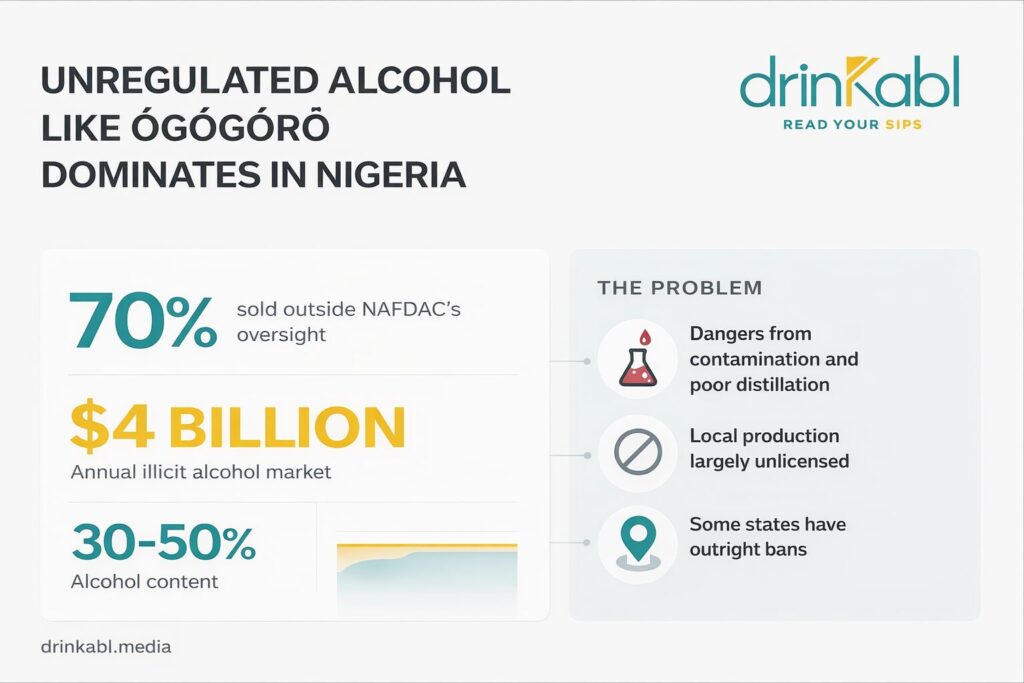
The result is a drink that typically runs between 30% and 50% alcohol by volume, though artisanal batches can go higher. What it is not, despite decades of received wisdom, is inherently dangerous. The health risks associated with ògógóró are real but specific: they arise from poor distillation practice, contamination, and the failure to discard the methanol-heavy “heads” fraction. A well-distilled ògógóró is no more dangerous than any other unaged spirit. The difference between heritage and hazard is craft, not the drink itself.
And the cultural weight ògógóró carries is immense. Ijaw priests pour it onto the ground as offerings to their gods. In many traditions across southern Nigeria, fathers of brides use it as the libation through which they pronounce their blessing on a union. It seals oaths and agreement rituals; in some traditions, to drink ògógóró on a sworn statement is to invoke ancestral consequence if you break your word. This is not moonshine. This is liturgy, the drink that blesses your children’s marriages, consecrates your ancestors, and holds your community to account. No imported Scotch has ever done that for a Nigerian family.
The Reputation Problem: Made in Britain, Kept in Nigeria
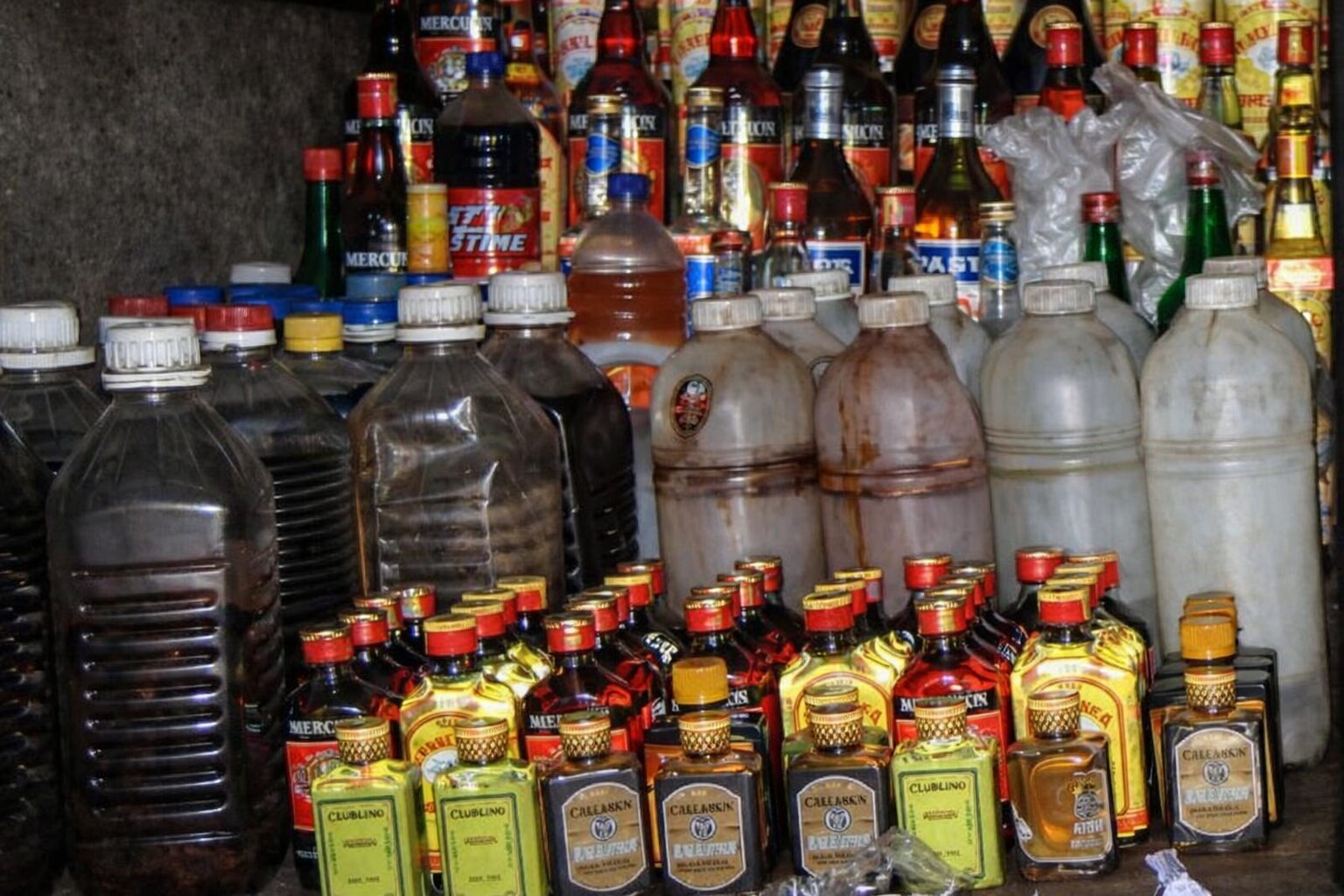
The colonial smear campaign worked better than any marketing consultant could have hoped. Today, as Drinkabl has reported extensively on Nigeria’s persistent counterfeit and unsafe drinks crisis, ògógóró is routinely conflated with adulterated and dangerous beverages, often unfairly. The drink itself is not the problem. Unregulated production without quality controls is the problem. It is a distinction Nigeria has never fully allowed itself to make.
The legal status of ògógóró today sits in a grey zone that benefits no one. At the federal level, there is no outright ban, but the vast majority of production operates outside NAFDAC licensing, meaning no standardised quality checks, no taxation, no traceability. Meanwhile, some Nigerian states have enacted their own prohibitions on local gin specifically, while imported spirits remain entirely unrestricted. Benue State’s 2009 prohibition law, for instance, criminalises the possession, sale, and consumption of ògógóró with penalties of up to three years’ imprisonment, while Gordon’s Gin is available at any supermarket. The colonial double standard lives on, now in Nigerian legislation.
“People don’t even want to say ògógóró, they prefer to say gin. There’s the perception that it is for people who just want to get high.”— Lola Pedro, Co-founder, Pedro’s Premium Ògógóró, via CNN
The Reclamation: From River Delta to the French Alps
The most powerful counter-argument to a century of stigma arrived not in a policy paper or a government directive, but in a bottle shaped deliberately like an oil drum, and in a video the internet didn’t see coming.
Earlier in 2025, footage surfaced on Instagram showing a group of Nigerians on the snowy slopes of the French Alps, passing a bottle of Pedro’s Premium Ògógóró between them, laughing and toasting in a mix of Lagosian, London, and American accents. The moment was unscripted, raw, and, as reported by African Business, oddly poignant: a drink that was once the equivalent of Nigerian moonshine, now drunk in one of Europe’s most exclusive playgrounds. Lola Pedro, the brand’s British-Nigerian co-founder, said she didn’t know who the skiers were. “Nigerians are everywhere,” she said. “And Pedro’s always finds its way into a suitcase.”
Pedro’s was founded by Lola Pedro, a researcher and multimedia technologist by training, and Chibu Akukwe, a financial analyst, who began the project in 2017 and launched their pilot batch of 1,800 bottles in 2018 to test how the market would receive premium ògógóró. The reaction surprised them. Pedro recalls people who laughed, people who were curious, and people who simply saw the packaging, a bold, colourful glass bottle, and said: “Let me try.” The first batch became a collectable.
Today, Pedro’s is stocked across Lagos, London, Nairobi, Accra, and as far as Australia. In the UK, a bottle sells for £60 ($80), a price point that places it squarely alongside Hendrick’s gin and aged mezcal. Their production is deliberately small-batch, limited by palm harvest cycles tied to Nigeria’s harmattan and rainy seasons. “The system is designed for us to ship raw materials and have the value added somewhere else,” Akukwe has said. “We are doing the opposite.” They are now building a larger distillery and developing an aged line.
“We want people to know ògógóró the way they know tequila or mezcal. And we want them to drink it with pride.”— Lola Pedro, Co-founder, Pedro’s Premium Ògógóró, via African Business (2025)
The Question Nigeria Must Answer
Tequila was once considered peasant drink across Latin America, beneath export and unfit for polite company. Mezcal was effectively criminalised in Mexico for decades, its producers pursued by the state. Today both are celebrated as national treasures, protected by geographic indication laws, and generating billions in global exports. Scotland did not build a global whisky empire by accident, it did so through sustained national pride backed by regulatory protection, investment, and a deliberate decision to take its own heritage seriously. Palm wine, the raw material from which ògógóró is distilled, may be one of the oldest alcoholic drinks known to humans, with a history stretching back possibly as far as 16,000 BC. The spirit derived from it is not a curiosity. It is a heritage.
And yet, right now, a handful of entrepreneurs are doing the work that Nigerian regulators, cultural institutions, and the formal beverage industry should have started decades ago. Pedro’s is not alone: across Nigeria, there is a quiet movement of craft distillers attempting to formalise, refine, and export what the state once criminalised. They are doing so without a regulatory roadmap, without geographic indication protection, and without the kind of national cultural endorsement that tequila, whisky, and cognac receive from their respective governments as a matter of policy and pride.
Ògógóró didn’t survive over a century of colonial prohibition, post-independence ambivalence, state-level bans, and sustained social stigma by accident. It survived because Nigerians kept choosing it, at ceremonies and street corners, in riverine communities and rooftop bars, in plastic cups and, now, in hand-blown glass on the ski slopes of the French Alps. The question is not whether ògógóró deserves recognition. The question is whether Nigeria is finally ready to give it what it has always been owed.