….Launches Crackdown
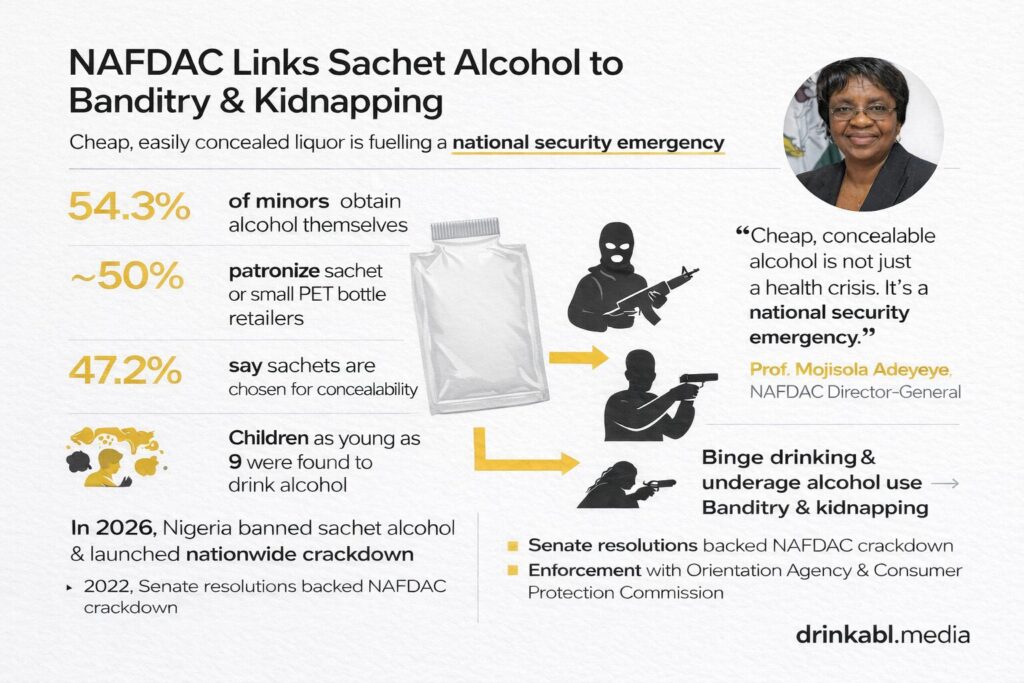
As regulators take their most aggressive enforcement stance yet, the NAFDAC director-general says cheap, easily concealed alcohol is not just a health crisis, it’s a national security emergency.
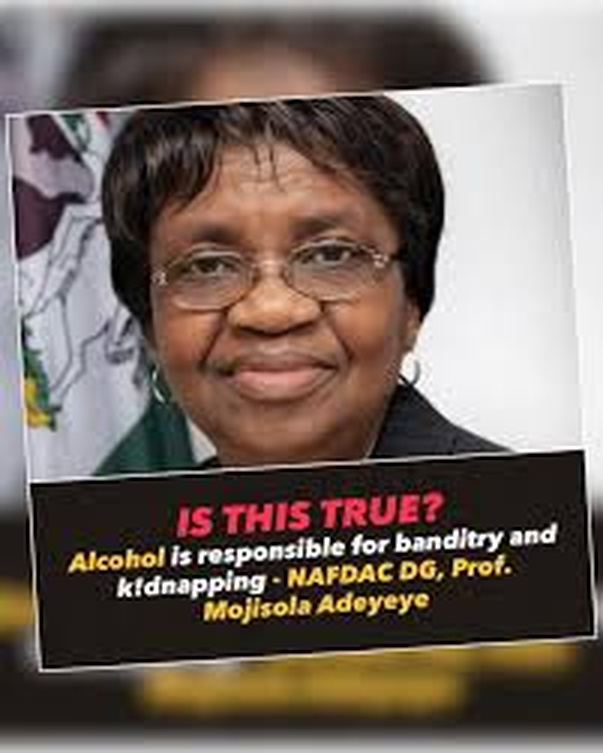
Nigeria’s food and drug regulator escalated its public messaging around the country’s sachet alcohol ban this week, with Director-General Prof. Mojisola Adeyeye making perhaps the most striking claim yet from a public health official in Africa: that cheap, small-pack alcohol is directly fueling the banditry and kidnapping plaguing the country.
“In our country, it is responsible for banditry, it is responsible for kidnapping. You cannot be in your right mind and point a gun at somebody; it starts from alcohol and then goes on to hard drugs,” Adeyeye declared at a joint press conference in Abuja on Tuesday, flanked by officials from the National Orientation Agency (NOA) and the Federal Competition and Consumer Protection Commission (FCCPC).
The statement came as the Federal Government formally flagged off a nationwide enforcement and public enlightenment campaign on the ban of alcoholic beverages packaged in sachets and small PET and glass bottles below 200 millilitres — a ban that took effect on January 1, 2026. The joint press conference was organised by NOA, in collaboration with NAFDAC and the FCCPC.
The data behind the alarm
The enforcement push is backed by findings from a 2021 nationwide survey conducted in collaboration with the Distillers and Blenders Association of Nigeria, which sampled 1,788 respondents across six states representing the six geopolitical zones. The results, Adeyeye said, were damning.
It was found that 54.3 per cent of minors and underage individuals obtain alcohol by themselves from various sources, and about 49.9 per cent of them patronise retailers of drinks sold in sachet packs and PET bottles. Approximately 47.2 per cent of minors obtain drinks in sachets specifically because they are easy to conceal.
More startling: children as young as nine years old were found to consume alcohol in the survey, with binge drinking notably reported in some states.
Adeyeye warned that the neurological consequences of early drinking are irreversible.
“Alcohol can damage the hippocampus, the memory centre in the brain, and the prefrontal cortex, leading to permanent issues with learning, memory, and impulse control.”
She added that youth who begin drinking before age 15 are 41 per cent more likely to become dependent on alcohol and may graduate to using cocaine and other narcotics.
Why sachets are uniquely dangerous
The sachet format sits at the heart of regulators’ concerns, not simply because of what’s in it, but how potent and concealable it is. Adeyeye noted that sachet alcohol contained as much as 50 per cent alcohol by volume at the time industry groups first raised concerns in 2018, compared to beer’s typical six to eight per cent, making it extraordinarily concentrated and easy to hide.
As Drinkabl.media has previously reported, at the very bottom of Nigeria’s affordability chain sits the sachet, a 25ml hit of Chelsea gin or Action Bitters for almost nothing, making it the default product for the most price-sensitive, and often youngest, consumers. In 2024, volume growth in Nigeria’s alcohol market was particularly evident in categories dominated by economy brands, including gin, beer, and bitters, as consumers traded down to more affordable options amid high inflation and weakened purchasing power. That economic slide has made the sachet question far more complicated than a simple public health intervention.
A contested, chaotic crackdown
The ban’s enforcement history has been anything but clean. The policy is technically active, politically contested, and practically incomplete: announced for December 2025, suspended mid-month by the Office of the Secretary to the Government of the Federation citing economic and security risks, then resumed on January 21, 2026 after NAFDAC cited a fresh Senate resolution, only for the Federal Government to again order a halt to enforcement in February.
Industry groups have not gone quietly. The Manufacturers Association of Nigeria warned that the planned ban could result in the loss of over ₦1.9 trillion in investments and jeopardise more than five million direct and indirect jobs across the country. On the morning after Tuesday’s press conference, the Distillers and Blenders Association of Nigeria staged their eighth protest of 2026 at NAFDAC’s office in Oshodi, Lagos.
Meanwhile, the legal battleground has clarified, and not in the direction earlier reporting suggested. The Socio-Economic Rights and Accountability Project (SERAP) went to court not to oppose the ban, but to demand it be enforced. In its originating summons dated December 15, 2025, SERAP argued that continued delay in enforcing the ban violates existing health and regulatory laws, as well as prior agreements supporting a nationwide prohibition of sachet alcohol. In February 2026, the Federal Ministry of Health filed a counter-affidavit backing NAFDAC’s sole authority to act.
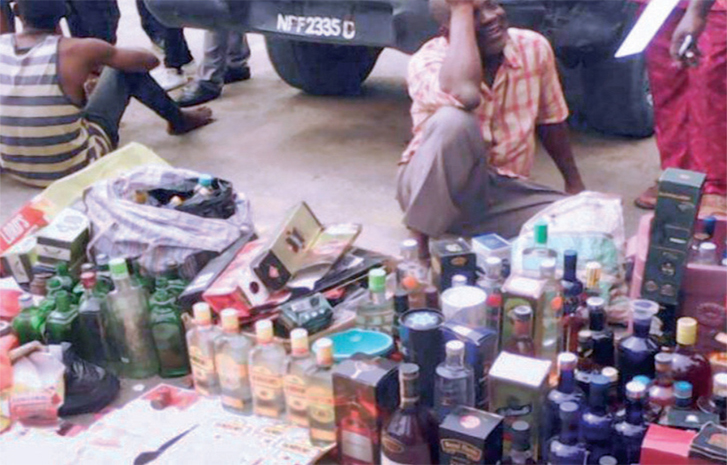
A separate Drinkabl.media investigation on the illegal “Kill Me Quick” trade illustrates the related risk that haunts regulators: drive out the regulated product, and illicit operators rush in to fill the vacuum.
What comes next
The enforcement follows Senate resolutions of November 6, 2025, urging NAFDAC not to grant further extensions of the moratorium on sachet alcohol and to ensure strict compliance with the ban. NOA says it will deploy its presence across all 36 states and the FCT to drive compliance at the grassroots, targeting markets, motor parks, schools, youth groups and faith-based institutions.
Whether Adeyeye’s blunt security framing, linking a sachet of gin directly to gun-toting bandits and kidnappers, will finally galvanise political will where public health arguments alone have not, remains the central question. What is beyond dispute is that Nigeria’s regulators are no longer treating this as a beverage industry dispute.
They are treating it as a national emergency.
Further Reading from Drinkabl.media: