The appointment signals a critical shift in strategy as the sector braces for its most consequential fiscal battle in years
Nigeria’s brewing sector has a new industry general, and the timing could not be more consequential.
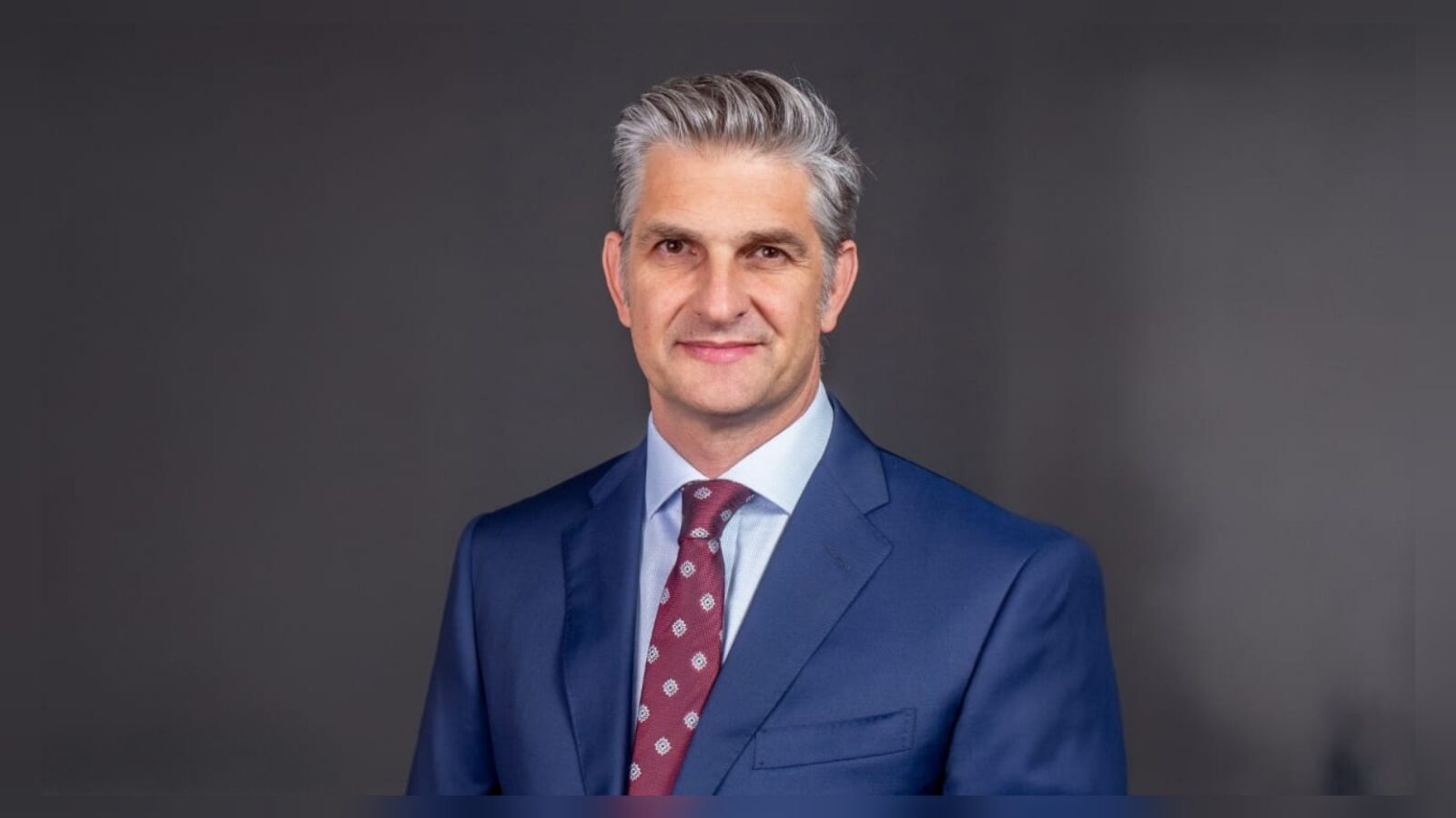
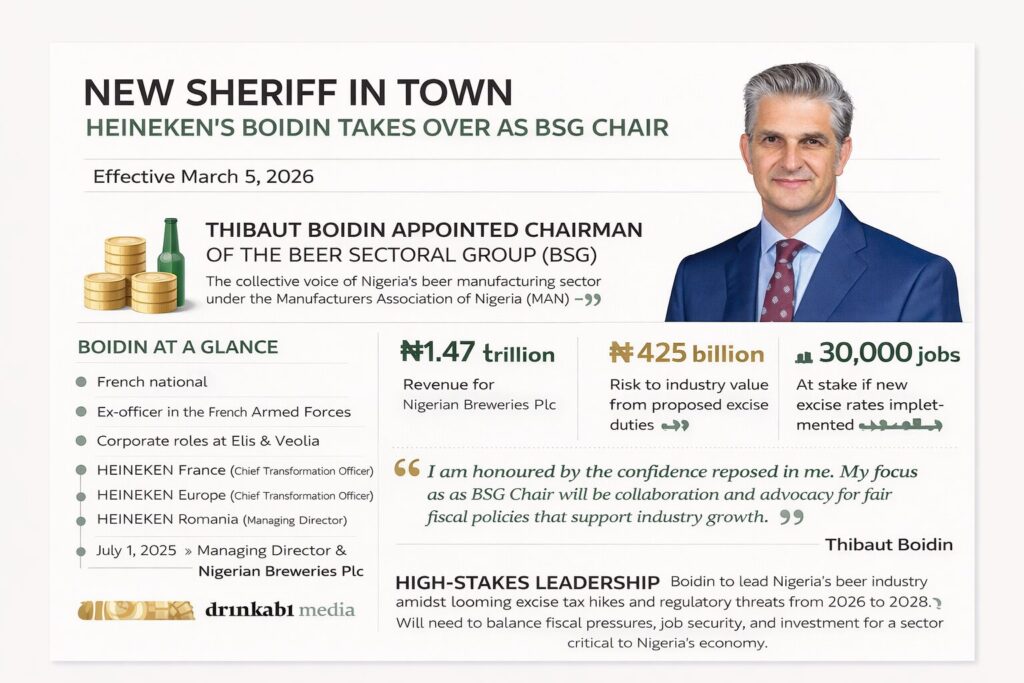
Thibaut Boidin, Managing Director and CEO of Nigerian Breweries Plc, has been appointed Chairman of the Beer Sectoral Group (BSG), the collective voice of Nigeria’s beer manufacturing sector operating under the Manufacturers Association of Nigeria, effective March 5, 2026. He succeeds Carlos Coutino, who led the BSG through a bruising period of naira devaluation and rising input costs before stepping down.
The appointment plants Boidin at the frontline of a sector that has only just clawed its way back from the edge. Nigerian Breweries swung back to profit in 2025, recording net income of N99.1 billion for the year ended December 31, compared with a N145.0 billion loss in 2024. Revenue rose 35 percent to a record N1.47 trillion, while operating profit climbed almost threefold to N205.2 billion, a turnaround driven by price increases, cost discipline, and sharply lower finance charges following a rights issue that eliminated foreign currency debt exposure.
But the recovery is fragile, and the threats are real.
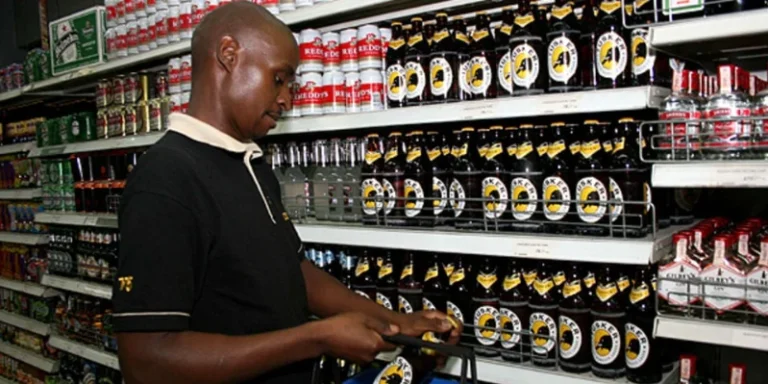
The Beer Sectoral Group, representing Nigerian Breweries, Guinness Nigeria, and International Breweries, has gone to the Federal Ministry of Industry, Trade and Investment with analysis warning that the proposed 2026 to 2028 excise framework puts over ₦425 billion of industry value at risk, alongside 30,000 direct jobs and the agricultural supply chains that feed into it. Meanwhile, the Tariff Review Board has already endorsed increases in excise rates on beer and stout, wines, whisky, and tobacco products for the 2026 to 2028 period, with the proposal expected to be presented to the Minister of Finance. The stakes are enormous for an industry that was already on its knees.
It is into this environment that Boidin now steps as BSG Chairman.
“I am honoured by the confidence reposed in me by my industry peers. With over three million jobs supported across the value chain, the beer sector plays a vital role in Nigeria’s manufacturing and economic ecosystem through investment, local value creation, responsible consumption, and sustainable contributions to government revenue.”
In his capacity as BSG Chairman, Boidin is working closely with the Board of CEOs to provide strategic leadership, advancing critical industry priorities including shaping sustainable category growth, advocating for commercial freedom through balanced and growth-oriented fiscal policies, and strengthening the differentiation and long-term competitiveness of beer within Nigeria’s beverages market.
Collaboration, he says, will define his approach.
“As Chairman, my focus will be to collaborate with MAN, government, and stakeholders to unlock category growth, enable fair competition, and foster a predictable fiscal environment where legitimate manufacturers can thrive.”
The man making these commitments brings uncommon depth. Before joining the HEINEKEN Group, Boidin served as an officer in the French Armed Forces across various continents, later transitioning to the corporate sector where he held senior executive and Managing Director roles at leading French organisations, including Elis and Veolia. He joined HEINEKEN in 2017 as Deputy Managing Director of France Boissons, the group’s largest integrated distributor, before going on to hold Chief Transformation Officer roles in HEINEKEN France and HEINEKEN Europe. Most recently, he served as Managing Director of HEINEKEN Romania, one of the Group’s largest operations in Eastern Europe, before being appointed CEO of Nigerian Breweries Plc. His appointment to the Nigerian role took effect July 1, 2025.
As Nigerian Breweries marks 80 years of operation, Boidin has been navigating economic headwinds while reshaping strategy for recovery and positioning the company for long-term growth in a complex and fast-evolving market. In a recent interview, he acknowledged the dual consumer reality facing the sector: a premium segment behaving like Western markets, and a vast majority of Nigerian consumers intensely price-sensitive, especially in a North where 110 million people have different expectations and preferences.
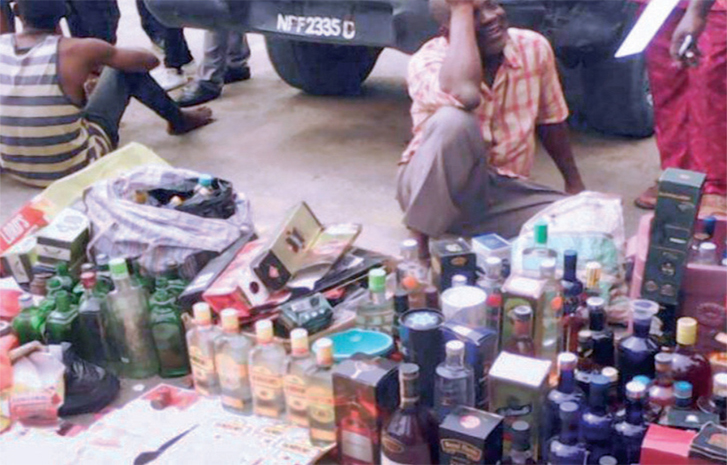
The BSG also represents an industry navigating a tricky public health dimension. Government-presented findings revealed that the average Nigerian now needs to work up to three hours to afford a single bottle of beer, raising alarm over public health risks from a potential shift towards unsafe, unregulated alternatives. It is an argument the BSG is leaning on heavily in its advocacy: that punitive excise policy does not reduce consumption, it merely redirects it toward illicit channels.
With Boidin in the chair, the industry now has a strategist shaped by military discipline, corporate transformation, and multinational operations across nine countries. Whether that resume is enough to win the fiscal argument with Abuja remains the defining question of his tenure.
Further Reading