As Nigeria’s customs authority actively enforces a sweeping prohibition on imported drinks, the country’s domestic beer sector has just posted its strongest recovery in years, raising questions about who really benefits when Africa’s most populous nation shuts the door on foreign beverages.
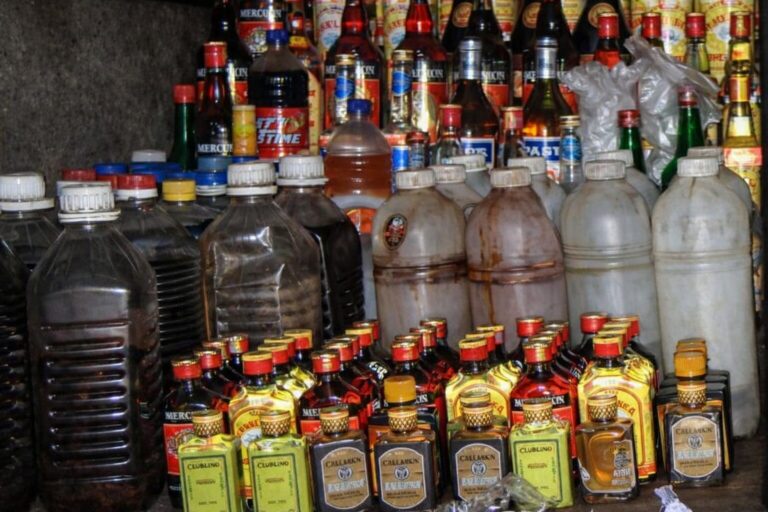
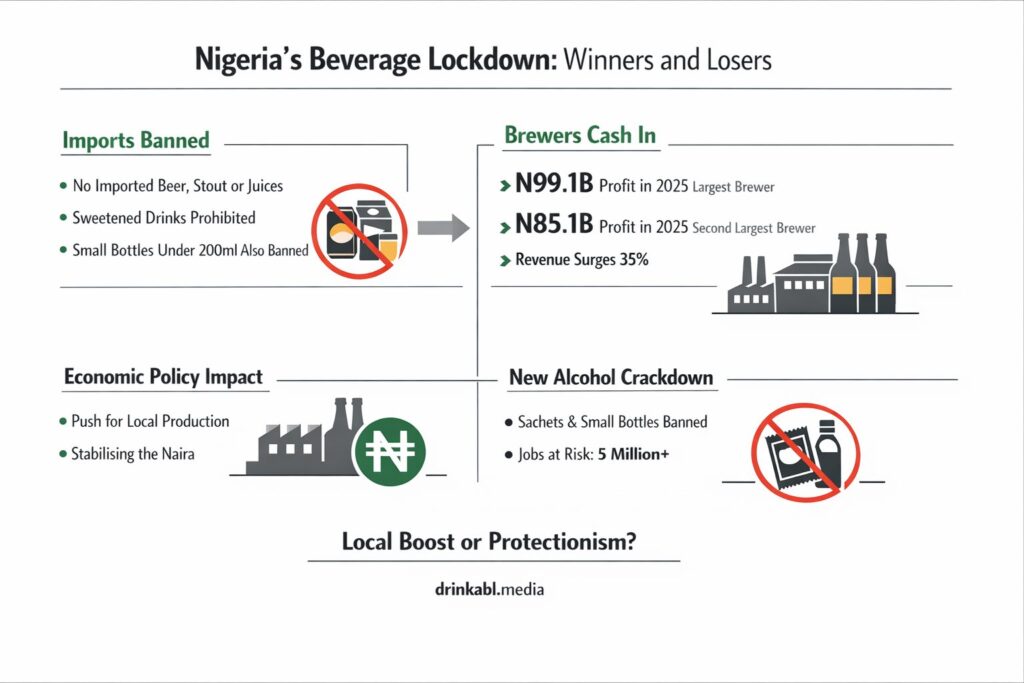
The Nigerian Customs Service’s import prohibition list, formally maintained and publicly accessible, bans bottled and canned beer and stout, fruit juices in retail packs, flavoured and sweetened mineral waters, and virtually all other non-alcoholic packaged beverages from entering the country. Goods found at airports, land borders, or seaports are subject to immediate seizure. The rules are not new, the beer import ban dates back to 2003, but enforcement attention has sharpened as Nigeria embarks on its most concentrated regulatory push in the drinks sector in recent memory.
The exemptions remain narrow. Energy and health drinks classified as liquid dietary supplements, brands like Power Horse and Red Ginseng, are explicitly carved out of the ban. Crude vegetable oils also escape restriction. Everything else in the sweetened, flavoured, or carbonated retail beverage category is off-limits.
The beverage ban forms part of a much wider industrial policy. Other prohibited items include bagged cement, a wide range of common medicines including paracetamol and chloroquine, NPK fertilisers, soaps and detergents in retail packs, used motor vehicles older than twelve years, and glass bottles exceeding 150ml used for beverage packaging. The breadth of the list frames the drinks prohibition as an economic policy instrument rather than a sector-specific measure.
“The policy is part of broader government efforts to reduce dependency on imports, support local farmers and manufacturers, and ensure that food consumed in the country is safe.”
For the brewing industry, the timing is significant. The prohibition creates a protected domestic market at the exact moment that Nigeria’s largest brewer has staged a dramatic financial comeback. The company swung back to profit in 2025, posting net income of N99.1 billion for the year ended December 31, reversing a N145 billion loss in 2024. Revenue rose 35 percent to a record N1.47 trillion, while operating profit climbed nearly threefold to N205.2 billion. The rebound reflected a combination of price increases, cost discipline, and sharply lower finance charges following a 2024 rights issue that reduced foreign currency exposure.
The country’s second-largest brewer also recovered sharply, recording a profit before tax of N85.1 billion in 2025, reversing a N111.8 billion loss in 2024, driven by strong revenue growth with full-year sales rising 26.83 percent year-on-year.
A shielded import environment did not single-handedly deliver these results, currency stabilisation, debt restructuring and premiumisation strategies all played important roles, but there is little doubt that the absence of imported competition gives domestic producers structural breathing room.
The import ban sits alongside a second, equally contentious regulatory move. Effective January 1, 2026, the federal government banned the production and sale of alcohol in sachets and in PET or glass bottles smaller than 200ml. Regulators this week launched a nationwide enforcement campaign, describing the crackdown as a public health intervention targeting underage drinking. The Manufacturers Association of Nigeria has warned the sachet ban could result in the loss of over N1.9 trillion in investments and jeopardise more than five million direct and indirect jobs.
Taken together, the two policies, import prohibition and small-pack alcohol ban, represent Nigeria’s most aggressive simultaneous regulatory push on beverages in decades. Nigeria has a long history of import bans as catch-all solutions for easing pressure on the naira and stimulating domestic production, a cycle that critics have long described as irrational policy somersaults. Whether the 2026 iteration breaks that pattern will depend almost entirely on enforcement consistency, historically the weakest link in Nigeria’s regulatory chain.
For international beverage brands eyeing one of Africa’s largest consumer markets, the calculation is stark: build locally, or stay out.
Further Reading: