
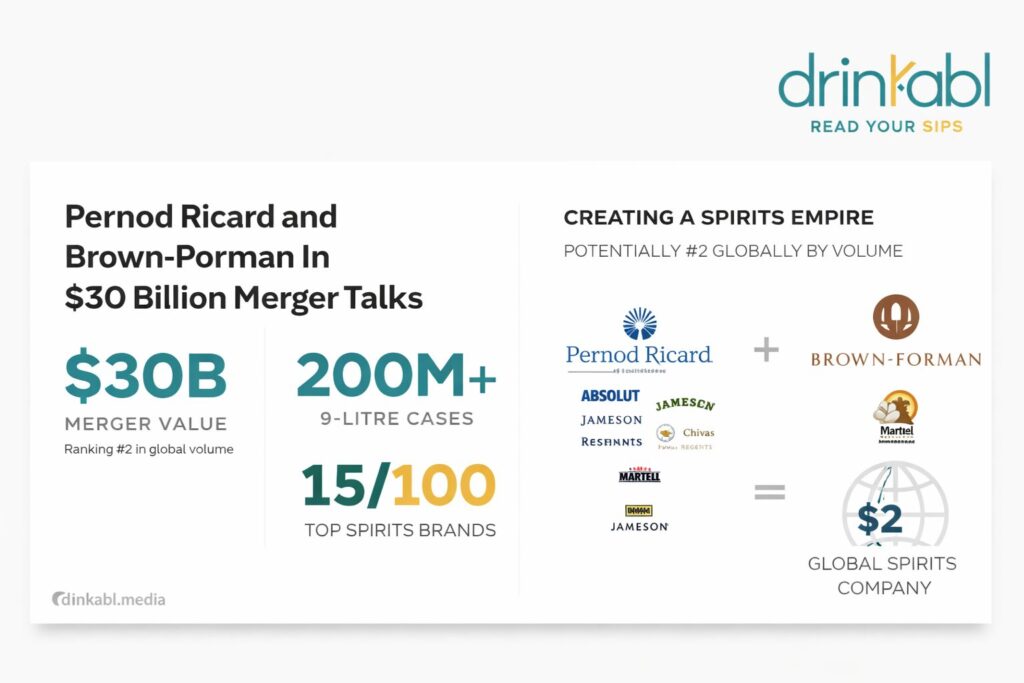
The global spirits industry has been shaken to its foundations. In what could become the most consequential consolidation deal in alcohol’s modern history, France’s Pernod Ricard and Kentucky’s Brown-Forman, the houses behind Absolut and Jack Daniel’s respectively, confirmed on March 26 that they are in active discussions about a potential merger. If completed, analysts say the deal would forge a spirits empire valued at approximately $30 billion, ranking second only to Diageo in global volume.
The announcement comes at a particularly revealing moment for Pernod Ricard. Even as the French spirits giant has been doubling down on high-growth emerging markets like Nigeria — where Jameson has risen to become the country’s number one whiskey brand — group-wide revenues have faced sharp pressure in its biggest Western and Asian markets, making a transformative deal like this increasingly hard to resist.
The Paris-headquartered Pernod Ricard, with a market value of approximately €15.9 billion, and Louisville, Kentucky-based Brown-Forman, valued at around $12.3 billion, both confirmed in separate statements that they are in talks to combine. The announcement came after the story broke, triggering frenzied movement on global markets.
Both companies are calling it a merger of equals, and the language from their official statements leaves little ambiguity about the ambition behind the deal.
“Synergies from the contemplated combination are expected to be significant, creating a global spirits leader with enhanced scale, a powerful brand portfolio, and a balanced geographic footprint, all anchored by two iconic families.” — Brown-Forman Corporation, March 26, 2026
“Operational synergies would be significant, leveraging Brown-Forman’s iconic brands, including Jack Daniel’s, and Pernod Ricard’s global distribution strength and exposure to highest growth potential markets.” — Pernod Ricard, March 26, 2026
For followers of the global alcoholic beverages sector, the proposed scale is breathtaking. Together, the two companies would control 15 of the top 100 global spirits brands by volume. A merged entity would have combined volume of nearly 200 million 9-litre cases, ranking second to Diageo in the global spirits category, with a combined market cap of approximately $30 billion.
The strategic logic is compelling on both sides. Pernod Ricard’s annual volume sits at approximately 150 million 9-litre cases, led by brands like Jameson, Absolut, Ballantine’s, Chivas Regal and Martell. Brown-Forman’s 46-million-case global portfolio is dominated by Jack Daniel’s at 17.6 million cases, alongside Woodford Reserve, El Jimador and Herradura Tequilas. A merger would hand Pernod a dramatically enlarged footprint in American whiskey and tequila, categories where it has long lagged competitors. For Brown-Forman, Pernod’s vast international distribution network offers a route to markets it has never fully penetrated.
The timing, however, tells a sobering story about the state of the industry. Spirits companies are battling a multi-year sales slump amid slowing demand and tariff pressures, which has triggered a slide in valuations, CEO exits and asset sales to cut costs. Pernod Ricard reported a 5.9% organic sales decline in the first half of fiscal 2026 and a 15% drop in U.S. net sales. Cash-strapped or health-conscious drinkers in key markets like the U.S. were already cutting back before import tariffs were raised, while emerging threats like fast-growing cannabis drinks also threaten sales.
Brown-Forman announced a corporate restructuring last year that would cut 12% of its global workforce, about 5,400 people. The company also closed its barrel-making operation in Louisville in April 2025, leaving 210 workers out of jobs, saving an estimated $70 million to $80 million annually.
The market’s reaction to the news was dramatic and revealing. Shares of Brown-Forman ended up nearly 9% on the day of the announcement, while Pernod Ricard’s shares fell nearly 6%. The divergence tells its own story, as Brown-Forman shareholders see a lifeline while Pernod’s investors are weighing what the French giant is taking on.
Analyst reaction has been measured. Berenberg’s Javier Gonzalez Lastra did not mince words:
“They have clear overlaps in the U.S., there is also some overlap in Europe. I see this as a defensive move, given the industry environment.”
While he acknowledged the deal could deliver significant cost savings, he cautioned that a merger would not resolve the companies’ underlying growth challenges.
TD Cowen analysts pointed out that the Brown family, which holds significant voting control in Brown-Forman, has resisted such deals in the past, but may be more receptive now given the industry’s weak growth and an uncertain timeline for recovery.
Regulatory scrutiny is broadly expected to be extensive given that a combined entity would sit directly behind Diageo as the world’s second-largest spirits group. Cultural integration between a deeply rooted French conglomerate and a 155-year-old Louisville family company also presents real complexity.
Both companies have said they do not intend to communicate further until an agreement is reached or discussions are terminated.
The bottle is open. What comes next could redefine the global spirits shelf for a generation.
Read More from Drinkabl.media:
Much Ado About Sapele Water Protests Erupt Again Over NAFDAC’s Sachet Alcohol Ban The Thirst Crisis That Could Break the Beverage Industry Alcoholic Beverages: Industry News and Analysis