
Rite Foods Limited on March 13 threw open the doors of its Ososa production facility to regulators, journalists and consumer advocates, using World Consumer Rights Day to make a public case for transparency in Nigeria’s competitive beverage sector.
The event, organised in collaboration with the Brand Journalists Association of Nigeria, brought together senior officials from the National Agency for Food and Drug Administration and Control, the Federal Competition and Consumer Protection Commission and the Consumer Advocacy Foundation of Nigeria, all inside the plant where Bigi Soft Drinks, Fearless Energy Drink, Sosa Fruit Drinks and Bigi Premium Drinking Water roll off the line daily.
This year’s global theme, “Safe Products, Confident Consumers,” was set to raise awareness that insufficient product safety undermines core consumer rights to life, health and safety, a message with particular weight in Nigeria’s soft drinks sector, where over 100 brands compete aggressively for consumer loyalty.
Founded in 2007 as a subsidiary of Ess-Ay Holdings, Rite Foods is an indigenous challenger in a market long dominated by multinationals. The company has invested over N30 billion in production capacity at Ososa, tripling output to compete directly with Coca-Cola and Pepsi, and its Bigi range alone spans 13 variants. That investment comes with institutional backing: the company holds the ISO 9001:2015 Certificate issued by the Standards Organisation of Nigeria, in conformity with international quality management requirements.
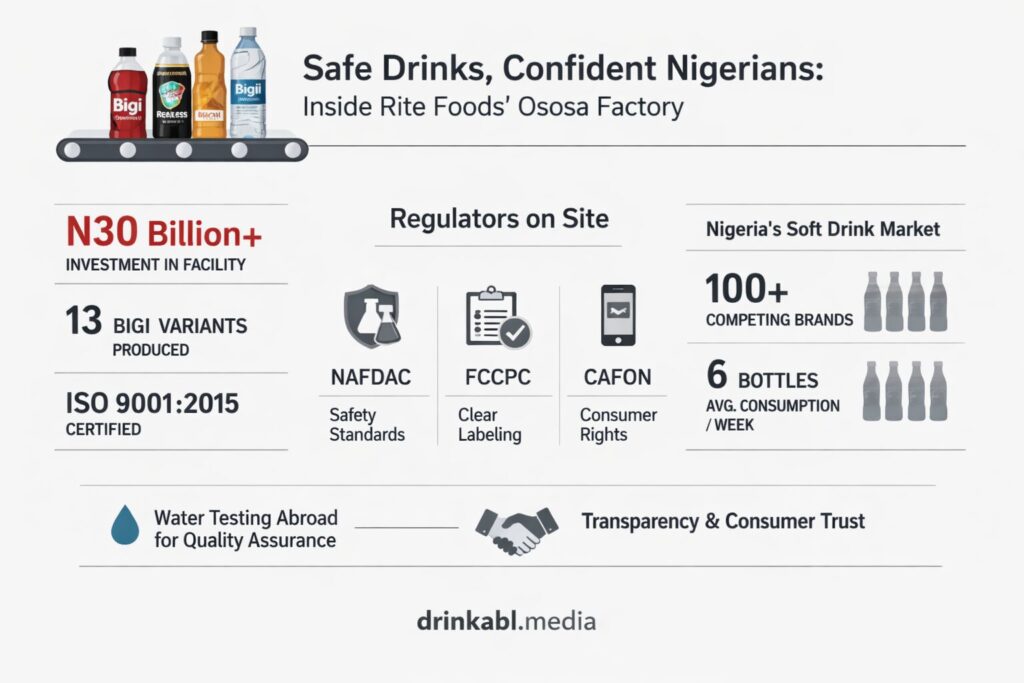
Olufemi Ajileye, General Manager for Operations, told attendees the company complies strictly with regulatory requirements and continues to invest in technology and skilled personnel. He disclosed that water samples are routinely sent abroad for independent testing against heavy metals and contaminants, a practice he said goes beyond domestic regulatory minimums.
NAFDAC’s representative, Dr. Tinuola Akinnubi, outlined a series of current regulatory interventions, including a strengthened post-market surveillance framework, updated labelling rules requiring clear ingredient disclosure and technology-driven authentication systems targeting falsified products. “A sustainable market cannot tolerate products that endanger health,” she said.
The FCCPC, represented by Dr. Olubunmi Otti, cited obligations under the Federal Competition and Consumer Protection Act 2018, which requires businesses to provide consumers with clear, accurate product labelling for informed purchasing decisions. “Compliance with safety standards is not just a regulatory obligation,” Dr. Otti said. “It is an investment in consumer trust and long-term brand credibility.”
CAFON founder Sola Salako-Ajulo pointed to a persistent gap between strong laws and public awareness, and introduced the CAFON Consumer Companion, an AI-powered platform designed to guide Nigerians through their rights and dispute resolution at any stage of a purchase.
The gathering comes against a significant commercial backdrop. Nigeria is one of the world’s largest soft drink markets, with the average consumer drinking roughly six bottles a week. In that environment, regulators and journalists physically walking a production line is less a public relations gesture and more a measurable act of accountability, one that homegrown manufacturers like Rite Foods increasingly understand is central to earning and keeping consumer trust.
Further Reading: