
How the Beverage Sector Is Reinventing Women’s Health
International Women’s Day, arrived days after the close of Natural Products Expo West 2026, the largest natural and organic trade show in North America. The timing felt almost deliberate. With tens of thousands of visitors from 130 countries and more than 3,000 food and beverage brands on the floor in Anaheim, California, the show’s 45th edition was suffused with a theme that resonated powerfully with the occasion: women’s health is not a niche. It is the industry’s fastest-growing, most clinically sophisticated frontier.
This piece focuses on three of the show’s most compelling narratives, functional beverages, gut microbiome science, and GLP-1 companion nutrition, and their particular relevance to women’s health. At the centre of it all is a probiotic strain that began in the most intimate of human settings: breast milk.
The Numbers Behind the Buzz
The natural and organic market’s trajectory was confirmed on the show’s opening day. SPINS data presented at the keynote put the sector at $342.1 billion in total sales, with 72.3% driven by food and beverage. Within that, functional sub-segments were outrunning the broader market decisively: gut-health beverages rose 16% in dollar sales, mood support drinks surged 42%, and protein-forward sips climbed 15%. These are structural gains, not statistical noise.
Two seismic forces shaped the show’s entire tenor. The first was the GLP-1 medication wave, glucagon-like peptide-1 receptor agonists that have fundamentally altered consumer expectations around satiety, digestive comfort, and metabolic health. The second was a broader “food as medicine” cultural shift that has made ingredient literacy a mainstream consumer behaviour. Women, who represent a disproportionate share of both GLP-1 users and functional wellness consumers, sat at the heart of every conversation.
What Was in the Glass
If Expo West 2026 had a single sensory motif, it was the sound of a can tab being pulled. Functional beverages flooded the show floor in formats and formulations that surprised even seasoned observers. The underlying consumer insight driving it all: time-starved shoppers want maximum benefit from minimum effort.
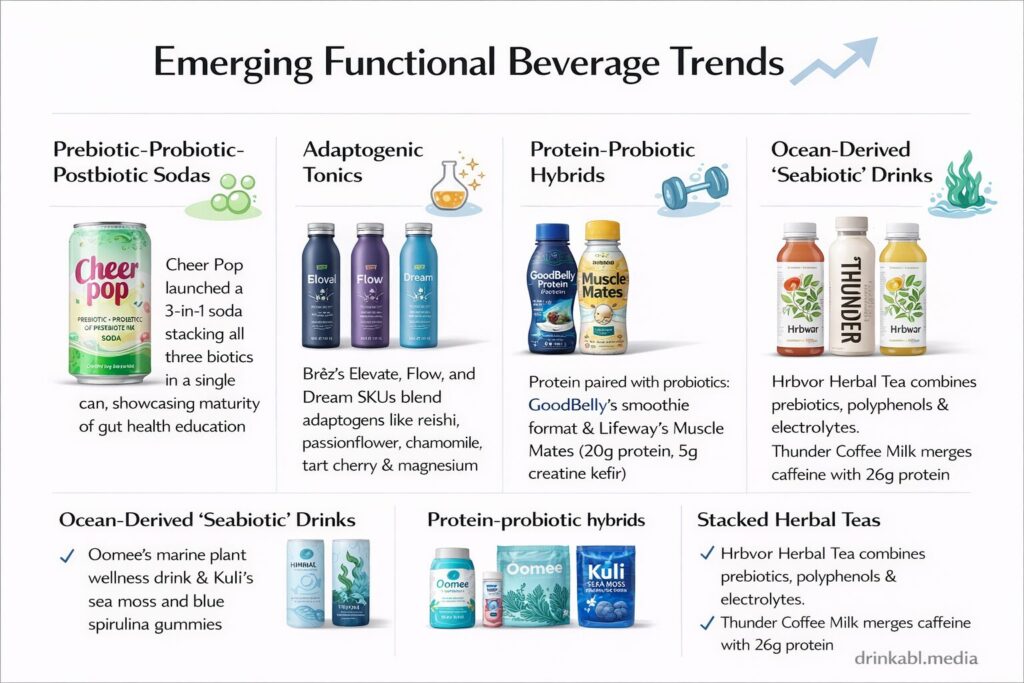
“Fast forward to the present and the world is drowning in functional beverages, most still without any proven benefit or function. This evolution is in the direction of including health-beneficial ingredients in convenient, ready-to-drink formats.”
GLP-1 and the Gut: A New Consumer Paradigm
The GLP-1 revolution has done something remarkable: it has made gut health personal for millions of people who previously had little reason to think about it. The gastrointestinal side effects associated with these medications, constipation, diarrhoea, nausea, nutrient malabsorption, have created urgent unmet demand for functional solutions that support digestive health from within. As Mondelēz Snack Futures panellists noted at the show, GLP-1 drugs are now a key lever that brands must account for in every product development decision.
With people eating less, every bite, and every sip, must count. Hydration SKUs proliferated accordingly, and beverages emerged as the format of choice for GLP-1 users who need nutrient density without volume. A product that delivers protein, probiotics, and gut-protective ingredients in a 250ml serve is not a supplement. It is a meal.
On the ingredient supply side, postbiotics, the metabolic byproducts of probiotic activity, generated significant attention. Unlike live probiotics, postbiotics require no refrigeration and face none of the aqueous stability constraints that have historically excluded probiotics from ambient RTD formats. They are, in effect, unlocking entire new beverage territory that probiotic capsules could never reach.
AceBiome’s BNR17: The Strain That Started in Breast Milk
Among the probiotic innovations circling the functional beverage conversation at Expo West 2026, AceBiome’s Lactobacillus gasseri BNR17 stands apart, not only for its clinical pedigree but for the story embedded in its origin. BNR17 was isolated from human breast milk, the most nutritionally and immunologically complex substance the female body produces. It is, in the most literal sense, a strain born of women’s biology.
The Science
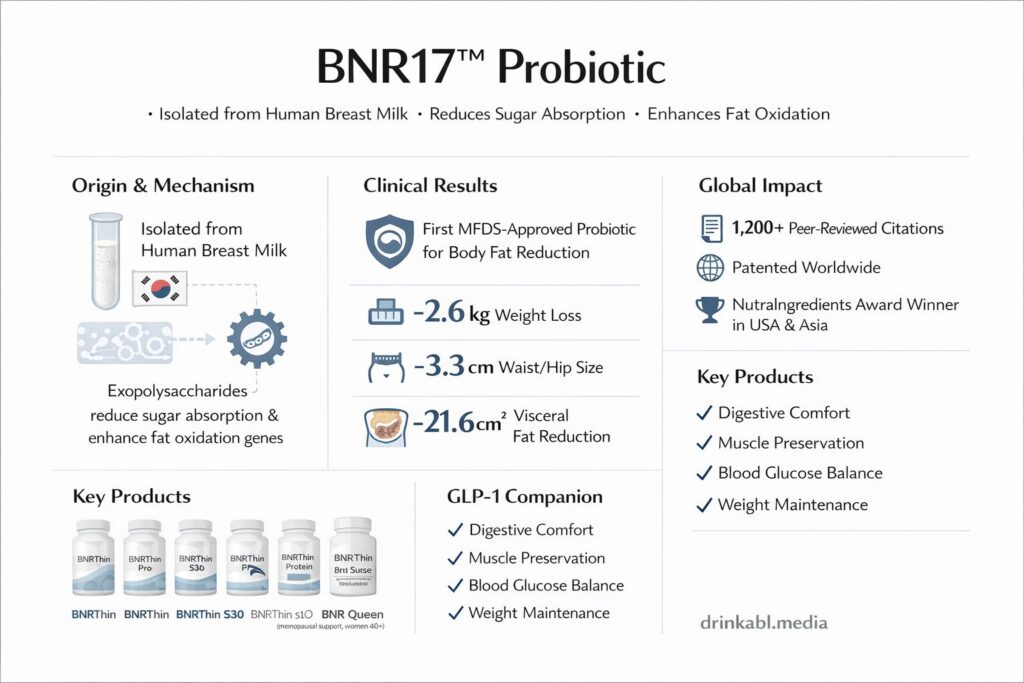
Research published in 2024 confirms that BNR17 produces exopolysaccharides that bind monosaccharides in the gut, reducing dietary sugar absorption, while simultaneously upregulating genes associated with fatty-acid oxidation, a dual metabolic pathway that addresses both caloric intake and caloric burning at the molecular level.
The clinical evidence base is substantial. Three placebo-controlled human trials have assessed BNR17’s effects. The first, published in the Korean Journal of Family Medicine (2013), enrolled around 60 overweight adults and demonstrated reductions in BMI and waist and hip circumferences after 12 weeks. The second trial, published in the Journal of Medicinal Food (2018), added a significant reduction in visceral adipose tissue in the high-dose group: –21.6 cm² versus placebo. The third trial assessed BNR17’s effects on digestive wellness in IBS with diarrhoea, broadening its clinical relevance beyond weight management.
The strain holds patents in multiple countries, has accumulated over 1,200 citations in peer-reviewed literature, and earned the inaugural NutraIngredients-USA Ingredient of the Year: Weight Management (2018) and NutraIngredients-Asia Product of the Year: Probiotic (2020). It is the first probiotic approved by the Korean Ministry of Food and Drug Safety (MFDS) for the functional claim of body fat reduction.
BNR17 as a GLP-1 Companion
AceBiome CEO Myeong Hee Kim has outlined how BNRThin addresses the specific failure modes of GLP-1 therapy across four areas: digestive comfort (via its IBS-D clinical data), muscle preservation (in-vivo data on muscle loss inhibition), weight maintenance post-therapy (to counteract the rebound effect), and menopausal support via the BNR Queen formulation , which combines BNR17 with sophoricoside, vitamin D, selenium, zinc, and vitamin A to target hormonal balance in women over 40.
“BNRThin may help mitigate potential downsides of GLP-1 weight loss treatments, such as digestive discomfort, constipation, diarrhea, muscle loss during treatment, and weight regain after treatment.”, Myeong Hee Kim, CEO, AceBiome
BNR17 at a Glance
Women’s Health: The Sector That Arrived
International Women’s Day is not merely a calendar date. At Expo West 2026, it was a statement about where the natural products industry has chosen to invest its most sophisticated science. The women’s health category arrived with robust momentum, carrying products targeting every life stage from reproductive health to menopause, vaginal and urinary wellness, hormonal balance, and mood.
The “beauty from within” movement continued to mature on the show floor. Greater Than targeted women specifically with beauty-focused hydration. Glow Beauty Fuel packed daily beauty supplements into a collagen protein bar. OSULLOC debuted Matcha Plus, combining matcha with probiotics, collagen, and L-theanine, targeting the functional matcha drinker who now expects her morning cup to multitask.
The overarching narrative was clear: women are done being underserved by an industry that historically treated them as a demographic afterthought. They are demanding, and funding, products built on human clinical data relevant to their biology, not extrapolated from male subjects.
The Convergence
Set against International Women’s Day, the story of Expo West 2026 is ultimately a story about recognition. The beverage sector is recognising that its most valuable consumer is not a generic health-conscious adult but a woman at a specific life stage, with specific microbiome needs, specific hormonal dynamics, and specific experiences of the healthcare system, including, increasingly, GLP-1 therapy.
AceBiome’s BNR17 represents the archetype of what this consumer now demands: a strain born from female biology, validated in peer-reviewed clinical trials, proven to address the metabolic and digestive challenges women actually face, and increasingly available in the synbiotic, protein-enriched formats that make sustained wellness achievable.
The brands that will define the next decade of women’s wellness will be those that put clinical rigour in a bottle, and make it delicious enough that a woman reaches for it not because she has to, but because she wants to.
Further Reading from Drinkabl Media
- Which Is Better Between Green Tea & Coffee? Science Has a VerdictHealth & Nutrition · March 2026
- How Africa & Middle East Are Reshaping the Beverage MapIndustry Analysis · February 2026
- Faith, Fasting, & FMCG Beverages: The 2026 Trade RealityDeep Dive · February 2026
- Canned Convenience: How RTDs and Hard Seltzers Are Reshaping Alcohol Consumption in AfricaBeverage Categories · February 2026
- How Health, Innovation & Youthful Demands Are Driving Africa’s Beverage Industry in 2026Special Report · 2026