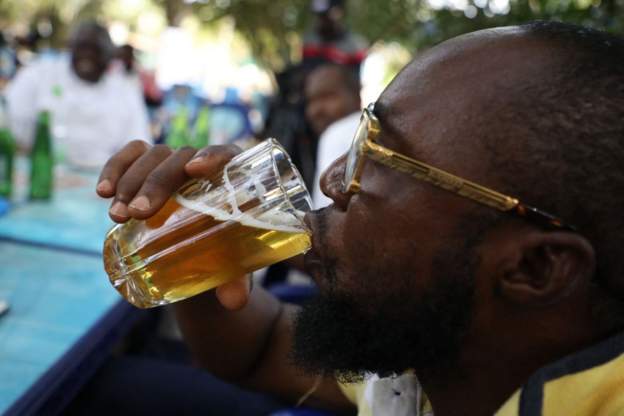
Your cold bottle of Star Lager now costs more. So does your Gulder, your Guinness, your Trophy. Three brewers. One week. Zero apologies. And Nigerians, from bar stools in Surulere to timelines in Abuja, are not staying quiet about it.
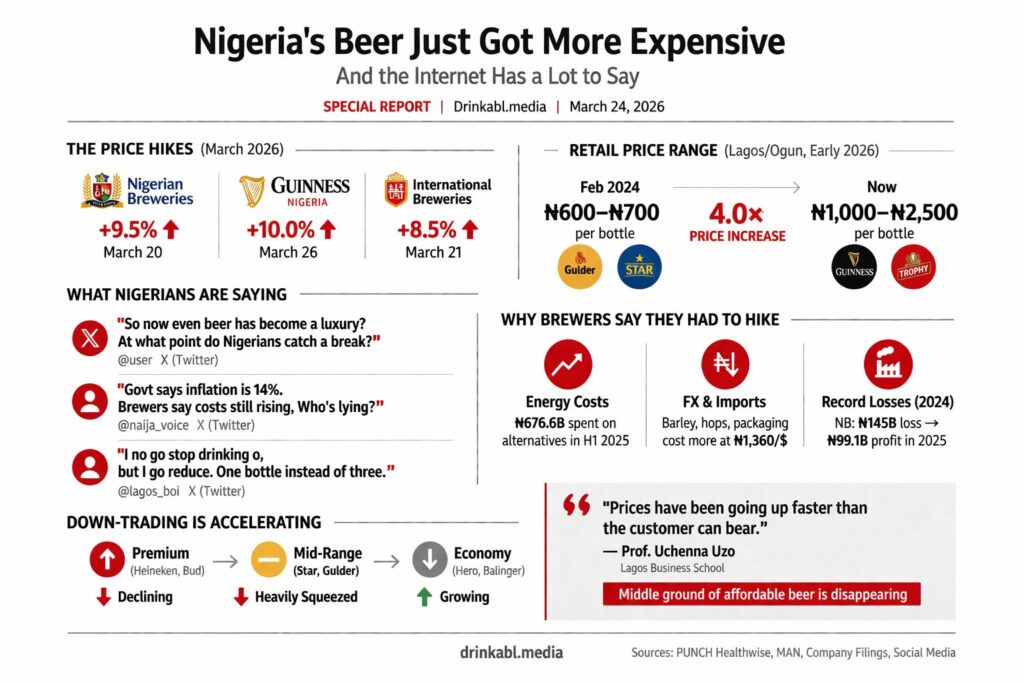
In the second week of March, Nigerian Breweries, Guinness Nigeria, and International Breweries each issued distributor notices announcing price hikes on selected SKUs, effective March 20, March 26, and March 21 respectively. The stated reason, in almost identical language across all three notices: rising operational and input costs. No percentages. No specific products named. Just higher prices, take it or leave it.
The internet, predictably, took it personally.
“Which Kind Country Be This?”
On X (formerly Twitter), the reactions were swift and unsparing. One widely shared thread captured the dominant mood:
“So now even beer has become a luxury? These breweries are posting record billions in revenue and still hiking prices. At what point do Nigerians catch a break?”
Another user put it more bluntly:
“The government says inflation has dropped to 14%. The beer companies say costs are still rising. One of them is lying to us.”
And then there was the quiet resignation that many found most relatable:
“I no go stop drinking o, but I go reduce. Maybe one bottle instead of three.”
On Facebook, bar owners vented their frustration in a different register, one of squeezed margins and shrinking footfall. A lounge operator in Port Harcourt wrote:
“My customers are already counting bottles. Three used to be normal. Now two is the maximum for most people. If prices go up again, some will just drink at home with whatever they find cheaper.”
The Price Is the Story
The numbers tell the tale. In February 2024, Nigerian Breweries raised prices and published a verified price list: Gulder jumped from ₦700 to ₦950, Star Lager from ₦600 to ₦850, Heineken to ₦1,300. Today, retail prices across Lagos and Ogun establishments range between ₦1,000 and ₦2,500 per bottle, depending on brand and venue, per PUNCH Healthwise field research in early 2026.
That is a price quadrupling in roughly four years for what was once Nigeria’s most democratic drink.
The economic squeeze was already pushing older, more affluent Nigerians down from premium spirits to beer as far back as 2023. Drinkabl reported that development economist Dr Joe Abah noted on X that many of his friends over 60 had abandoned cognac and single-malt whiskey in favour of beer. Now, that last refuge is also getting out of reach.
Why the Brewers Say They Have No Choice
The companies’ cost arguments are not manufactured. Nigerian Breweries posted a ₦145 billion loss in 2024, before recovering to a ₦99.1 billion net profit in 2025 on record revenue of ₦1.47 trillion. Guinness Nigeria posted similar FX-driven losses. Manufacturers collectively spent approximately ₦676.6 billion on alternative energy in the first half of 2025 alone, per the Manufacturers Association of Nigeria, because diesel generators remain the fallback when the national grid fails, which it does, at length and without notice.
The naira has stabilised at roughly ₦1,360 to the dollar. But stability at a far weaker rate than before the 2024 devaluation means imported barley, hops, enzymes, and packaging materials all cost significantly more, permanently. As Drinkabl’s analysis of global brewing trends shows, the economics of beer production in African markets are uniquely punishing, with energy, FX exposure, and infrastructure gaps forming a cost structure that no amount of macro optimism fully resolves.
The Deeper Shift: Down-Trading Is Real
The social media anger reflects a structural reality that analysts have tracked for years. Nigeria’s beer market is bifurcating: premium brands face headwinds while economy brands grow. Mid-range lager, the traditional heart of the market, is where consumers are being squeezed out entirely.
Prof. Uchenna Uzo of Lagos Business School has observed pointedly:
“Prices have been going up faster than the customer can bear, and for that reason, there has been a fall in demand for some categories of beer.”
Below the economy tier sits the sachet and informal alcohol market, and that regulatory wild card remains unresolved. NAFDAC’s December 2025 enforcement deadline for the sachet alcohol ban was suspended by the Federal Government and is now before the Federal High Court, following a SERAP lawsuit. If enforcement resumes, millions of low-income consumers lose the one option still priced within reach.
“Survival Pricing” vs “Premiumisation”
The phrase that keeps surfacing in LinkedIn discussions among Nigerian FMCG professionals is the collision between two irreconcilable strategies: premiumisation, the long-term ambition of brewers to move consumers up the value ladder, and survival pricing, what happens when cost pressures force hikes that the market simply cannot absorb at volume.
“You cannot premiumise a market where median income hasn’t kept pace with price increases over three years,” one Lagos-based FMCG consultant noted in a widely circulated post.
That tension, visible in every bar argument and Twitter thread this week, is the real story of Nigeria’s beverage market in 2026. The bottles are still cold. The demand is still there. But the middle ground, the affordable, everyday, anyone’s-beer segment, is quietly disappearing.
📖 Read More on Drinkabl.media: Nigerian Breweries, Guinness Announce Price Hike | Global Brewers Pivot South and East as Beer’s Western Dream Fades | Economic Shifts and Changing Tastes: The Impact on Premium Spirits in Nigeria | The Safety Question Lurking in Packaged Beverages | Nigerian Breweries Launches “Big Fiesta” Campaign