The drinks industry is built on water. And the water is running out.
This year’s World Water Day, observed on 22 March under the theme “Water and Gender: Where Water Flows, Equality Grows,” landed not as an awareness moment but as a live reckoning. The 2026 theme places safe drinking water and sanitation at the centre of both gender equality and human rights, directly tied to UN Sustainable Development Goals 5 and 6. With the 2026 UN Water Conference, co-hosted by Senegal and the UAE and scheduled for 2,4 December in Abu Dhabi, now months away, the pressure on governments and industry alike has never been greater.
For the global beverage sector, the urgency is existential.
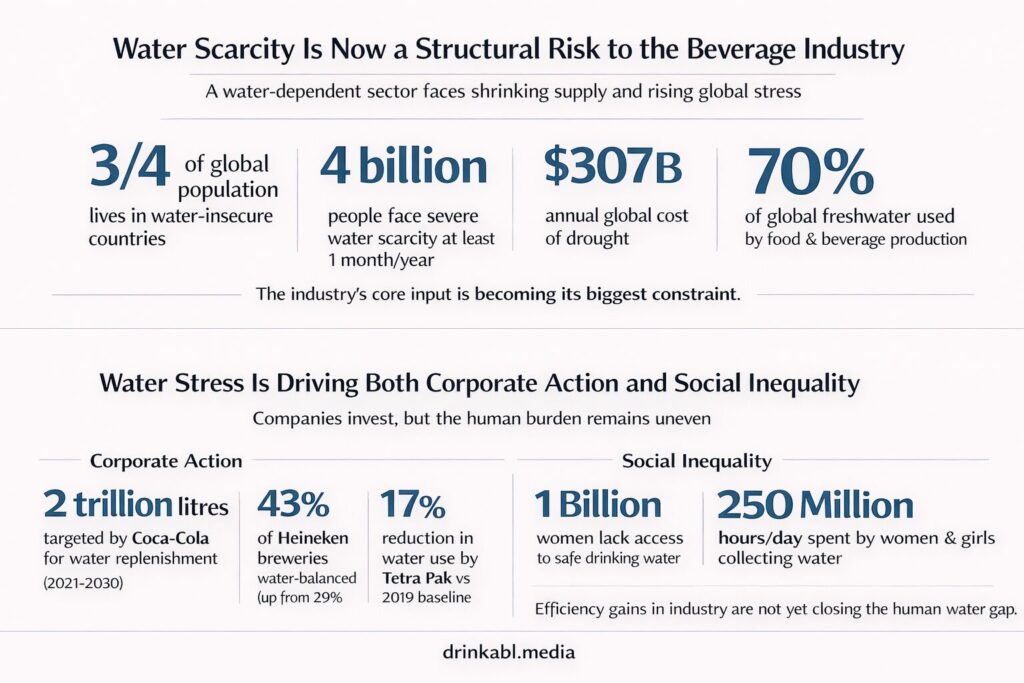
In January, the UN University’s Institute for Water, Environment and Health issued a landmark verdict: humanity has crossed into an era of global water bankruptcy, a point where depleted water systems can no longer return to their historical baselines. Nearly three-quarters of the global population now lives in countries classified as water-insecure. Around 4 billion people face severe water scarcity for at least one month per year. Drought costs the world an estimated $307 billion annually. The $6 trillion global food and beverage sector sits squarely at the epicentre, consuming around 70% of the world’s freshwater to grow and manufacture its products.
“For much of the world, ‘normal’ is gone.” , Prof. Kaveh Madani, Director, UN University Institute for Water, Environment and Health
Water is not a by-product of the beverage industry. It is the product.
Big Brands on the Hook
The industry’s major players can no longer treat water stewardship as a footnote. Heineken’s 2030 goal commits to returning 1.5 litres of water for every litre of beer produced in water-stressed areas. As of end-2025, replenishment projects have started at 38 of the 40 sites in scope, with 43% of those breweries now fully water-balanced, up from 29% in 2024. The company was also named to CDP’s A-list for Water Security for the first time in 2025, recognising its watershed strategy.
Coca-Cola’s 2030 Water Security Strategy commits to returning a cumulative 2 trillion litres of water to nature and communities globally between 2021 and 2030. Since 2015, the company has returned more than 100% of the water used in its finished products globally, on an aggregate level, to nature and communities. Molson Coors, meanwhile, has set a goal to improve water use efficiency in its large breweries by 22% compared to 2016, targeting a water-to-product ratio of 2.8 hectolitres per hectolitre.
On the continent, Guinness Nigeria’s Water of Life initiative remains one of the most concrete examples of a beverage brand translating commitment into community impact. Since 2012, the programme has provided safe drinking water to over two million Nigerians through approximately 22 water schemes across the country. On World Water Day 2026, Guinness Nigeria reaffirmed the programme’s role, with the company using the occasion, as Vanguard reported, not merely for awareness but for accountability.
Technology Is Doing the Heavy Lifting
Innovation is delivering measurable results. Tetra Pak has reduced its water usage by 17% versus its 2019 baseline, and its Approach to Nature framework targets a 50% reduction in freshwater withdrawal on best-practice food processing lines by 2030.
“Food security cannot be separated from water security. Water is the precondition for resilient food systems, and without it, no one gets fed.” , Francesca Priora, VP Climate & Nature, Tetra Pak
The investment case is increasingly hard to ignore. According to Bluefield Research, focused on the U.S. and Canadian markets, manufacturing industries represent a 45% share of planned industrial water spend, $175.3 billion, fuelled by high-growth sectors including semiconductors, pharmaceuticals, and beverages, with annual expenditures projected to exceed $62 billion by 2030. Companies leading on water efficiency will hold a structural cost advantage. Those that lag will face both resource scarcity and sharpening reputational risk.
A Justice Issue, Not Just an Environmental One
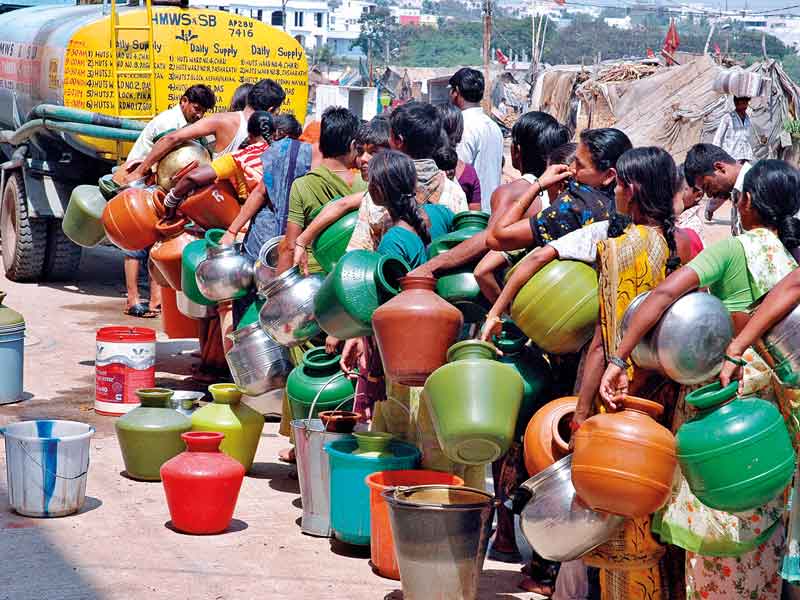
Globally, more than 1 billion women, over a quarter of all women, lack access to safely managed drinking water. In 1.8 billion households without on-premises water, women remain primarily responsible for collection. In 53 countries with available data, women and girls spend 250 million hours per day on water collection, more than three times that of men and boys. This is not a corporate social responsibility add-on. It is a development emergency with direct consequences for the labour forces and communities that underpin every beverage supply chain across the developing world.
The UN report calls for a fundamental transition, stopping the bleeding, protecting essential resources, and investing in rebuilding. The beverage industry, more than almost any other sector, has both the motivation and the market power to lead that transition. With the UN Water Conference in Abu Dhabi fast approaching, the window for pledges to become action is closing.
The question is no longer whether to act. The water is already running out.
📖 Further Reading on Drinkabl: