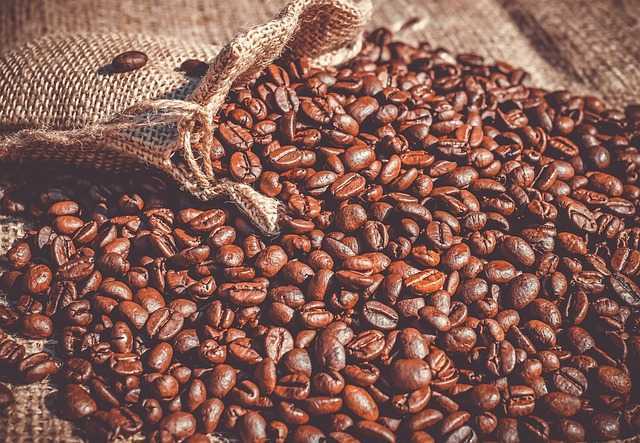
Your morning cup of coffee is only as secure as the seedling that grew it. And right now, some of the world’s biggest names in the beverage business are making sure that seedling survives.
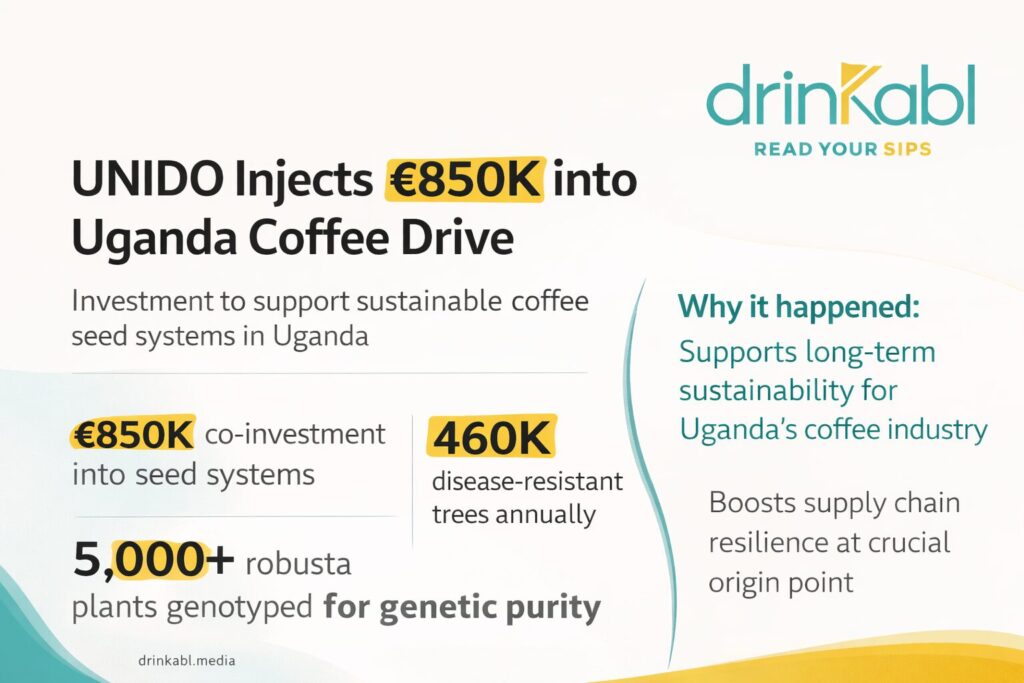
The UNIDO and WCR, through the Advancing Climate-Resilience and Transformation in African Coffee Programme (ACT), have announced a €850,000 co-investment to strengthen Uganda’s coffee seed systems, support farmer livelihoods, and advance long-term sustainability.
The three-year programme unites WCR, UNIDO through its ACT Coffee Programme funded by Italian Cooperation, alongside the Lavazza Foundation, The J.M. Smucker Co., and JDE Peet’s in a coalition that reads like a who’s who of the global hot beverages market. For an industry already navigating tightening supply chains from multiple fronts, the move signals a strategic pivot toward origin-level investment.
At the heart of the programme is the expansion of seed system infrastructure. New robusta mother gardens and nurseries will be established across Northern, Central, and Western Uganda, producing up to 460,000 high-yielding, disease-resistant trees annually. Over 5,000 robusta mother garden plants will also be genotyped to verify genetic purity, giving farmers confidence that their new trees will deliver the expected resilience and productivity.
Coffee wilt disease in robusta, and coffee leaf rust and coffee berry disease in arabica, remain persistent threats. Previous research shows that using resistant varieties can increase smallholder farmer profits by up to 250%, securing livelihoods and sustaining the coffee value chain. The programme directly targets these bottlenecks, with grafted plants designed to withstand drought conditions, particularly in Uganda’s northern regions.
“Uganda’s coffee sector holds extraordinary potential, and this initiative demonstrates precisely the kind of public-private partnership that can unlock it.” , Andrea De Marco, UNIDO Programme Manager and Partnership Advisor
WCR CEO Dr Jennifer “Vern” Long underscored the strategic imperative for global beverage companies investing at the farm level.
“The commitment by WCR member companies JDE Peet’s, Lavazza Foundation, and The J.M. Smucker Co., alongside UNIDO, validates the power of collective action to de-risk key origins and secure the future of quality coffee supply.” , Dr Jennifer “Vern” Long, CEO, World Coffee Research
The programme also builds local capacity through collaboration with Uganda’s Ministry of Agriculture, the NaCORI and training placements at international research centres including Cenicafé in Colombia. Demonstration plots of KR robusta lines and advanced arabica hybrids will drive farmer adoption of improved planting material.
The investment arrives at a moment of extraordinary momentum for Ugandan coffee. The country earned US$2.5 billion from coffee exports in the 12 months to February 2026, with 8.8 million 60-kilogram bags shipped, up from 6.3 million bags valued at US$1.6 billion the previous year, representing increases of 41% in volume and 61% in value. Arabica exports accounted for 21.4% of total shipments but contributed 31% of total earnings, fetching an average of $6.72 per kilogram, compared with $4.06 per kilogram for robusta.
Europe remained the largest destination, taking 58% of shipments, with Italy retaining the biggest single market at 28.8%, followed by Sudan and Germany. The continent’s beverage sector is clearly deepening its dependence on Ugandan origin.
The initiative supports Uganda’s national goal of reaching 20 million bags of annual production by 2030, a target set in the country’s 2017 Coffee Roadmap. Since that roadmap launched, Uganda has risen from the 7th to the 3rd largest global coffee exporter in just a decade, nearly doubling annual production from around 4 million to 8 million bags. This seed system programme directly addresses one of the remaining structural gaps between that ambition and reality.
For roasters, buyers, and beverage manufacturers, Uganda’s rise is no longer a promising subplot. It is a supply chain story that now demands attention at the boardroom level.
FURTHER READING