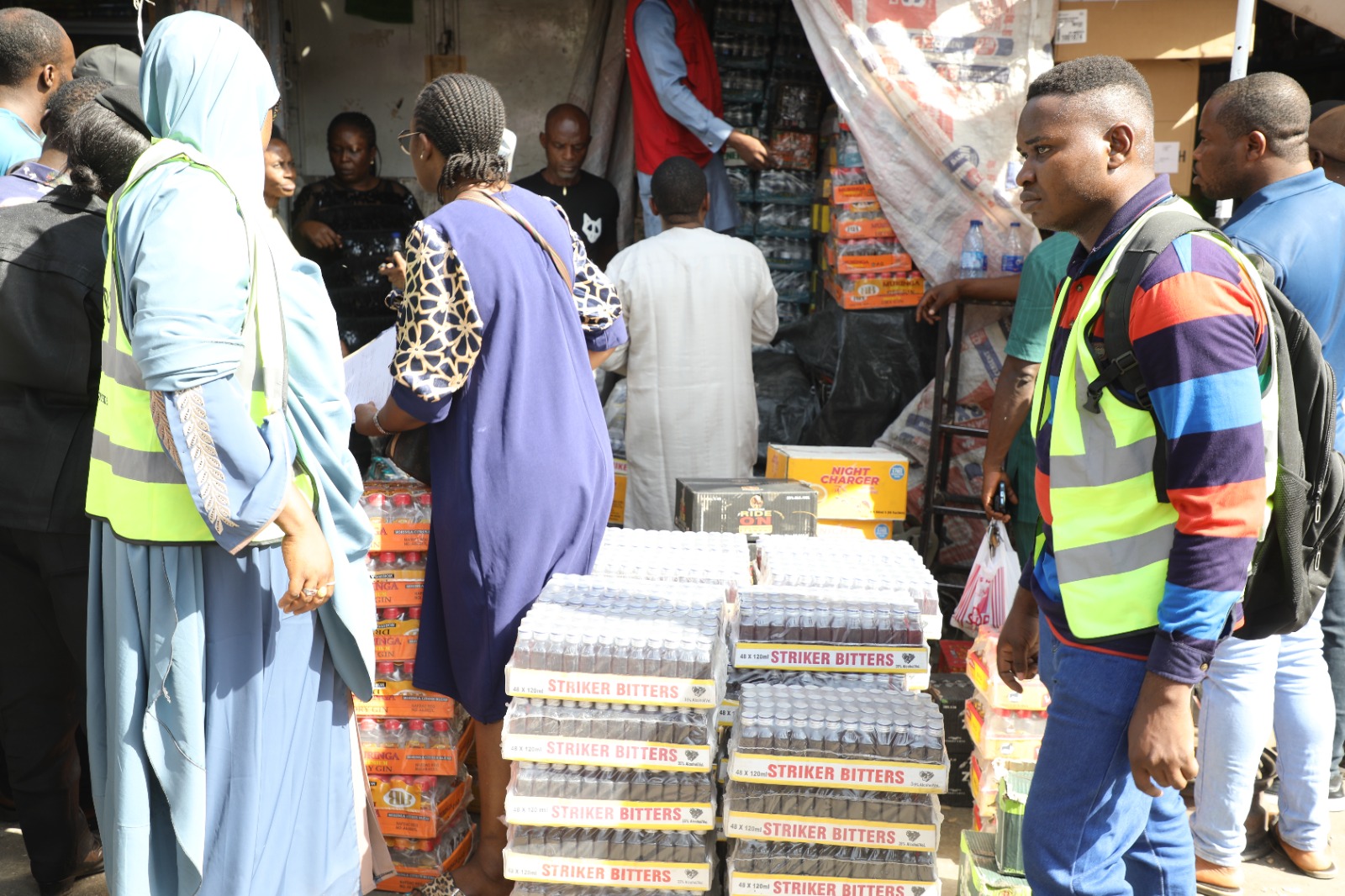
As street prices climb and a three-way government standoff drags on, the National Agency for Food Drugs Administration and Control, NAFDAC has moved to kill the fast-spreading rumour that large bottled alcohol has been banned.
Speaking at the 2026 World Consumer Rights Day event in Ijebu-Ode, NAFDAC’s deputy director Tinuola Akinnubi was categorical. The enforcement targets only sachets and small PET-bottled spirits below 200ml, not standard bottles, not mainstream brands.
“We are only against sachet and small PET bottled hot drinks to prevent children from becoming addicted to alcohol as they grow up,” Akinnubi said.
The clarification lands at a charged moment. As we reported in February, this policy has had a tortured journey. Announced for December 2025, the ban was suspended mid-month by the Office of the Secretary to the Government of the Federation citing economic and security risks, then resumed on January 21, 2026 after NAFDAC cited a fresh Senate resolution, only for the Federal Government to again order a halt to enforcement in February. Three arms of government have been pulling in opposite directions, and street traders have been watching, and selling, all the while.
On the ground, enforcement remains patchy. Sachet spirits hang openly from market stalls across the country. Akinnubi acknowledged the gap bluntly.
“Some people are still exhibiting them for sale, but we have started enforcement. It may take some time before they are completely wiped out from circulation.”
Yet the market is already responding. Street prices for sachet alcohol have risen noticeably in recent weeks as traders report tightening supply, a real signal that the crackdown, however inconsistent, is beginning to bite distribution chains.
The policy’s roots go back further than most remember. In December 2018, NAFDAC, the Federal Ministry of Health, the FCCPC, and industry bodies AFBTE and DIBAN signed a five-year MOU to phase out sachet and small-volume alcohol packaging by January 31, 2024. The deadline was later extended to December 2025 to allow manufacturers to exhaust old stock and reconfigure production lines. When the final deadline came, some companies were still lobbying for yet another extension, a pattern that prompted the Senate to draw a firm line, with Senate President Godswill Akpabio declaring that the time for excuses was over.
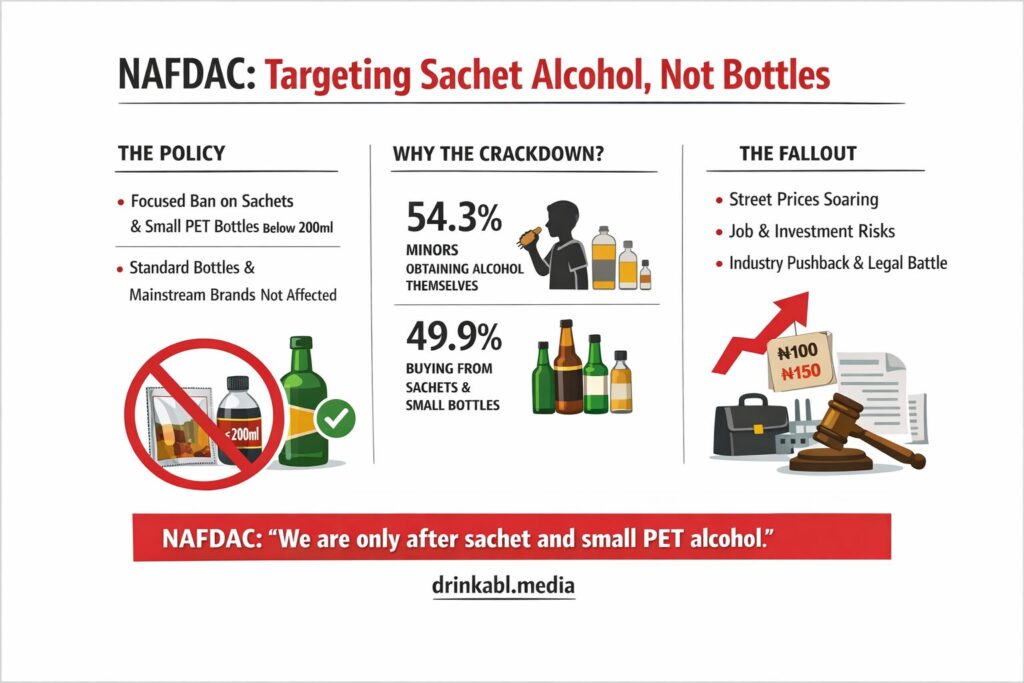
The public health data backing the ban is hard to dismiss. A 2021 nationwide survey, conducted in collaboration with the industry body DIBAN across six geopolitical zones and sampling 1,788 respondents, found that 54.3% of minors and underaged persons obtain alcohol by themselves, and of those, 49.9% sourced it from retailers selling sachet packs and small PET bottles. NAFDAC Director-General Prof. Mojisola Adeyeye has also warned repeatedly that youths who begin drinking before age 15 are 41% more likely to become alcohol-dependent later in life.
The legal front is heating up simultaneously. SERAP filed suit in December 2025 arguing that continued delay in enforcement violates existing health and regulatory laws. In a counter-affidavit filed on February 23, 2026, the Federal Ministry of Health told the Federal High Court that NAFDAC holds exclusive statutory authority under Sections 5 and 30 of the NAFDAC Act to enforce the ban, and that the ministry cannot legally restrain it from doing so.
Industry pushback, meanwhile, is fierce and well-organised. The Manufacturers Association of Nigeria has warned that the ban could wipe out ₦1.9 trillion in indigenous investment, threaten over 500,000 direct jobs, and put up to five million indirect jobs at risk across logistics, distribution, and marketing. Both the NLC and TUC have protested aggressively, going as far as calling for NAFDAC’s Director-General to be suspended entirely. MAN’s core argument is that the problem is misuse, not packaging, and that a blunt ban will simply push consumers toward unregulated and potentially more dangerous alternatives.
That argument has a partial counter in the African data. A peer-reviewed study of Uganda’s 2019 sachet ban found that availability dropped from 52% of establishments to just 1.4% after enactment, though researchers across the continent have also noted significant failures to monitor small back-door producers, with smuggling across porous borders endemic in several countries that attempted similar bans. Nigeria will need to navigate both sides of that precedent.
NAFDAC also used the Ijebu-Ode platform to signal a broader regulatory push, calling for tighter collaboration with SON and the FCCPC to address substandard and expired products across the market more generally. The sachet is not the only problem. But for now, it is the one with a deadline, and a rising price tag on the street to prove it.
READ YOUR SIPS — Further Reading on Drinkabl.media: