Before any drink reaches your hand in Nigeria, it first has to survive the port. For too long, many didn’t make it out without a bruising, in cost, in time, in margin. A new platform just changed the rules of that fight.
The Federal Government on March 24 formally unveiled Phase 1 of Nigeria’s NSW, a centralised digital platform that integrates all trade-related regulatory agencies into a single portal for import and export documentation, with the platform officially going live on March 27. For an industry that has spent the last two years nursing wounds from naira devaluation, ballooning input costs, and a brutal excise standoff, it may be the most consequential piece of trade policy to land on beverage producers’ desks since the pandemic.
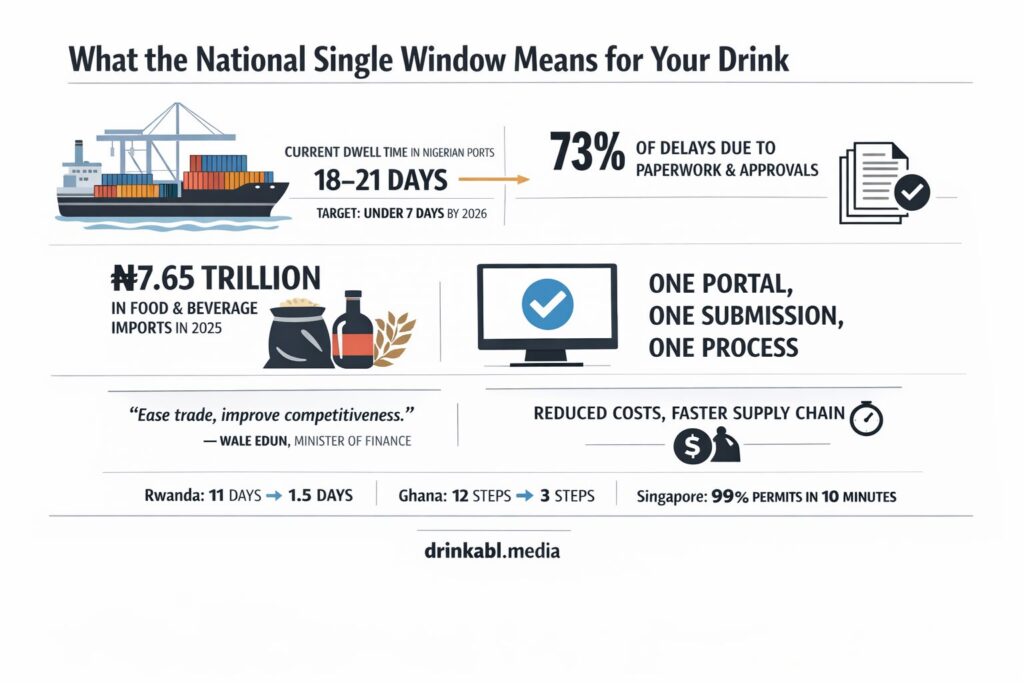
The numbers that made this reform unavoidable are staggering. Speaking at the Lagos launch, Finance Minister Wale Edun disclosed that cargo dwell time in Nigerian ports currently averages 18 to 21 days, approximately 475% above the global benchmark of four days, and that a full 73% of that dwell time is eaten up by documentation, customs processing, and regulatory approvals. Not physical congestion. Paper.
For beverage producers, brewers, bottlers, juice manufacturers, spirits importers, this distinction is everything. Nigeria’s spending on food and beverage imports surged to ₦7.65 trillion in 2025, according to the National Bureau of Statistics, with a substantial portion covering raw materials for industrial production. Every unnecessary day those inputs sit on a dock accrues demurrage, erodes shelf life, and pushes production costs higher, costs that inevitably reach the consumer.
“This is a decisive shift from complexity to coordination. It will ease trade, improve competitiveness, and support economic growth.”
— Wale Edun, Minister of Finance and Coordinating Minister of the Economy
Phase 1, which went live on March 27, covers import licences, certificates, and permits for key regulatory agencies, including NAFDAC, the Standards Organisation of Nigeria, the Nigerian Agricultural Quarantine Service, and NESREA, alongside centralised risk management tools and cargo manifest submission by shipping lines and airlines. For beverage brands, NAFDAC’s integration alone is significant. The agency’s approval process has historically been one of the most friction-heavy checkpoints on any importer’s journey.
“In simple terms, it is one portal, one submission, one coordinated process.”— Tola Fakolade, National Single Window Coordinator
The government’s stated ambition is to slash cargo dwell time from 21 days to under seven days before the end of 2026. If that target is met, beverage producers will be looking at faster access to raw materials, reduced demurrage and carrying costs, and a more predictable supply chain, precisely the structural relief the industry has been demanding.
What makes the moment significant is its weight of history. This is Nigeria’s fourth attempt at implementing a Single Window. The previous three collapsed under the weight of inter-agency rivalry, lack of political will, and institutional resistance. Attempts in 2009/2010 and again in 2012/2013 never made it past early implementation. The beverage industry, which relies more heavily on imported raw materials than almost any other manufacturing sector, has watched each of those efforts quietly die.
The timing of this fourth attempt is not lost on the trade. As Drinkabl.media reported, Nigeria’s beverage sector enters 2026 having clawed its way back from ₦364.8 billion in combined sector losses across 2023 and 2024. The brewers are profitable again, but the recovery remains fragile. Nigerian Breweries announced price increases on select products effective March 20, 2026, while Guinness Nigeria followed with its own price hike effective March 27, both citing the same culprit, rising operational and input costs driven by prevailing economic conditions.
Into that context, a trade reform that structurally reduces port-related costs, rather than simply shifting them, is the kind of intervention that could actually move the needle on consumer pricing rather than just protect margins.
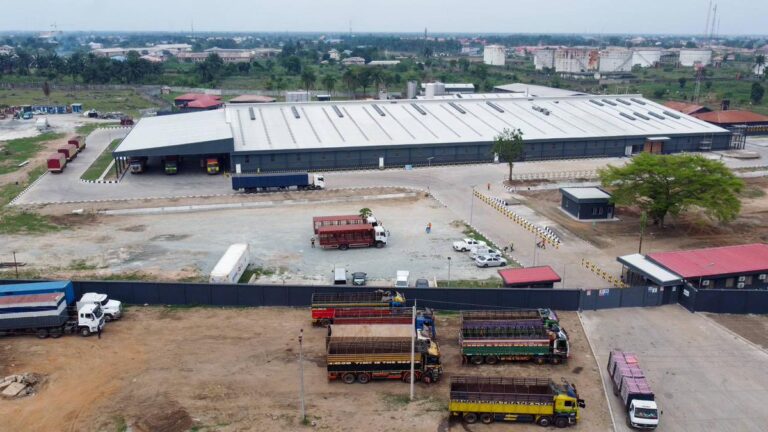
Apapa and Tin Can ports, both undergoing infrastructure upgrades, handle roughly 70% of Nigeria’s maritime trade. The digital reform and the port modernisation are two sides of the same coin, and the government is betting that both moving together will produce compounding results.
The caution, though, remains warranted. Singapore’s TradeNet processes 99% of permits within 10 minutes. Rwanda’s Single Window saved $18 million annually and reduced import time from 11 days to 1.5 days. Ghana’s GCNet cut clearance steps from 12 officers to 3. These successes share a common thread, strong execution, private sector partnership, and sustained political commitment beyond the launch event. Nigeria has historically excelled at the launch.
The industry will be watching Phase 2, due between Q2 and Q3 2026, which covers export processes and data dashboards, and Phase 3, scheduled for Q1 2027, which targets full ecosystem integration. For beverage exporters positioning under the African Continental Free Trade Area, those later phases may matter even more than Phase 1.
For now, the gate is open. Whether the industry can walk through it, without hitting another wall of bureaucracy on the other side, is the question that will define whether this reform is historic, or merely the fourth chapter of a very familiar story.