Some three years ago, back in December of 2023, Afrobeats cinematographer ThankGod Omori Smith, better known as TG Omori, the director behind some of the genre’s most iconic visuals, posted on X what became one of Nigerian social media’s most shared public health testimonies…he wrote, “It’s all fun n jokes but Fake drinks left me hospitalised most part of this year.” — TG Omori (@boy_director), December 19, 2023.
Not too long, eight months later, on August 26, 2024, Omori underwent a kidney transplant at St. Nicholas Hospital in Lagos, with his brother donating one of his kidneys so he could live. Days later, he posted that the procedure had failed. He was 29. The internet erupted, fans donated, colleagues prayed, and strangers flooded his timeline with their own stories of suspicious illnesses after nights out. Though no medical report establishes a direct link between his kidney condition and fake drinks, the timeline of his hospitalisation and his own public testimony reignited the national conversation with fresh intensity.
But, Omori was not the only one speaking. Also in December 2023, pop star BNXN, Daniel Benson, posted a direct challenge to Nigerian nightlife venues that his two million followers amplified across the country: “Stop selling us fake drinks after spending so much money on the overpriced drinks. You’re killing us. Respect my health, Respect my money. Give me what I pay for. If you don’t have it, don’t bring a fake one!” — BNXN (@BNXN), December 10, 2023.
By July 2024, singer Timaya had joined the chorus, fuming on X: “It will never be well with people that sell fake alcohol. Amen.” Three major artists. The same crisis. A growing social media record that the system has yet to catch up with.
Real People. Real Consequences.
The stories behind the posts are worse than the posts themselves.
In Oba, Anambra State, a mourner named Enyinnaya Erondu attended a burial in late 2024. Drinks were served, as they always are at funerals, a ritual of solidarity. The beer tasted unusually bitter. He noticed. He drank it anyway. You don’t make a scene at a burial. For two days, he and two friends were in agony: throbbing headaches, profuse sweating, relentless dehydration despite drinking water by the litre. “When we drank it, we couldn’t help but notice that the taste was more bitter than usual. But we waved it off and kept drinking.” — Enyinnaya Erondu, November 2024.
Lagos-based architect Simon Daramola, 52, tells a quieter but equally devastating story. He is not a heavy drinker. He bought red wine from the same trusted liquor store for over two years. In 2022, he began experiencing sharp pains in his kidneys. Tests confirmed toxins consistent with fake beverages, causing organ inflammation and scarring. “Several tests were carried out to analyse the symptoms. According to the tests, I had ingested toxins found in fake beverages, which cause inflammation and scarring of the liver, leading to liver damage, and kidney damage.” — Simon Daramola.
On X, users have been sharing encounters with alarming consistency, describing severe headaches, blurred vision, and mysterious hospitalisations after nights out. One user recounted waking unable to see properly after drinks at a Lagos club. A thread that simply opened with the words “I need to tell you something about what you’re drinking” went viral, then the algorithm moved on. Social media influencer Ajebo Danny posted that he avoids Nigerian clubs entirely because of fake drinks, while a clubgoer named Tobiloba described how the fear of contaminated alcohol caused him to drastically reduce his drinking: “The thought that alcohol can also damage some parts of my body that I wasn’t sure if they are fine or not got me scared so I cut back a lot.”
This is a trend that appears entrenched in the very fabric of our society. Ideally, when you pay N260,000 for a bottle of vodka at a Victoria Island club, the price is the guarantee. But then, you take a sip, notice something is off, keep drinking. You wake up in a hospital.
That is not a hypothetical. It is a documented case. It appears like we are living through a slow-burn public health catastrophe, visible, screenshotted, debated in real time, and chronically unresolved.
Every week, Nigerians post about fake and poisoned drinks. Every week, people are still drinking them. We’ve documented how the same crisis is bleeding South Africa’s economy of R25 billion and how illicit alcohol now commands 60% of Kenya’s drinks market. But Nigeria’s story is different in scale, in texture, and in the sheer volume of voices crying out, and being ignored.
The Supply Chain That Kills Quietly
When edu-tech expert Gabriel Egunjobi reported his hospitalisation to the Victoria Island club that served him the N260,000 vodka, the venue’s management apologised, and confessed they had also been supplied counterfeits. The deception doesn’t begin at the bar. It begins much further back.
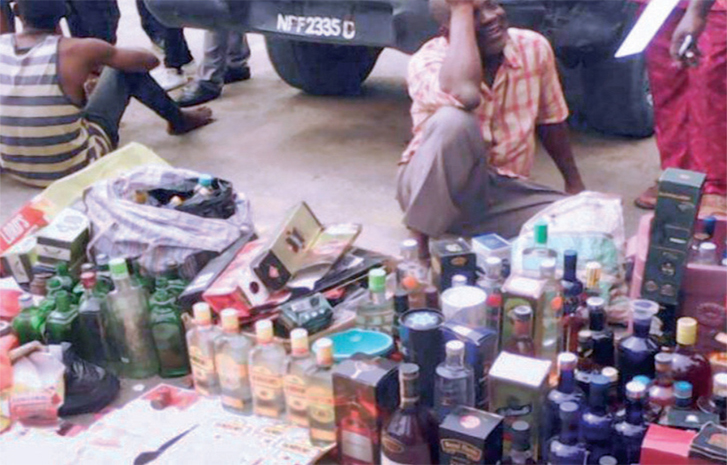
NAFDAC has conducted multiple raids on fake alcohol operations across Lagos. In August 2024, officers discovered that packing stores and rooms in Oke-Arin Market, Lagos Island had been converted into makeshift factories producing and distributing counterfeit alcoholic drinks. Over 2,000 cartons of empty bottles and packaged drinks were seized, along with a mini plastic mixing tank, an improvised filter, and packaging materials. Three suspects, Ikenna Daniel Ndeka, Innocent Chike, and Chukwu John, were arrested and NAFDAC estimated the seizure at N200 million. By December 2024, the same market was raided again: this time the lead suspect, Tochukwu Henry, confessed to refilling bottles labelled as Rémy Martin with cheaper ST-Rémy contents, with seizures valued at over N180 million. In November 2024, a separate operation at Abule-Osun, Lagos, uncovered over 50,000 counterfeit branded labels and packaging materials valued at approximately N2 billion.
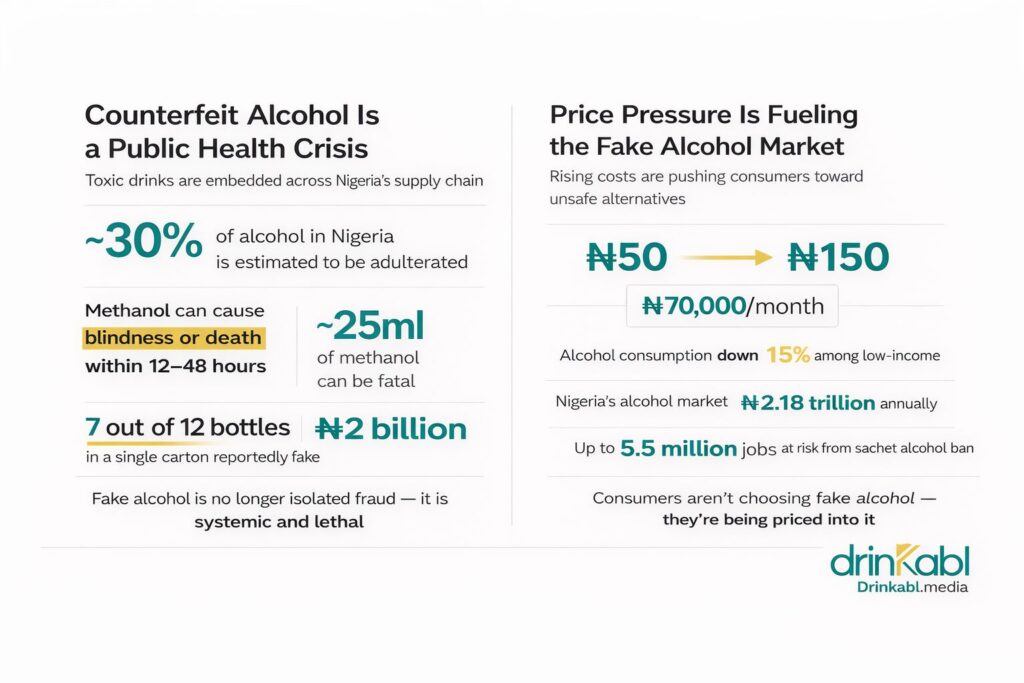
The toxin at the centre of the worst cases is methanol. It has no colour or flavour, making it particularly difficult to detect. Even small amounts can cause blindness or death within 12 to 48 hours of consumption, and late diagnosis can result in breathing disorders and lung failure. Industry experts estimate that roughly 30% of alcoholic beverages in Nigeria are adulterated, with counterfeiters substituting ethanol with cheaper but toxic methanol — a colourless, odourless substance that can cause breathing disorders, lung failure, and death even in quantities as small as 25ml. Lagos optometrist Dr Sharon Enemuoh described what she sees at the clinical end of this crisis: “Young people losing vision suddenly, breadwinners going blind overnight, families devastated by a drink they never thought could harm them.” — Dr Sharon Enemuoh, Optometrist, December 2025.
In early March 2026, the Federal High Court in Lagos convicted and sentenced two men to a combined 40 years in prison for producing and distributing counterfeit alcohol. The convicts, Otuorimuno Nelson Aziakpono, 58, and Ikegwuonu Davidson Ikechukwu, 28, were found guilty on eight counts, including possession of unwholesome products and manufacture of counterfeit beverages. Their conviction followed the December 3, 2025 enforcement operation at Kojo Street, Ijanikin, and Vespa Market, where fake versions of Hennessy VSOP, Jameson Irish Whiskey, William Lawson’s, and Gordon’s Dry Gin were among the recovered products. The sentences are the stiffest handed down in a fake alcohol case to date. The raids are real. But a 16-year veteran Lagos bartender, identified as Bankole, told investigators that at a previous posting at Elegushi Beach, up to seven of every twelve bottles in a single carton were fake. Individual vigilance has replaced systemic safety. That is the crisis in miniature.
The Economics of Poison
This cannot be understood without inflation. A rising spate of excise duties on alcoholic beverages has led to a 15% decline in consumption among low-income consumers. Sachet gin that once cost N50 now costs N150. Against a minimum wage of N70,000 per month and inflation at three-decade highs, the economics of safe drinking are simply impossible for millions of Nigerians.
“As a drink seller, the price of drinks has increased beyond what an average man could afford. With the situation of the country, what seems to be the alternative for many to ease their thinking is taking alcohol, but they have been deprived by the prices.” — Damilola Olakayode, drinks seller, Berger area, Lagos, October 2024.
When regulated alcohol prices become unattainable, people don’t stop drinking. They shift. The illicit market exists not because Nigerians are reckless, but because the formal market has priced a portion of the population out of safety. Conversations on X reflect the impossible arithmetic, with users describing the impossible choice between eating and risking a cheaper, unverified bottle. Others have flagged market stalls openly selling suspicious products with no regulatory presence in sight.
NAFDAC’s ban on alcohol packaged in sachets and PET bottles smaller than 200ml came into effect following an official directive from the Senate, though the initial enforcement had been suspended pending stakeholder consultations. The Distillers and Blenders Association of Nigeria has staged eight protests in 2026 alone, arguing the ban could displace as many as 5.5 million Nigerians from their jobs. Critics further warn it may push consumers toward ogogoro, locally distilled gin operating entirely outside the regulatory system and centuries deep in Nigerian social culture.
The Samuel Olutuyi Foundation, which has launched a national campaign against counterfeit alcohol, framed it plainly: “This is a national emergency hiding in plain sight. Beyond the staggering death toll, the economic and social consequences are devastating. Families already burdened by inflation and unemployment now face crushing medical bills, loss of income, and grief from preventable deaths.”
Detty December and a Global Warning
Every December, Nigeria hosts the world. The diaspora returns, international artists follow, and Lagos becomes the centre of the Afrobeats universe. But December 2024 had an undercurrent of dread. Party organisers, entertainment hubs, and partygoers were on high alert amid the spread of counterfeit and substandard drinks proliferating the markets. “I am sure the Casamigos I drank were fake. This is not good considering the possible health implications,” one visibly seething person told reporters. “We cannot even verify what we drink in this country,” a UK-based Nigerian in Lagos for the holidays shared. “This is supposed to be a carefree period for me but I always have to be careful that I am drinking poison.”
Posts from returnees described feeling acutely ill after club nights, with several documenting symptoms consistent with methanol exposure without initially connecting the cause. In October 2025, the UK Foreign, Commonwealth & Development Office formally added Nigeria to its official methanol poisoning travel warning list, alongside Ecuador, Japan, Kenya, Mexico, Peru, Uganda, and Russia, as part of a broader global advisory covering destinations where contaminated drinks have led to severe illnesses and fatalities among British travellers.
But Nigeria’s crisis is not a tourist story. It is domestic and systemic, embedded in a market of over 220 million people generating an estimated N2.18 trillion in annual alcohol spending, with counterfeit product woven into the supply chain at every level.
The Paradox No Tweet Can Solve
Nigerians know. They post warnings. They share tips for spotting refilled bottles. They joke about the “akuruaku hangover.” They send GoFundMe links for victims. And then the algorithm moves on, and the factories keep running.
Public health advocates are calling for a multi-pronged approach that combines technology, consumer education, and stronger regulatory oversight. Naija Liquor is deploying AI and blockchain technology to verify the authenticity of alcoholic beverages, providing consumers and retailers with a real-time way to detect fake products. It is a promising private-sector intervention. But by design it serves premium consumers, not the millions who cannot afford them.
Awareness is not safety. Knowing a risk is not the same as having the means to avoid it. Nigeria’s illicit alcohol crisis will not be solved by celebrity tweets, however viral, or Detty December TikTok guides, however well-intentioned. It requires coordinated regulatory enforcement, supply chain verification at scale, economic policy that does not price the working class out of safe consumption, and public health infrastructure that extends beyond press releases.
Until then, every night out in Lagos, Abuja, Aba, or Ogun State carries a question that no timeline can answer: is what’s in this bottle safe to drink?
Everyone is talking about it. People are still drinking it. And the system hasn’t caught up.
Further Reading
- The Safety Question Lurking in Packaged Beverages — How a product safety scandal from Australia throws a sharp light on Africa’s own beverage accountability gap, and what Nigeria’s N5 billion Aba counterfeiting bust reveals about the depth of the problem.
- Inside South Africa’s R25bn Illicit Alcohol Crisis — A deep dive into how illegal alcohol has surged 55% in South Africa since 2017, the industry task force now fighting back, and why the crisis mirrors Nigeria’s in its economic and public health dimensions.
- Crackdown Fears Grow as Illicit Alcohol Hits 60% in Kenya — The paradox of aggressive regulatory intervention in a market already dominated by illegal trade, and why Kenya’s experience offers Nigeria an important cautionary lesson.
- NAFDAC Begins Enforcement of Ban on Alcoholic Beverages in Sachets, Small Bottles — The full story of the sachet alcohol ban, the stakeholder standoff that delayed it, and what enforcement now means for Nigeria’s most price-vulnerable drinkers.
- Beverage Industry Tightens the Noose on Bottle-Theft Networks — How organised packaging theft feeds directly into the same informal economy driving counterfeiting across Nigeria, closing the loop on where fake bottles actually come from.