While multinationals quietly exit Nigeria’s beverage sector, one state government is doing the opposite, buying back industrial graveyards and daring private capital to bring them back to life.
Nigeria’s beverage ownership map is being redrawn. Diageo completed the exit of its Guinness Nigeria shareholding to Tolaram in late 2024, retaining brand exposure through licensing while retreating to an asset-light model. Coca-Cola followed suit, completing its sale of Chivita|Hollandia (CHI Limited) to UAC of Nigeria on October 3, 2025 Finelib, as Drinkabl.media has reported. Into that landscape of multinationals retreating, a state government in the southeast is doing something that cuts entirely against the grain.
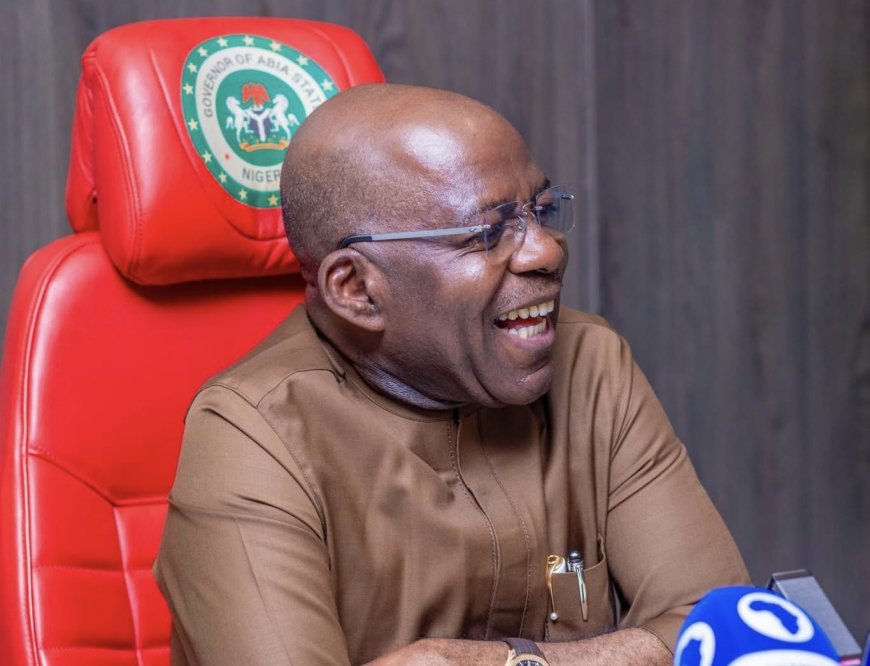
The Abia State Government has finalised the acquisition of Afro Beverages from the Asset Management Corporation of Nigeria (AMCON), marking a pivotal step in its industrial revival agenda. The announcement was made by Governor Alex Otti at his February media briefing in Umuahia.
Afro Beverages, located in Owerrinta, is one of five moribund industries the administration has earmarked for revival. The others are Star Paper Mill, Textile Mills, International Equitable Associates, and Ogwe Golden Chicken, most of them anchored in Aba, the state’s commercial hub.
“The State Government has completed the acquisition of Afro Beverages from the Asset Management Corporation of Nigeria and begun receiving expressions of interest from prospective investors. Similar investor interest is being recorded for Star Paper Mill in Owerrinta, because we prefer competent private sector operators to manage the firms sustainably.” — Governor Alex Otti
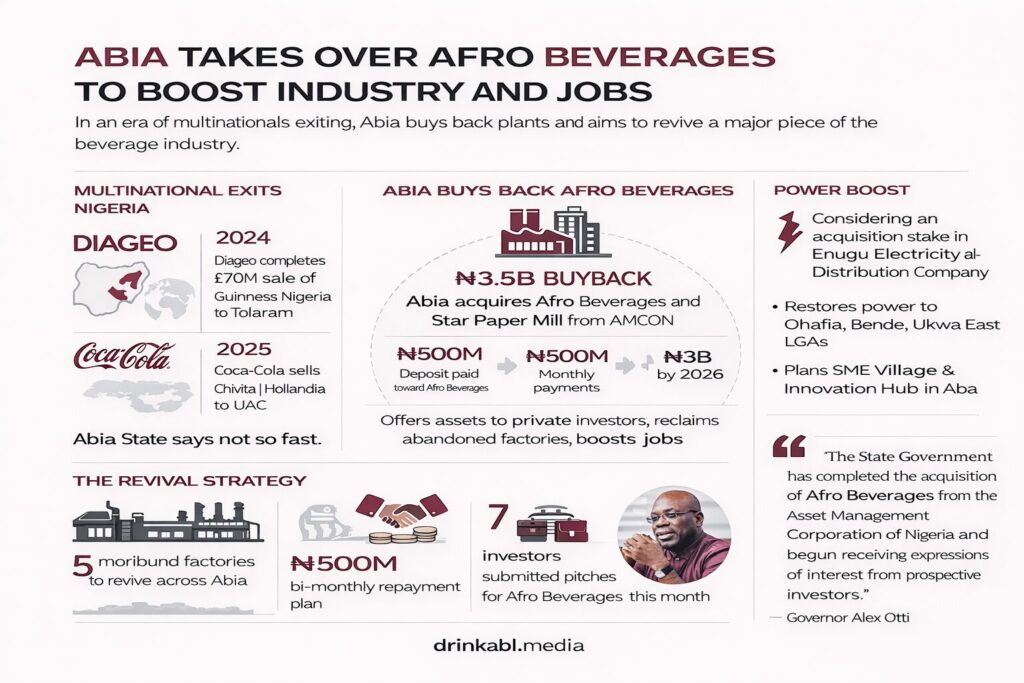
The deal has been months in the making. The state had already completed the acquisition of Star Paper Mill in a ₦2.5 billion buyback from AMCON, making an initial ₦500 million deposit toward Afro Beverages. A structured bi-monthly repayment of ₦500 million was then put in place to clear the remaining ₦3 billion balance within the 2026 fiscal year, a plan disclosed by the Commissioner for Industries and SMEs, Mike Akpara, at the Star Paper Mill handover in December 2025.
What makes the Otti model notable is its deliberate rejection of government-as-operator logic. The state is not taking over these factories to run them. It is reclaiming title from AMCON, stabilising ownership, and then opening the assets to private investors and operators who can run them on a commercial footing. As Drinkabl.media’s energy report on Nigerian beverage plants makes plain, the operational challenges facing any manufacturer in this environment, energy costs above all, are not problems a government balance sheet can absorb indefinitely.
“The State Government has taken a principled stand to support SMEs in the state, and that land has already been acquired for the project.” — Governor Alex Otti
Beyond the factories, Otti announced approval for an SME Village and Innovation Hub in Aba, a centre for technology services, device sales and repairs, with planned collaboration involving the Export Group Lab at Ogbonnaya Onu Polytechnic. The pipeline of assets under negotiation also includes International Equitable Industries, KAN Biscuits, and the completion of the Enyimba Hotel as a five-star facility.
Electricity, as always, is the binding question. The state is pursuing power restoration across Ohafia, Bende and Ukwa East local government areas, and is considering acquiring a majority stake in Enugu Electricity Distribution Company (EEDC) to facilitate electricity wheeling from Geometric Power into Umuahia. Without that piece, any revival of beverage or paper manufacturing in this corridor will face the same wall that closed these factories in the first place.
The Afro Beverages deal is, in one sense, a small transaction in a large sector. But it is the kind of move that reveals intent, and intent, in a part of Nigeria that has watched its industrial base hollow out for decades, matters enormously. Whether it bottles product again, or becomes another entry in the long ledger of well-meaning revivals, will be one of 2026’s most instructive southeast stories.
Further reading on Drinkabl.media: