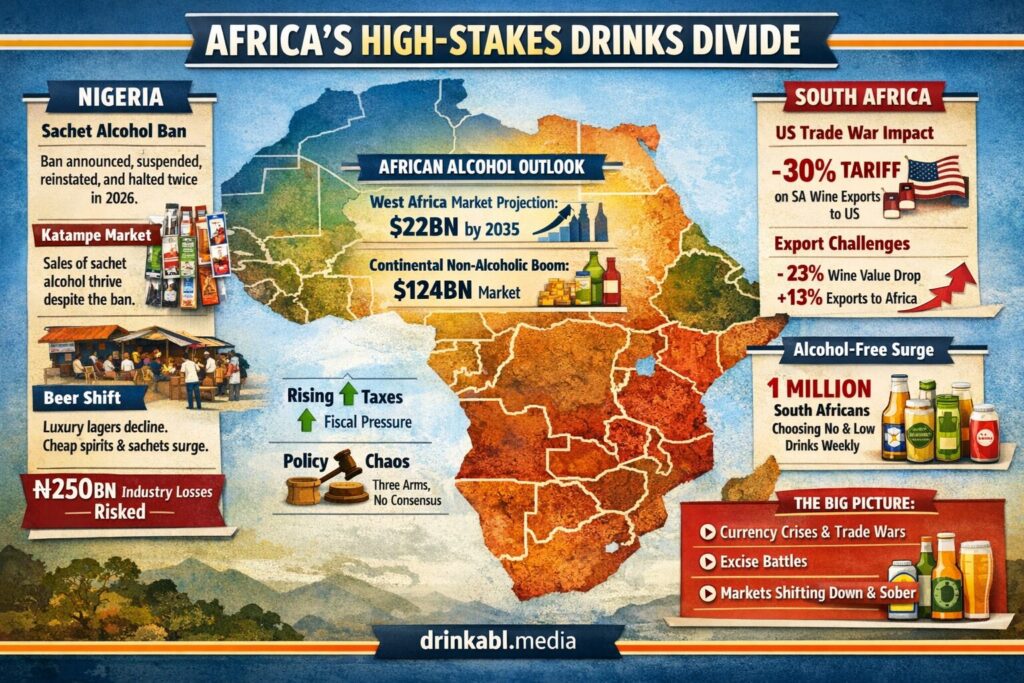
At Katampe market on the northern edge of Abuja, sachet alcohol is not smuggled. It hangs in clusters from nails, openly, casually, like ripe fruit at a roadside stall. The ban that was supposed to clear it from shelves has had a tortured journey: announced for December 2025, suspended mid-month by the Office of the Secretary to the Government of the Federation citing economic and security risks, then resumed on January 21, 2026 after NAFDAC cited a fresh Senate resolution, only for the Federal Government to again order a halt to enforcement in February. As of today, the policy is technically active, politically contested, and practically incomplete. Three arms of government are pulling in different directions. NAFDAC’s Director-General says the ban is protective. The presidency says it is disruptive. A Federal High Court case brought by SERAP is pending. And at Katampe market, Kingsley the wholesaler shrugs.
“Omo I no know ooh,” he said in Pidgin. “Why dem even ban am sef? I go sell this one finish before I stop. Na money I use to buy am.”
A few stalls down, Aliue Kabiru was blunter. “Many people still dey sell am. E be like dem never serious about am.” He gestured across the market, at five other stalls selling the same thing.
That scene, policy on paper, commerce on the street , is, in miniature, the story of Africa’s alcohol industry right now. A continent where the formal industry is fighting for survival under the weight of currency collapses, punishing excise regimes, and trade wars it didn’t start. And yet the actual drinking, formal, informal, sachet and bottle , continues largely on its own terms.
The world’s biggest alcohol groups, meanwhile, are in structural retreat. Diageo’s operating profit fell 27.8% last year. Pernod Ricard offloaded Jacob’s Creek, Brancott Estate, and Campo Viejo in a single move, exiting wine almost entirely. Carlsberg’s core beer fell below half of total revenue for the first time in the company’s history. Globally, alcohol consumption has fallen 12% since 2010, and the numbers have not recovered.
Africa is not in that story. Not really. The continent’s beer market alone is projected to grow from $44 billion to $74.65 billion by 2033. West Africa’s alcoholic beverages market is expected to nearly double to $22.21 billion by 2035. These are not struggling markets. They are markets mid-stride.
The question is whether Africa can get its policy, investment, and innovation in order fast enough to take full advantage, or whether a combination of punitive taxation, trade shocks, and missed category opportunities lets that potential run dry.
Nigeria: When a Mainstream Lager Becomes a Luxury
When Hans Essaadi stood before Nigerian Breweries investors in early 2024 to explain a ₦106 billion loss, the line that landed hardest had nothing to do with foreign exchange exposure or fuel subsidy removal. It was simpler, and far more damning.
“Consumers,” he said, “are no longer able to afford a Goldberg after a hard day’s work.“
Goldberg. A mainstream lager. Not a craft beer at a rooftop bar in Victoria Island. The fact that it had become financially out of reach for ordinary workers told you everything about what inflation, naira devaluation, and a badly timed global slowdown had done to Africa’s largest beer market.
What happened next is the part that does not show up in the profit-and-loss statements. Consumers did not stop drinking. They moved down. Euromonitor confirms it: volume growth in Nigeria’s alcohol market in 2024 was driven almost entirely by economy brands, cheaper gins, bitters, and budget lagers. As consumer purchasing power declined, categories dominated by economy brands posted the strongest growth, while mainstream lager contracted. Below that, at the very bottom of the affordability chain, sat the sachet.
A 25ml hit of Chelsea gin or Action bitters for the price of almost nothing. Ambrose Omokordion, Chief Research Officer at Investa, put it plainly in a note to Business Hallmark: “The loss of sachet products, which are designed for low-income, high-volume markets, threatens a major revenue stream.” The companies most exposed, Intercontinental Distillers, Nigeria Distilleries, Stellar Beverages, are now urgently retooling factories for larger formats. Whether consumers follow them up the price ladder, or simply move to the unregulated market that NAFDAC cannot yet control, is the central question hanging over Nigeria’s drinks sector in 2026.
Which brings us back to that contested ban. Originating in a 2018 MOU between NAFDAC, the Federal Ministry of Health, and industry groups, the phase-out deadline was extended twice, first to January 2024, then to December 2025. When December came, the Senate backed enforcement. The OSGF suspended it. NAFDAC resumed on January 21 citing the Senate. The Federal Government halted enforcement again on February 11, with the OSGF and National Security Adviser jointly warning that warehouse sealing was already causing economic disruption and “creating conditions that could pose wider security risks.” The Manufacturers Association of Nigeria called for the policy to be shelved entirely. The Association of Community Pharmacists called the government’s reversal “a troubling setback for evidence-based regulation.” Right now, no one knows what comes next.
That regulatory chaos is the backdrop against which Nigeria’s Beer Sectoral Group, representing Nigerian Breweries, Guinness Nigeria, and International Breweries, is simultaneously fighting a proposed three-year excise framework. As we reported in detail, PwC analysis submitted to the Federal Ministry of Industry, Trade and Investment puts the potential industry losses at ₦425 billion, with further strain on a sector that supports over 30,000 direct jobs and sources approximately 300 metric tonnes of grain locally. The sector returned to profitability only in Q4 2024, with Q1 2025 showing a 148% year-on-year jump in profit after tax. That recovery is precisely what is being wagered.
“Excise measures must remain balanced and predictable to support long-term business planning.” — John Owan Enoh, Minister of State for Industry, Trade and Investment
The minister’s words were measured. His room for manoeuvre is not. The World Bank has simultaneously pressed Abuja to raise excise duties on alcohol, tobacco, and sugary drinks as a condition of a $750 million non-oil revenue reform loan. The government is being pulled in opposite directions by an international lender and a domestic industry both claiming the fiscal high ground. How Nigeria resolves that tension over the next twelve months will shape the drinks industry across the continent, not just in Lagos and Abuja.
South Africa: Caught in Someone Else’s Trade War
At the other end of the continent, the pain arrived differently but no less directly.
Jannie Strydom, CEO of Agri Western Cape, did not mince words when the 30% US tariff on South African exports landed in August 2025: “For the primary agricultural sector in the Western Cape, it will have a severe impact, given the fact that under the AGOA agreement, it was a non-tariff agreement.” He called on government to urgently establish new markets. Months on, that search is still happening.
The numbers from 2025 are stark. Packaged wine exports to the US fell 21% in volume and 23% in dollar value. UNCTAD’s February 2026 global trade update showed US imports of South African goods falling 11% in Q3 2025, then plunging 39% in Q4. South African wine is now 17 percentage points more expensive on American shelves relative to competing imports than it was in 2024. Chile faces a 10% tariff. The math is devastating.
The compounding effect is what makes this particularly brutal for an industry navigating structural headwinds already. As we reported last week, as French and Italian producers lose their own US access, they redirect surplus wine to Europe, South Africa’s primary export markets, creating oversupply and driving down prices in Germany, the UK and Belgium. A US trade war is damaging South African wine in markets where America is not even competing.
“Our produce is of a very high standard, but the US market is price-sensitive. If buyers switch to lower-cost alternatives, the impact will be severe.” — Jannie Strydom, CEO, Agri Western Cape
The R56.5 billion the wine industry contributes to South Africa’s GDP, and the 270,000 people employed across the value chain, are not abstract figures. In the Franschhoek and Stellenbosch valleys — communities where wine is not just an industry but the entire economy, lost shelf space in Columbus, Ohio translates into fewer seasonal contracts, reduced hours, and quieter cellars.
There is a brighter thread, and it matters. Africa picked up some of the slack. Exports to the continent rose 13% to $55 million in 2025: Kenya up 10%, Zambia up 22%, Uganda up 24%. Despite the US shock, South Africa’s agricultural sector as a whole closed 2025 at a record $15.1 billion in total exports , producers adapted, pivoted, found buyers elsewhere. The American dream is on hold for the Western Cape’s winemakers. The African opportunity is only beginning.
The Sober Surprise: A Million South Africans Alternating
Here is the data point that deserves more attention than it is getting.
Close to a million South Africans are now reaching for a non-alcoholic beer, cider or gin in any given week — up from 666,000 just twelve months ago. In a country where the WHO puts per-capita consumption at 7.8 litres annually, fifth highest in the world among active drinkers, that is not a wellness niche. That is a cultural shift.
What makes the data more interesting is the composition of that shift. Fewer than 5% of this new cohort are abstainers. The rest are alternators, people swapping every second or third drink for a zero, staying at the same social occasion, spending the same money, but choosing differently for some of those rounds. The categories are not cannibalising each other. They are growing together.
This is the “Zebra Striping” behaviour that Carlsberg has built an entire product architecture around in Europe, 100 scientists in a Copenhagen laboratory, 50 new alcohol-free launches in 2025 alone. Diageo’s non-alcoholic portfolio grew 40% organically last fiscal year. Pernod Ricard took a stake in Almave, the Lewis Hamilton-backed non-alcoholic agave spirit. These products will arrive on African shelves. The question for local producers is whether their own alternatives are already there when that happens, or whether they cede the no-and-low category to multinationals by default.
The timing matters too. With Ramadan and Lent converging simultaneously for the first time since 1863 , covering virtually the entire country of Nigeria from north to south in a shared season of restraint, the demand signal for non-alcoholic alternatives right now is louder than at any point in living memory. It is a six-week window. Most brands in the no-and-low category are not ready for it.
The Larger Picture
Pull back and the picture is complex rather than catastrophic, which is different, and important.
As our 2026 industry overview documents, from Lagos to Nairobi and Casablanca to Cape Town, Africa’s beverages consumers are drinking more intentionally, trading up where their wallets allow, and reaching for categories that barely existed five years ago. The non-alcoholic sector alone is projected at $124 billion across the continent. Nigeria’s brewery industry holds its position as Africa’s second-largest beer producer. South Africa holds 24.7% of continental beer market share. These are durable foundations.
None of that growth is guaranteed. It needs fiscal environments that do not strangle recovering industries with blunt excise instruments. Trade frameworks that give exporters a fighting chance. Distribution infrastructure that can reach a consumer in Kano or Kisumu as reliably as one in Johannesburg. And a regulatory conversation about no-and-low that treats African consumers as the health-aware, increasingly discerning adults they are becoming, not a residual market for products designed elsewhere.
The Goldberg moment was a warning. The Katampe market scene is a warning. Affordability crises do not simply compress demand, they redirect it, underground, into margins where no brand and no government collects anything, and where the public health cost mounts quietly.
The global alcohol industry is in retreat. Africa doesn’t have to follow it there. But that outcome has to be built, market by market, regulation by regulation, bottle by bottle.
READ YOUR SIPS — Further Reading on Drinkabl.Media:
- Nigeria’s Brewers Sound the Alarm on Three-Year Excise Plan, With ₦425bn on the Line
- South Africa’s Wine Industry Faces Existential Reckoning As US 30% Tariff Hits Harder
- Alcohol-Free Beer Is No Longer the Odd One Out
- Rising Costs, Brand Switching, and Public Health Risks: The Triple Threat of Inflation
- Faith, Fasting & FMCG Beverages: The 2026 Trade Reality
- How Health, Innovation, and Youthful Demands Are Driving Africa’s Beverage Industry in 2026
- Major Alcohol Producers Face Historic Inventory Crisis As Global Demand for Premium Spirits Drops