For six and a half decades, Coca-Cola has done something remarkably simple and remarkably difficult: raised the amount of money it sends to shareholders every single year. On Thursday, the Coca-Cola Company’s Board of Directors upheld that tradition, approving a roughly 4 percent increase in its quarterly dividend, from 51 cents to 53 cents per common share, cementing the company’s standing as one of the world’s most durable income investments.
Annualised, that translates to $2.12 per share, up from the $2.04 paid throughout 2025. Shareholders of record as of March 13 will receive the first quarterly payment on April 1.
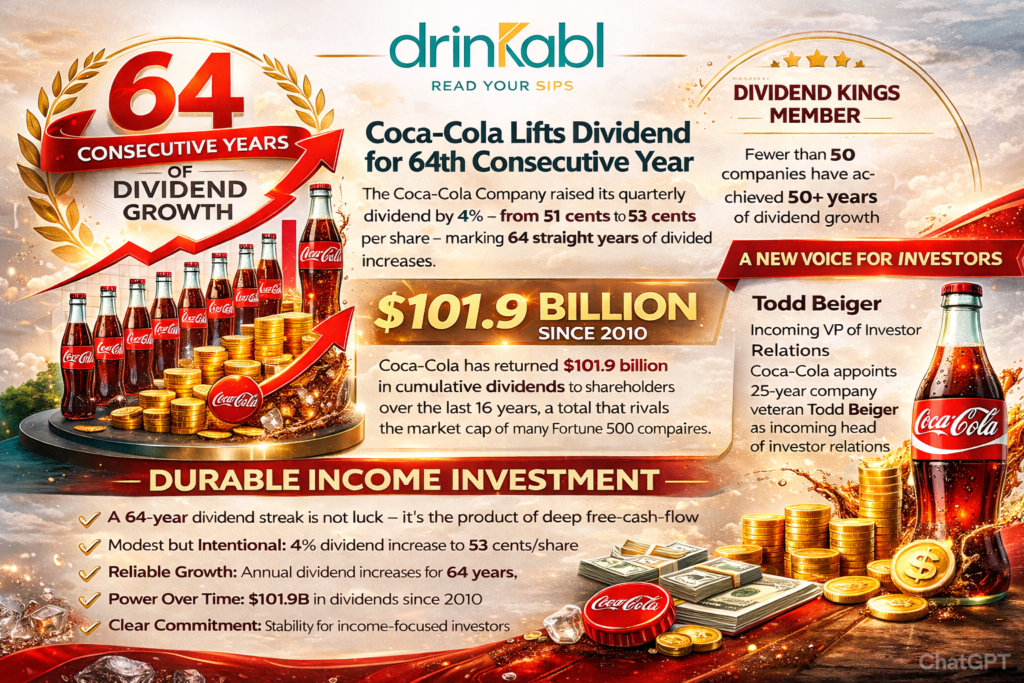
The numbers frame a company that treats its dividend not as a quarterly afterthought but as a core commitment to its identity. Since January 1, 2010 alone, Coca-Cola has returned a cumulative $101.9 billion in dividends to shareholders , a figure that rivals the entire market capitalisation of many Fortune 500 peers.
Since 2010 alone, Coca-Cola has returned more than $101 billion in dividends , a figure that rivals the entire market cap of many Fortune 500 peers.— Markets Desk Analysis
Membership in the so-called S&P 500 Dividend Aristocrats, companies that have raised dividends for at least 25 consecutive years, is coveted. At 64 years, Coca-Cola sits in an even rarer tier: the Dividend Kings, a group of fewer than 50 publicly traded U.S. companies to have achieved half a century or more of unbroken annual increases. The streak has survived recessions, pandemics, currency crises, and sweeping shifts in consumer taste.
“A 64-year dividend streak is not luck, it is institutional architecture. It reflects deep free-cash-flow discipline baked into the company’s operating model over generations.”
A New Voice for Investors
Alongside the dividend announcement, Coca-Cola’s board made a quieter but strategically meaningful move: electing Todd Beiger as vice president and incoming head of investor relations, effective March 31. He succeeds Robin Halpern in the role.
Beiger’s appointment is notable less for its novelty than for its depth of institutional pedigree. He first joined Coca-Cola in 2001 as a corporate mergers and acquisitions manager, a formative period when the company was navigating the aftermath of a major accounting restatement and rebuilding trust with investors. Over the subsequent 25 years, he has moved steadily through senior finance roles, played a central part in the complex refranchising of U.S. bottling territories, a multiyear restructuring that fundamentally shifted Coca-Cola toward an asset-light model , and spent more than five years within the investor relations function itself.
Most recently, Beiger has served as CFO of Costa Limited, the coffee chain Coca-Cola acquired from Whitbread in 2019 for £3.9 billion, operating within the company’s Europe unit. That posting gave him front-line exposure to Coca-Cola’s non-carbonated growth ambitions at a time when the category is under increasing competitive and margin pressure.
The choice signals that Coca-Cola wants its investor-facing voice to carry genuine operational credibility, someone who can speak fluently about refranchising economics, category diversification, and long-term capital allocation, not just quarter-to-quarter earnings guidance.
What 53 Cents Signals to the Market
The 4 percent increase is modest but intentional. It tracks broadly with the company’s underlying organic revenue growth trajectory while remaining well within its free-cash-flow capacity, a balance Coca-Cola has historically prioritised over higher but potentially unsustainable payout ratios.
In an environment where interest rates remain elevated and bond yields compete with equity income for institutional capital, a reliable, growing dividend retains real power as a portfolio anchor. Coca-Cola’s shares (NYSE: KO) have long been held as much for income stability as for capital appreciation, and Thursday’s announcement does nothing to disturb that proposition.
For income-focused investors, the message is clear: the streak continues, the payout grows, and the machinery behind both remains intact.
Coca-Cola lifts its dividend for the 64th consecutive year, a streak few companies on earth can match, while quietly positioning a seasoned insider to reshape how it tells its own story to Wall Street.
Markets Desk|February 20, 2026|4 min read
For six and a half decades, Coca-Cola has done something remarkably simple and remarkably difficult: raised the amount of money it sends to shareholders every single year. On Thursday, the Coca-Cola Company’s Board of Directors upheld that tradition, approving a roughly 4 percent increase in its quarterly dividend — from 51 cents to 53 cents per common share , cementing the company’s standing as one of the world’s most durable income investments.
Annualised, that translates to $2.12 per share, up from the $2.04 paid throughout 2025. Shareholders of record as of March 13 will receive the first quarterly payment on April 1.
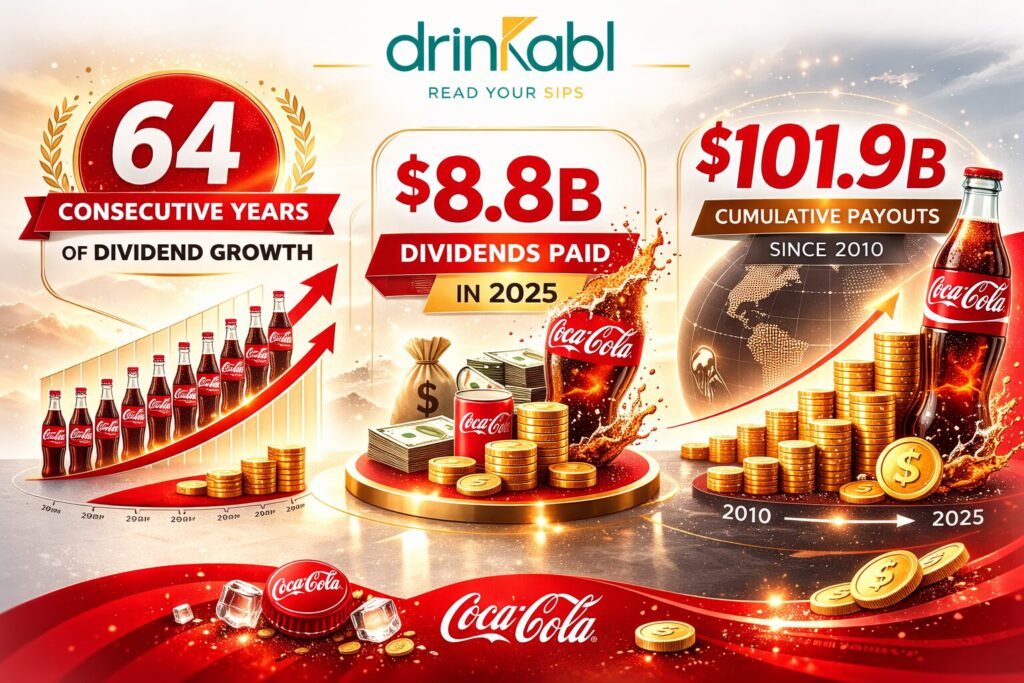
The numbers frame a company that treats its dividend not as a quarterly afterthought but as a core commitment to its identity. Since January 1, 2010 alone, Coca-Cola has returned a cumulative $101.9 billion in dividends to shareholders, a figure that rivals the entire market capitalisation of many Fortune 500 peers.
Since 2010 alone, Coca-Cola has returned more than $101 billion in dividends , a figure that rivals the entire market cap of many Fortune 500 peers.— Markets Desk Analysis
Membership in the so-called S&P 500 Dividend Aristocrats, companies that have raised dividends for at least 25 consecutive years, is coveted. At 64 years, Coca-Cola sits in an even rarer tier: the Dividend Kings, a group of fewer than 50 publicly traded U.S. companies to have achieved half a century or more of unbroken annual increases. The streak has survived recessions, pandemics, currency crises, and sweeping shifts in consumer taste.
“A 64-year dividend streak is not luck, it is institutional architecture. It reflects deep free-cash-flow discipline baked into the company’s operating model over generations.”
A New Voice for Investors
Alongside the dividend announcement, Coca-Cola’s board made a quieter but strategically meaningful move: electing Todd Beiger as vice president and incoming head of investor relations, effective March 31. He succeeds Robin Halpern in the role.
Beiger’s appointment is notable less for its novelty than for its depth of institutional pedigree. He first joined Coca-Cola in 2001 as a corporate mergers and acquisitions manager, a formative period when the company was navigating the aftermath of a major accounting restatement and rebuilding trust with investors. Over the subsequent 25 years, he has moved steadily through senior finance roles, played a central part in the complex refranchising of U.S. bottling territories , a multiyear restructuring that fundamentally shifted Coca-Cola toward an asset-light model, and spent more than five years within the investor relations function itself.
Most recently, Beiger has served as CFO of Costa Limited, the coffee chain Coca-Cola acquired from Whitbread in 2019 for £3.9 billion, operating within the company’s Europe unit. That posting gave him front-line exposure to Coca-Cola’s non-carbonated growth ambitions at a time when the category is under increasing competitive and margin pressure.
The choice signals that Coca-Cola wants its investor-facing voice to carry genuine operational credibility — someone who can speak fluently about refranchising economics, category diversification, and long-term capital allocation, not just quarter-to-quarter earnings guidance.
What 53 Cents Signals to the Market
The 4 percent increase is modest but intentional. It tracks broadly with the company’s underlying organic revenue growth trajectory while remaining well within its free-cash-flow capacity, a balance Coca-Cola has historically prioritised over higher but potentially unsustainable payout ratios.
In an environment where interest rates remain elevated and bond yields compete with equity income for institutional capital, a reliable, growing dividend retains real power as a portfolio anchor. Coca-Cola’s shares (NYSE: KO) have long been held as much for income stability as for capital appreciation, and Thursday’s announcement does nothing to disturb that proposition.
For income-focused investors, the message is clear: the streak continues, the payout grows, and the machinery behind both remains intact.