
A Cabinet-approved policy banning supermarket sales, home deliveries and raising the drinking age to 21 has set off a fierce industry backlash, and raised a question nobody wants to answer: what happens when the legal market shrinks and the illegal one doesn’t?
NAIROBI, Kenya’s alcohol regulators launched what they called a landmark national policy last July. Industry executives called it a one-way door to a bigger crisis. Eight months on, neither side has blinked, and the numbers keep getting worse.
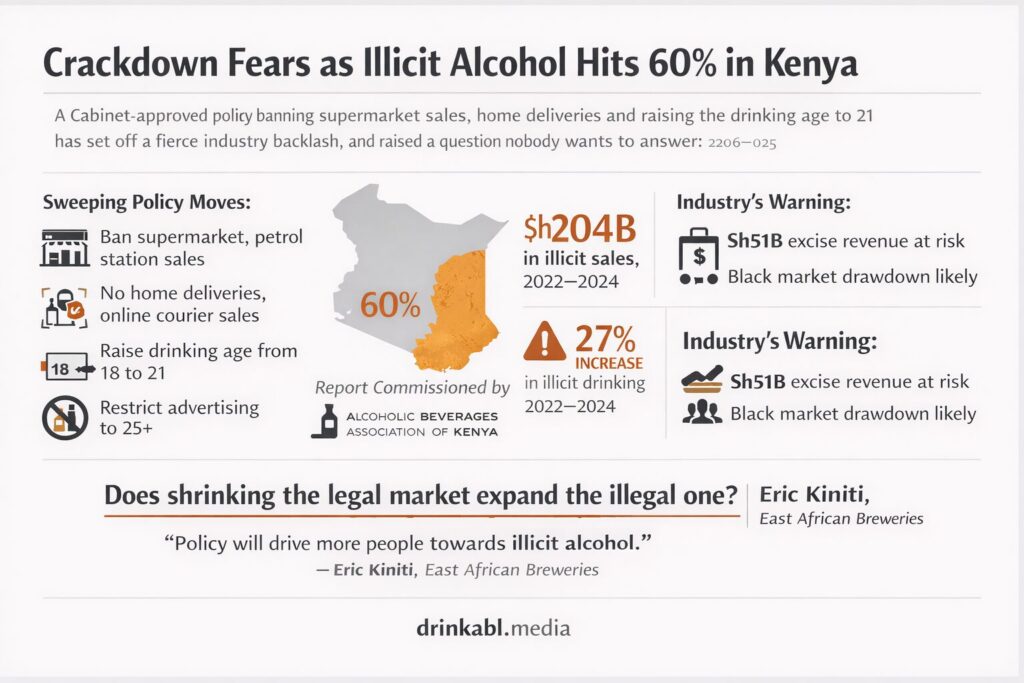
A Euromonitor International report commissioned by the Alcoholic Beverages Association of Kenya (ABAK) found that 60 percent of all alcohol consumed in Kenya between 2022 and 2024 was illicit, generating an estimated Sh204 billion in sales that never touched a tax register, a health inspector, or a licensed retailer. Illicit consumption rose 27 percent over the same period, outpacing growth in the legal market on every metric.
Then, on July 30, 2025, the National Authority for the Campaign Against Alcohol and Drug Abuse unveiled its most aggressive policy framework to date: ban alcohol sales in supermarkets, restaurants, online platforms, petrol stations and residential areas; prohibit home deliveries and courier sales entirely; restrict advertising to those over 25; and raise the legal drinking age from 18 to 21.
“There is no way to collect tax from illicit traders. This policy will drive more people towards illicit alcohol.”Eric Kiniti, Corporate Relations Director, East African Breweries Ltd
Kiniti’s warning echoes a pattern Kenya knows well. The 2015 collapse of the millet-based spirits sub-sector, crushed by sudden excise hikes, took down legal producers, contracted farmers and anticipated tax revenues simultaneously, while the illicit market absorbed the displaced consumers without missing a step.
The stakes are substantial. Kenya’s formal alcohol sector generated Sh51 billion in excise duty in 2023 and Sh366 billion in total revenue, a fiscal base that analysts warn could erode sharply if NACADA’s proposals pass into binding law. The policy is currently a framework, not a statute, and NACADA CEO Anthony Omerikwa has said any enforcement regulations will go through formal public participation. Critics, however, note that the Cabinet approved the framework on June 24, 2025, signalling serious political intent.
The public health backdrop is not abstract. According to the WHO, Kenya records 14,000 alcohol-related deaths every year, more than tobacco and COVID-19 combined in a typical year. Chang’aa, the unregulated grain spirit whose name translates roughly as “kill me quick,” has been documented with ethanol concentrations ranging from 25 to 98 percent by volume, and is frequently adulterated with methanol to accelerate fermentation. In February 2024, 17 people died in Kirinyaga County after drinking at a single bar, with more than ten others left permanently blind. A bar owner and several police officers were subsequently charged with murder.
“Teenagers are ordering alcohol from their phones and getting it delivered to their homes. This must stop.”NACADA, statement on digital alcohol sales, July 2025
NACADA’s data shows that approximately 4.7 million Kenyans aged 15 to 65 consume alcohol, with the 18-to-24 bracket registering the highest prevalence. One in ten high school students admits to drinking. NACADA’s head of enforcement Nicholas Kosgey, speaking during a crackdown in Uasin Gishu in September 2025, said that over 30 percent of young people in the region were affected by substance abuse.
Industry bodies and small traders have pushed back hard. The Metropolitan Small and Medium Liquor Traders Association warned of mass unemployment across a value chain spanning boda boda riders, supermarket cashiers, warehousing and logistics. ABAK pointed out the central contradiction: “Regardless of the current legal drinking age of 18 years, Kenyans have more access to illicit alcohol than they do to legal alcohol.” Raising the age to 21, the association argued, would not change that arithmetic, it would worsen it, by pushing the 18 to 20 cohort further toward unregulated brews rather than eliminating their consumption.
The enforcement track record lends weight to that concern. A 2024 assessment found that enforcement remains fragmented, with overlapping agencies duplicating effort and local political interests frequently shielding illegal operators. Post-Kirinyaga crackdowns saw eight local administrators interdicted, and then quietly reinstated months later, with officials citing courts that repeatedly freed arrested suspects and returned confiscated stock.
Kenya is not alone in confronting this paradox. Nigeria’s regulator NAFDAC recently drew a sharp line between sachet and bottled alcohol enforcement, wary of the same blowback effect. Uganda, Kenya’s primary source of illegally smuggled ethanol costing Sh8.6 billion in lost taxes in 2024 alone, has faced its own parallel crisis with unregulated spirits.
For now, Kenya’s policy debate remains unresolved and the illicit market remains open. The question NACADA and its critics are circling, without quite saying it plainly, is whether the goal is a healthier country or a tidier rulebook, and whether, in a market where six in ten drinks already flow outside the law, those two things are still the same.
Related on Drinkabl