November validation workshop sets stage for industry transformation as Nestlé, Danone, Promasidor intensify local production investments
Nigeria’s push to overturn its $1.5 billion annual dairy import dependency gained critical momentum in November 2025 when the Minister of Livestock Development convened stakeholders in Abuja to validate the Implementation Framework of the National Dairy Policy—a strategic platform designed to translate policy into tangible results.
The two-day workshop, held on November 4-5, 2025, brought together senior government officials, industry players, researchers and development partners to align on practical steps for repositioning Nigeria’s dairy sector. The timing coincides with major dairy multinationals ramping up investments in local production infrastructure across the continent, signaling a fundamental shift in how global dairy giants approach the Nigerian market.
Nigeria’s Dairy Gap in Sharp Focus
Nigeria, home to more than 20 million cattle, produces approximately 700 million litres of milk annually—less than half of the estimated 1.6 billion litres of national demand. This supply gap represents both a critical challenge and a massive commercial opportunity for private sector investors.
According to market projections, Nigeria’s dairy sector is expected to grow from 1.60 billion litres in 2024 to 2.11 billion litres by 2034, representing a 2.80% compound annual growth rate.
Policy Framework Emphasizes Backward Integration
Declaring the validation workshop open, Minister of Livestock Development Idi Maiha described the exercise as critical to moving Nigeria from being a consumer of imported milk to a producer nation. He stressed that continued dependence on imports was unsustainable for a country with such vast livestock resources.
Representing the Minister of State for Industry, Trade and Investment, Dr. Adedeji Adeshile reaffirmed the Federal Government’s commitment to the policy as a driver of industrial growth, job creation and food security. “This supply gap is both a challenge and an opportunity,” he noted. “The Implementation Framework being validated today is a crucial step in operationalising the National Dairy Policy.”
“The Implementation Framework of the National Dairy Policy aligns government and private sector efforts to achieve self-sufficiency in milk production.” — Dr. Adedeji Adeshile, Senior Special Adviser on Policy and Governance, Ministry of State for Industry, Trade and Investment
M.D. Abubakar, president of the Commercial Dairy Ranchers Association of Nigeria (CODARAN), described the framework as a roadmap for systematic development of the dairy industry. He emphasized the importance of backward integration—where dairy processors invest in local milk production, feed formulation and breeding programmes—as the most sustainable route to self-reliance.
Global Dairy Giants Shift Strategy
The policy validation comes as multinational dairy companies operating in Nigeria are fundamentally rethinking their business models in response to both economic pressures and policy incentives.
Nestlé Nigeria: Scaling Up Local Production
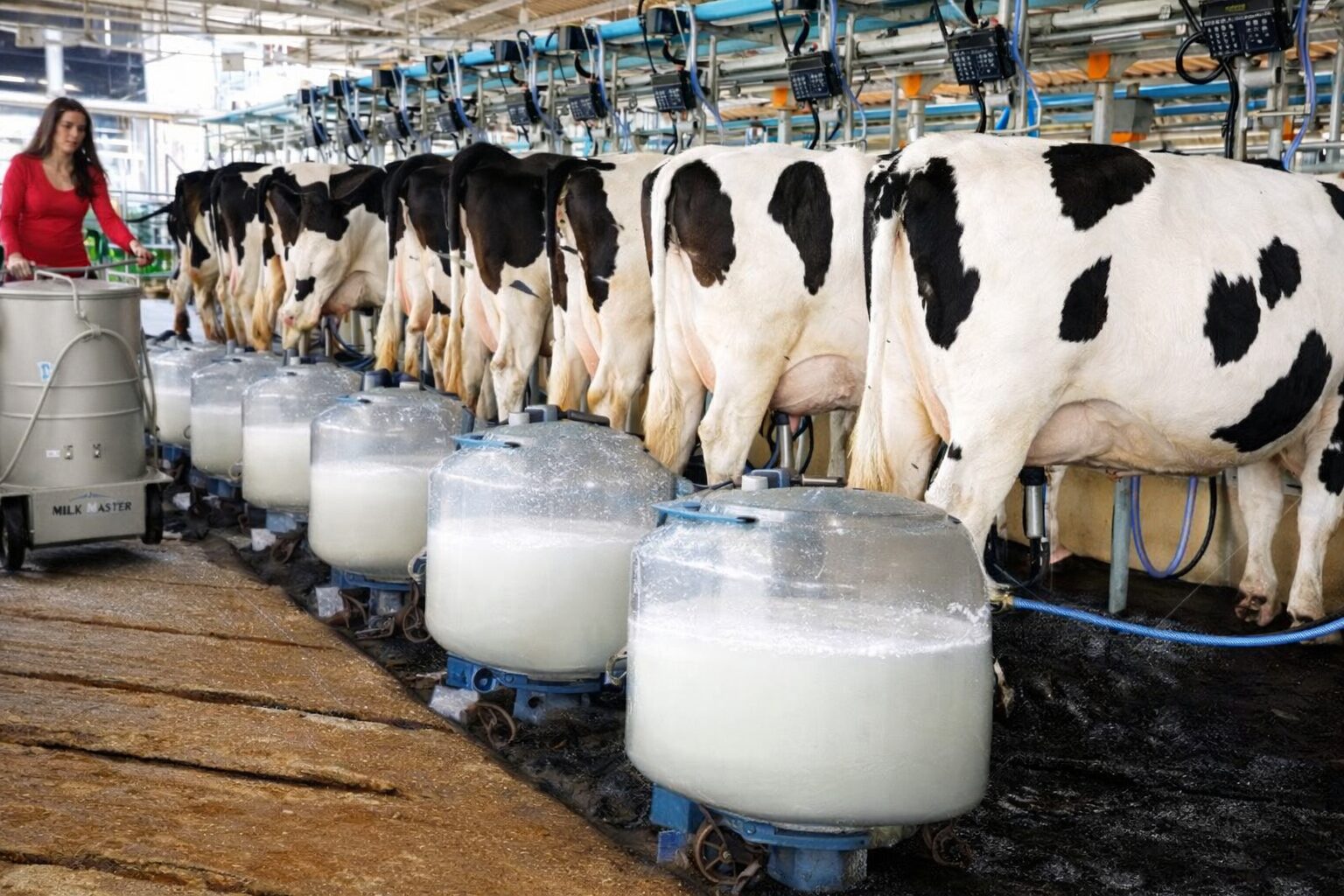
Nestlé Nigeria, in collaboration with the Federal Capital Territory Administration, has announced plans to increase daily milk production to 30,000 litres by November 2027 at its demonstration dairy farm at Paikon Kore Grazing Reserve in Abuja.
The project, which has received over ₦1.8 billion in investment since 2019, integrates advanced technologies including semi-automated milking systems, sustainable waste management, and artificial insemination. Daily milk collection has already surged from 200 litres in 2021 to 6,000 litres, demonstrating the viability of commercial dairy operations in Nigeria.
Alexandra Pecoux, global external communications manager for Danone, revealed in August 2025 that the company is “investing in local milk capabilities and supply chain in Ibadan, Nigeria,” allowing it to “reduce consumption of imported milk powder by using fresh local milk.”
“Over the course of the next decade, we foresee an exponential boom for protein needs in Africa. Dairy is uniquely positioned to address this nutritional requirement, in a health-focused, cost effective, sustainable way, and we are ramping up to address this opportunity.” — Alexandra Pecoux, Global External Communications Manager, Danone
Danone’s Africa operations, which include partnerships with over 200,000 farmers across the continent, are actively supporting the establishment and professionalization of milk collection infrastructure to help farmers secure reliable market access. The company emphasizes that “resilience of our supply chains is a key priority,” with focuses on localization, contingency planning, and dynamic management of safety stock.
Promasidor’s Ikun Model Gains Attention
While multinationals adjust their strategies, Nigerian FMCG player Promasidor has emerged as a case study in successful backward integration through its Ikun Dairy Farm in Ekiti State.
Established in 2019 in partnership with the Ekiti State government with an initial $5 million investment, the 500-hectare facility now hosts over 750 high-yielding cattle, making it Nigeria’s largest dairy farm. The operation has created over 200 direct jobs and more than 1,000 indirect employment opportunities in surrounding communities.
François Gillet, CEO of Promasidor Nigeria, said the company’s investment in the farm has significantly boosted local dairy output while creating a sustainable framework that supports national economic development. The farm utilizes advanced dairy management systems, including routine artificial insemination techniques designed to achieve maximum heifer births for sustainable herd growth.
To ensure feed security, Promasidor has cultivated over 500 hectares of maize and soybeans, guaranteeing consistent, high-quality nutrition for the herd while creating additional agricultural employment.
In May 2025, Promasidor launched the “Ikun Milk Day” initiative, distributing fresh milk weekly to primary school children in the Ikun community—addressing Nigeria’s critical malnutrition challenge where approximately one in three children under five suffers from stunting.
Industry Challenges Remain Formidable
Despite the policy momentum and private sector investments, dairy companies operating in Nigeria continue to face significant operational challenges.
According to industry reports from October 2025, inflation remains a major concern. Danone’s spokesperson noted that “inflation remains a challenge in some markets like Nigeria, Egypt, etc. Combined with repeated devaluations, it puts a lot of pressure on the cost of our products, and in turn, on the prices we are able to offer to our consumers.”
“Rising feed costs and limited access to credit prevent farmers from investing in improvements, while fragmented value chains reduce profit margins in Africa,” Pecoux added, explaining why Danone is “always looking at productivity initiatives to drive efficiency and mitigate the inflation impact.”
The African Dairy Paradox
Nigeria’s challenges mirror broader continental trends. According to recent analysis, Africa controls 20% of the world’s cattle but produces just 5% of global milk, while importing 80% of dairy consumption. The continent imports $7.5 billion in dairy products annually, with projections suggesting this could reach $15 billion by 2035 without significant production increases.
Research indicates that only 1-7% of locally produced milk in West Africa enters formal trade channels, highlighting the infrastructure gap that the National Dairy Policy aims to address.
Technology and Innovation as Game Changers
Industry leaders see digital transformation and local sourcing as critical to overcoming supply chain disruptions. Nestlé reports using “local sourcing, supplier development, and digital tools” such as advanced replenishment solutions that have “improved delivery speed and reduced human error.”
Conny Sethaelo, corporate affairs director for Nestlé East and Southern Africa region, emphasized that the company sees “immense potential for dairy growth in Southern Africa” through scaling up regenerative practices and empowerment of young agripreneurs.
National Livestock Growth Strategy Provides Framework
The validated dairy policy framework operates within Nigeria’s broader National Livestock Growth Acceleration Strategy (NL-GAS 2025-2035), which aims to more than double the livestock sector’s GDP contribution from $32 billion to $74 billion by 2035.
The strategy emphasizes genetic upgrades, improved animal health, better feed systems, and increased access to finance. Policy-driven measures include tax breaks, duty waivers, farmer training, and women and youth empowerment programmes designed to develop a strong dairy value chain.
Prof. Attahiru Jega, speaking on behalf of the Presidential Livestock Reforms Implementation Committee during the November validation workshop, called for stronger institutional capacity, private sector-led innovation, and Nigeria’s participation in the International Dairy Federation to benchmark global best practices.
Path to Self-Sufficiency
With Nigeria’s population projected to nearly double to 400 million by 2050, the urgency of achieving dairy self-sufficiency intensifies. The validated implementation framework represents a critical step toward bridging the production-consumption gap.
Participants at the November workshop expressed strong support for the framework and reaffirmed their collective resolve to build a competitive and resilient dairy economy. The framework calls for establishing a National Dairy Development and Milk Marketing Board alongside a dedicated development fund to coordinate value chain activities.
As dairy multinationals recalibrate their African strategies and local producers like Promasidor demonstrate viable production models, the National Dairy Policy’s success will ultimately depend on sustained collaboration between government, private sector, and development partners—exactly the kind of alignment that the November validation workshop sought to achieve.