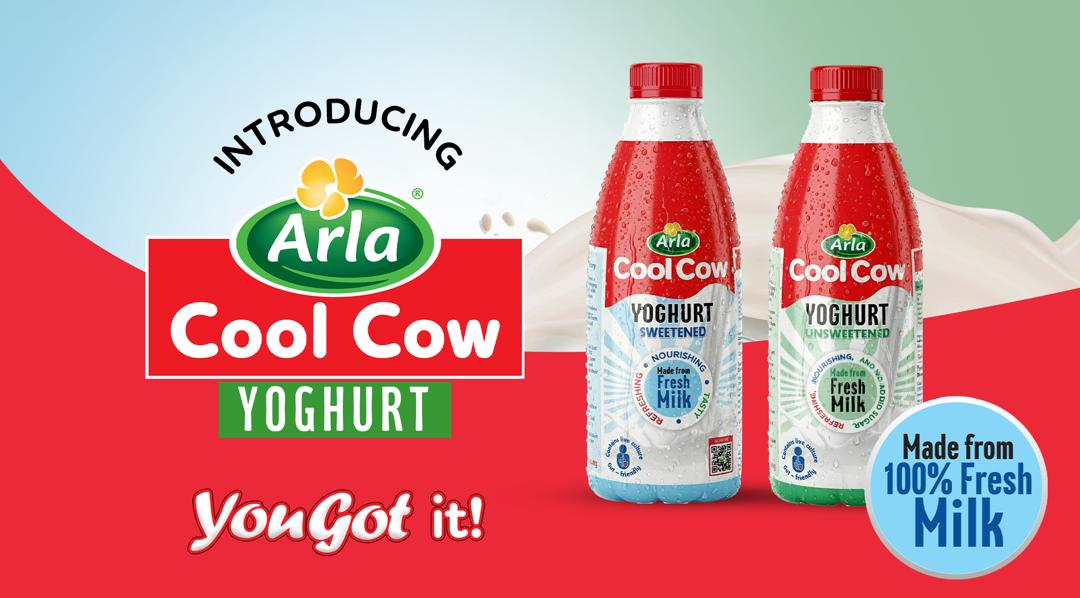
Cool Cow Yoghurt, made entirely from fresh milk at the Arla-Dano Farm, marks a turning point in Nigeria’s long struggle to feed itself with dairy it actually produces.
The Arla-Dano Farm in Damau, Kaduna State, the source of every drop of milk in Cool Cow Yoghurt. The farm has grown its herd from 215 to over 400 cows since opening in 2023.
For decades, Nigeria has had an awkward relationship with dairy: a country of 220 million people and millions of cattle that still imports more than $1.5 billion worth of milk and dairy products every year, with local production meeting less than 40 percent of demand. On Monday, the Danish cooperative Arla Foods made its most deliberate argument yet that things can be different , launching Cool Cow Yoghurt, its first yoghurt manufactured inside Nigeria, and the first major branded yoghurt in the country made entirely from 100% fresh, locally sourced milk.
The product rolls off a new, purpose-built production line at the Arla-Dano Integrated Dairy Farm in Damau, Kaduna State, which Arla commissioned in late 2025 alongside the Nigerian Dairy Centre of Excellence , a training hub for local farmers and agricultural professionals. Unlike many commercial yoghurts on Nigerian shelves that rely on reconstituted milk powder, Cool Cow Yoghurt is made from raw milk taken directly from Arla’s Kaduna herd, a distinction the company is leaning into hard.
“It’s tasty, it’s wholesome, and it’s made right here in Nigeria.”
— Ifunanya Obiakor, Head of Marketing, Arla Foods Nigeria
Why This Launch Matters Beyond the Yoghurt Aisle
The numbers that surround this launch frame its significance sharply. Nigeria currently produces only about 0.7 million litres of milk annually , far below what a population its size requires , while spending those billions on imports. Meanwhile, approximately one in three Nigerian children under five is affected by stunting, with dairy identified as a critical source of the proteins, calcium, and micronutrients needed to close the nutrition gap.
Arla’s move to local fresh-milk production is also a direct hedge against Nigeria’s currency volatility. Manufacturers across Nigeria’s food sector have been badly exposed by exchange-rate swings following currency reforms , companies dependent on imported powder find costs rising and falling with the naira. A farm-to-factory supply chain anchored in Kaduna insulates Arla from that exposure, at least partially.
Cool Cow Yoghurt — Quick Facts
- Made from 100% fresh milk sourced from the Arla-Dano Farm, Damau, Kaduna
- Available in Sweetened and Unsweetened variants
- Comes in 300 ml and 470 ml bottles
- Contains live cultures to support gut health
- Produced at Arla’s newly commissioned Kaduna yoghurt facility
- Now available at supermarkets, retail stores, and neighbourhood kiosks nationwide
A Farm Grown to Make This Possible
The Kaduna facility that underpins the launch is itself a remarkable piece of agricultural infrastructure for West Africa. The Arla-Dano farm uses solar-powered cooling systems and advanced animal welfare practices to ensure milk quality from the moment of milking to processing. Since opening in 2023, the farm has more than doubled its herd from 215 to over 400 cows, and it now doubles as a knowledge-transfer hub, hosting students, agricultural professionals, and local farmers to share modern dairy techniques. The adjoining Nigerian Dairy Centre of Excellence is designed to be a model for the entire West African industry, with ambitions to uplift smallholder farmers well beyond Arla’s own supply chain.
Arla has set a longer-range target of sourcing 50% of its Nigerian milk locally within a decade, a goal that will require both expanding its own farm and convincing independent Nigerian dairy ranchers to scale up. The Cool Cow launch is, in that sense, as much a commercial statement as a supply-chain milestone: a proof point that the Nigerian dairy transformation narrative can turn into product on a shelf.
“Nigeria produces only about 0.7 million litres of milk annually, far below what our growing population needs, while spending over $1.5 billion annually importing milk and dairy products, despite having millions of cattle and capable producers.” , Alhaji Idi Mukhtar Maiha, Nigeria’s Minister of Livestock Development, speaking at the factory inauguration, November 2025
The Competitive Landscape
Cool Cow Yoghurt enters a yoghurt market that remains fragmented, with regional producers competing alongside multinational brands. Urban demand has grown steadily, but high inflation continues to pressure household budgets, making pricing and distribution the two variables that will ultimately determine the product’s reach. Arla says Cool Cow is available at supermarkets, retail stores, and neighbourhood kiosks across Nigeria — a distribution ambition that signals it is not positioning this as a premium-only play.
The broader competitive challenge is consumer habit. Many Nigerian households are familiar with Arla through its Dano Milk powder brand, a very different product category. Converting that trust into yoghurt shelf-picks — especially a fresh-milk yoghurt at a time of squeezed budgets, will test the marketing muscle behind the “Cool Cow” brand name. Arla’s bet is that the fresh-milk credential and the “made in Nigeria” story carry their own premium in a market increasingly sceptical of processed imports.
For now, Cool Cow Yoghurt is available in sweetened and unsweetened variants in 300 ml and 470 ml bottles. More information about the product and Arla’s work in Nigeria is available at arla.ng.
Arla Foods is a global, farmer-owned dairy cooperative headquartered in Denmark, operating in more than 100 countries. In Nigeria, the company is known for its Dano Milk brand and its Integrated Arla-Dano Dairy Farm in Kaduna State, which serves as its hub for local fresh-milk production and agricultural training.
Stay informed on the latest developments in Nigeria’s beverage industry. Subscribe to our newsletter for exclusive insights and analysis.