By Victor Owencho
A landmark United Nations report has declared the world has entered an era of “global water bankruptcy,” sending shockwaves through the global beverage industry, which depends heavily on reliable water supplies for production.
The world has entered the era of “global water bankruptcy,” sending shockwaves through the global beverage industry, which depends heavily on reliable water supplies for production. A United Nations (UN) report has found that water systems relied on by six billion people and half of the world’s food production are pushed beyond the point of recovery.
The report marks the first time UN scientists have declared water systems “bankrupt” rather than “stressed” or “in crisis”, a distinction that denotes irreversible damage to natural water systems, as opposed to acute, time-limited shortages due to factors like weather, high demand or economic shocks.
“This report tells an uncomfortable truth: many regions are living beyond their hydrological means, and many critical water systems are already bankrupt,” said Kaveh Madani, director of the UN University’s Institute for Water, Environment and Health and lead author of the report. “If we continue to manage these failures as temporary crises with short-term fixes, we will only deepen the ecological damage and fuel social conflicts,” Madani said. “We must act because water bankruptcy is a justice and security issue. The cost of the hydrological overshoot that the world is facing falls disproportionately on those who can least afford it.”
Industry at the frontline
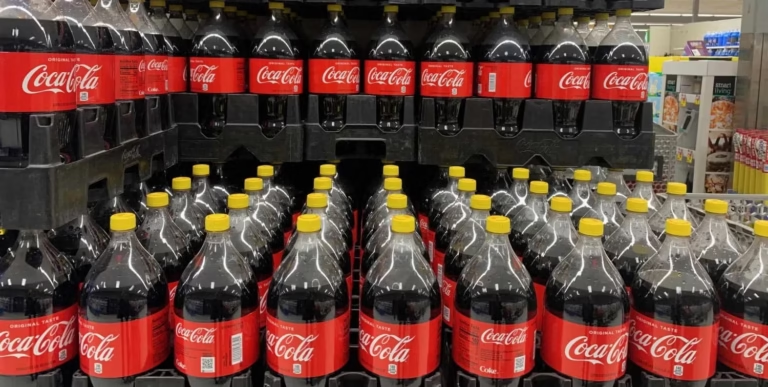
The beverage industry is among the most water-intensive sectors globally. Major drinks manufacturers require between 1.4 to 2.7 liters of water to produce just one liter of finished beverage, when accounting for production, cleaning, cooling, and other operational needs. With half of the world’s 100 largest cities experiencing high water stress—including major beverage production hubs like Beijing, Delhi, Los Angeles, and Rio de Janeiro—the industry faces unprecedented operational risks, according to a separate analysis published by Watershed Investigations this week.
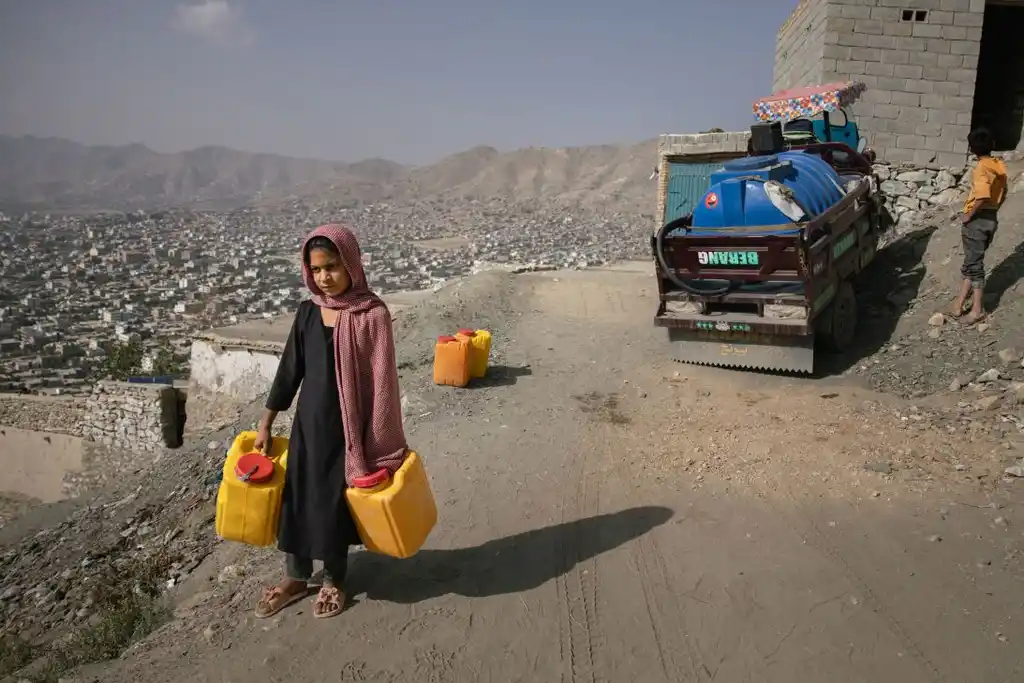
In Nigeria, where over 60 million people lack access to basic clean water supply, beverage companies are already grappling with water scarcity challenges. The country’s bottled water and soft drinks market, valued at billions of naira, relies on consistent water access that is becoming increasingly uncertain.
Despite Nigeria’s abundant water resources, more than half of available water sources are contaminated, forcing beverage manufacturers to invest heavily in water treatment infrastructure. The average Nigerian has access to just nine liters of water daily—far below the World Health Organization’s recommended minimum of 100 liters per day—creating both operational challenges and growing consumer demand for bottled water.
The shrinking of Lake Chad, which has lost 90 percent of its surface area since the 1960s, exemplifies the regional water crisis affecting beverage production across West and Central Africa. The lake serves as a critical water source for over 30 million people across Nigeria, Chad, Niger, and Cameroon.
‘Day Zero’ threatens production facilities
For some of the world’s largest cities hosting major beverage production facilities, the crisis has already arrived. Metropolises around the globe, from Cape Town to Sao Paolo and Tehran, have already faced their first “Day Zero” emergencies – events where water supplies for a city are near complete depletion.
While cities survived, these first “Day Zero” events are warning shots for beverage manufacturers, the UN warned.
“Emergency measures—severe restrictions, tariff changes, rapid drilling of new wells, reliance on tanker supplies, and behavioural campaigns—helped some cities narrowly avoid a complete shutdown of taps,” the report found.
Water scarcity forces beverage companies to drill deeper wells, invest in expensive desalination or treatment technologies, and navigate increasingly complex water rights and regulations. Many manufacturers in water-stressed regions now depend on costly tanker supplies during shortages, significantly increasing operational costs.
Supply chain and ingredient disruption
Agriculture, which provides key ingredients for the beverage industry—including sugar, fruits, barley, and hops—accounts for an estimated 72% of global freshwater withdrawals. Three billion people and more than half of global food production are concentrated in areas where total water storage is already declining or unstable, according to the report.
With agriculture accounting for 72% of global freshwater withdrawals, recent research by the World Resources Institute (WRI) found 25% of the world’s crops are grown in areas where water supply is highly stressed or unreliable.
“One out of every 11 people in the world grapples with hunger,” WRI found. “A hidden and growing driver is lack of water.” One-third of rice, wheat and corn produced globally—which provide more than half of global food calories—is grown in water-stressed regions, while irrigation water demand is forecast to increase 16% over the next two decades due to warming temperatures, according to WRI. This threatens the agricultural supply chain that beverage companies depend on for key ingredients.
India, a major supplier of tea, sugar, and fruit concentrates to global beverage markets, is losing up to 30 centimeters of groundwater per year in some regions, with depletion rates projected to triple by 2080.
Just 10 countries produce 72% of the world’s irrigated crops, with two-thirds of that production facing high to extremely high water stress. Over 170 million hectares of irrigated cropland—equivalent to the combined land area of France, Spain, Germany and Italy—are under high or very high water stress.
Water-driven conflicts threaten operations
Water-related violence has nearly doubled since 2022, rising from 235 incidents to 419 in 2024, according to Water Conflict Chronology, a database updated this week by the Pacific Institute that tracks water-driven violence throughout history.
In Nigeria, water-related violence has been responsible for more casualties than the Boko Haram insurgency, highlighting how water scarcity has become a major security threat for beverage manufacturing and distribution operations.
Water has increasingly been a target in major wars, despite Article 54 of the Geneva Convention classifying attacks or destruction of water infrastructure or supplies necessary for civilian survival as a war crime.
“In East Africa and the Sahel, water is becoming increasingly insecure, and people are moving into new areas to access water, which in itself can trigger competition and conflict with the host population,” said Joanna Trevor, Oxfam’s water security lead.
Industry transformation required
“We need to decouple growth from water,” Madani said. “We need to move away from the assumption that economic prosperity requires ever-increasing water withdrawals – the problem that has got us in this situation.”
The UN report arrived ahead of high-level meetings in Dakar, Senegal, this week to prepare the agenda for the 2026 UN Water Conference, set for December in the UAE. It calls on member states to formally recognise water bankruptcy, establish global monitoring frameworks and position water investments as fundamental to achieving climate, biodiversity and food security targets.
This year’s summit is only the second major international meeting on water governance this century, following a 2023 summit at UN headquarters in New York.
For the beverage industry, the report signals that transformation is no longer optional. Leading companies are responding by investing in water conservation technologies, recycling systems, and watershed protection programs. Industry experts suggest manufacturers must:
- Invest in closed-loop water systems that recycle up to 95% of production water
- Relocate production facilities away from water-stressed regions
- Support watershed conservation in sourcing areas
- Develop products with lower water footprints
- Collaborate on regional water management solutions
“Declaring bankruptcy is not about giving up, it is about starting fresh. By acknowledging the reality of water bankruptcy, we can finally make the hard choices that will protect people, economies, and ecosystems,” Madani said. “The longer we delay, the deeper the deficit grows.”
“Water bankruptcy is becoming a driver of fragility, displacement and conflict,” said Tshilidzi Marwala, UN Under-Secretary-General. “Managing it fairly is now central to maintaining peace, stability and social cohesion.
” For beverage manufacturers in Nigeria and across Africa, the message is clear: water is no longer an unlimited resource, and business models must adapt to a new era of water scarcity. The companies that invest in water resilience today will be best positioned to thrive in tomorrow’s water-constrained world.
“Despite its warnings, the report is not a statement of hopelessness,” Madani concluded. “It is a call for honesty, realism, and transformation.”