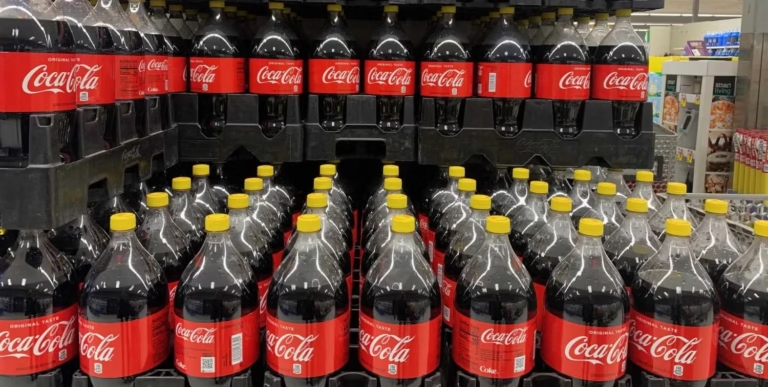
The numbers landed like a wake-up call for anyone still treating Africa as a secondary market. Coca-Cola HBC’s full-year 2025 results, released on 10 February, confirmed what the company has quietly been signalling for years: its emerging markets, led by Nigeria and Egypt are no longer just growth stories. They are the engine.
Revenues climbed 7.9% to €11.6 billion, while underlying profits rose 11.5% to €1.4 billion. Organic volumes grew 2.8% overall, but it was the 28.3% surge in energy drink volumes that defined the year, and notably, 2025 marked the tenth consecutive year of double-digit energy drink growth for the group. In Africa, the affordable brands Predator and Fury, activated through football partnerships and local campaigns, led that charge. Nigeria alone posted 6.4% volume growth, with emerging markets overall delivering 13.2% organic revenue growth — even as currency headwinds from the Naira and Egyptian Pound created friction.
“Energy volumes grew by 28.3%, making 2025 the tenth consecutive year of double-digit growth.”
— Coca-Cola HBC AG Full Year Results, February 2026
The story is not purely carbonated. Sports drinks rose by low double digits across the portfolio, and premium spirits grew 12.2%. Yet it is the energy category driven by young, urban consumers in markets like Lagos and Cairo — that has redrawn the strategic map. It is a shift with implications far beyond one company’s earnings call.
From dark kitchens to the beverage supply chain
Across the Gulf, a parallel story is unfolding in how drinks and food reach consumers. talabat announced plans to expand its cloud kitchen network from 30+ hubs to 50 locations over three years, with an ambition for 10% of food orders in mature markets to be fulfilled through its network. The platform already operates more than 500 kitchen stalls across the UAE, Kuwait, Qatar, Bahrain, and Jordan.
Crucially, beverages are integral to the cloud kitchen model , restaurants operating within the network fulfil complete meal orders, including drinks. As delivery culture deepens across MENA, the companies managing what people drink are having to think as much about logistics and proximity as about flavour.
“With Pepper, we’re not just placing kitchens — we’re predicting demand, optimizing preparation, shortening delivery loops, and identifying the right partners before the market does.”
— Tarek El Halabi, Country Lead, Kitchens, talabat UAE
talabat’s AI engine, Pepper, now underpins kitchen placement decisions , a signal that the competitive advantage in food and beverage delivery is increasingly algorithmic.
Camel milk gets a global passport
A quieter but significant development emerged from the UAE’s regulatory sphere this week. The Codex Alimentarius Commission approved the UAE’s proposal to develop the first international standard for pasteurised camel milk — a product the country produces at more than 7,000 tonnes annually. The move is designed to prevent fraudulent blending and protect product integrity. The global camel milk market is projected to reach $1.93 billion by 2033, and a Codex-backed standard would significantly ease export pathways for Gulf producers.
It is a small story with long legs: a niche beverage category that until recently was largely local is now being structured for international trade.
Coffee routes and the Ethiopia factor
Ethiopia’s coffee economy is also attracting attention beyond the usual trade circles. Export revenues from coffee sales to Russia hit $123 million in 2025, more than double the $46 million recorded in 2024, with volumes rising to 18,300 tonnes. The shift reflects both Russia’s search for alternative supply chains and Ethiopia’s growing capacity to diversify its export destinations. For a country where coffee is not just an export crop but a cultural cornerstone, the revenue boost is significant , and likely to intensify competition for Ethiopian beans in international markets.
Taken together, this week’s news tells a consistent story: beverages in Africa and the Middle East are no longer shaped solely by multinational strategy. Local demand, regulatory frameworks, digital infrastructure, and new trade routes are all playing a role. The region is not following a global template. It is writing one.
Stay informed on the latest developments in Nigeria’s beverage industry. Subscribe to our newsletter for exclusive insights and analysis.