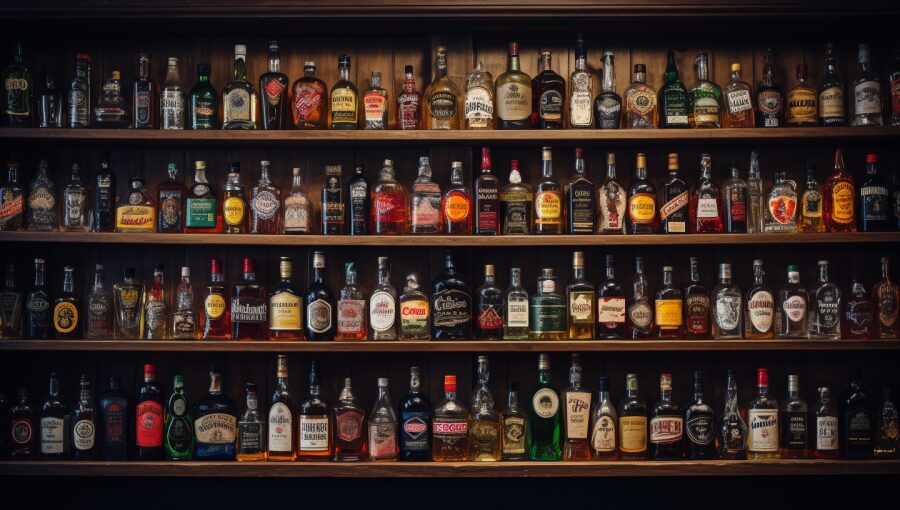
In an unmarked beige building in Riyadh’s diplomatic quarter, the kingdom is quietly testing whether it can maintain its Islamic identity while courting Western dollars—one $124 bottle of whisky at a time.
When wealthy expatriates in Saudi Arabia want to legally purchase alcohol, they don’t search for the store on Google Maps. They can’t. The kingdom’s only legal liquor outlet doesn’t appear on any mapping application, has no sign on its door, and requires customers to seal their mobile phones in tamper-proof bags before entering.
Yet this ghost store represents one of the most significant social policy experiments in modern Saudi history—a calculated gamble that the kingdom can attract the foreign investment and tourism dollars it desperately needs without alienating its conservative populace.
The shift began quietly in late 2025 when Saudi authorities expanded access to the liquor shop beyond foreign diplomats to include wealthy non-Muslim residents earning at least 50,000 Saudi riyals ($13,300) monthly or holding Premium Residency permits costing $27,000 annually, according to Bloomberg and multiple industry sources.
The $90 Whisky Economy
For those who qualify, the experience is surreal. After proving their religion, residency status, and income at the door, customers enter a “well-stocked” facility where prices run two to three times Western market rates—but still far below Saudi Arabia’s thriving black market.
“A bottle of Johnny Walker Black Label whisky cost me $124 (£90). But I don’t mind paying the premium,” a British company executive told the BBC, speaking anonymously due to the sensitivity of the topic.
The store operates on a complex points-based quota system generous enough to allow patrons to purchase “dozens of litres of spirits each month,” according to customers. For many, the legal option beats the alternative: homemade brews of questionable safety or expensive smuggled supplies that have circulated in the shadows for decades.
“We were surprised and didn’t believe it at the beginning,” one purchaser told Agence France-Presse. “We entered the store after checking and succeeded in buying alcohol.”
Vision 2030’s Uncomfortable Truth
The timing of Saudi Arabia’s alcohol liberalization reveals the economic pressures driving Crown Prince Mohammed bin Salman’s sweeping Vision 2030 reforms. With crude oil prices hovering around $60-66 per barrel—down from over $100 in 2022 following Russia’s invasion of Ukraine—the kingdom faces a stark reality: oil revenues, which still account for approximately 40% of GDP and 75% of fiscal revenue, cannot sustain its ambitious transformation alone.
The non-oil economy now represents 52% of GDP, with projections to reach 65% by 2030. Tourism has emerged as a critical pillar of this diversification strategy. In 2024, the kingdom attracted nearly 30 million international visitors, with non-religious travel accounting for more than half of arrivals for the first time, according to Tourism Minister Ahmed Al Khateeb.
“We want to double tourism’s contribution to the GDP by 2030,”
Al Khateeb said in a November 2025 BBC interview.
To reach the ambitious target of 70 million annual tourists by 2030, Saudi Arabia has poured billions into luxury Red Sea resorts, reopened cinemas, hosted major music festivals, and curtailed the once-feared religious police. But the kingdom faces fierce regional competition, particularly from Dubai, where expatriates and tourists enjoy easy access to alcohol and a liberal social environment.
The Delicate Balancing Act
Saudi authorities have made no official announcement about the expanded alcohol policy—a silence that analysts say is deliberate.
“They are willing to go two steps forward and one step back, if necessary, when it comes to sensitive issues,” Sebastian Sons, a senior researcher at German think tank Carpo, told the BBC. “With alcohol, it could be the same.”
The caution is understandable. Alcohol remains prohibited under Islamic law, and Saudi Arabia is home to Islam’s two holiest sites. For many of the kingdom’s Saudi nationals—who comprise nearly two-thirds of the population—alcohol represents a “major social taboo,” according to one Saudi intellectual who spoke anonymously.
“A majority of Saudis who welcomed the reforms in recent years will also be hesitant to support this publicly,” the intellectual noted. “Even Saudis that consume alcohol, do it outside the country, or privately in their homes.”
What About Tourists?
The hospitality industry is already preparing for further liberalization. Several international hotel chains have begun hiring bartenders “in anticipation” of policy changes, with job advertisements listing knowledge of spirits, beer, and wine as desirable skills, according to industry executives who spoke to the BBC.
“If the rules change, we want to be able to act immediately,” one senior executive at a multinational hospitality chain said.
Media reports suggest Saudi authorities plan to open two additional alcohol outlets—one in Jeddah on the Red Sea coast and another in Dhahran, home to state oil company Aramco. Industry sources believe tourist destinations like the Red Sea islands and the ancient city of al-Ula could be among the first locations where alcohol is permitted more widely if restrictions ease.
However, any broader rollout likely won’t extend to Saudi Arabia’s crown jewel events. Despite the quiet expansion of domestic alcohol sales, Saudi officials have been unequivocal about the 2034 FIFA World Cup: no alcohol will be sold in stadiums, hotels, or restaurants during the tournament.
“Rather like our weather, it’s a dry country,” Prince Khalid bin Bandar Al Saud, Saudi Arabia’s ambassador to the UK, told LBC radio in February 2025. “At the moment, we don’t allow alcohol, but plenty of fun can be had without it. It’s not 100% necessary.”
When pressed about accommodating international fans, the ambassador was firm: “Everyone has their own culture. We’re happy to accommodate people within the boundaries of our culture but we don’t want to change our culture for someone else.”
The Qatar Comparison
Analysts expect Saudi Arabia to adopt an approach similar to Qatar’s during the 2022 World Cup, where alcohol was restricted to designated fan zones and five-star hotels but banned inside stadiums—and even those limited sales were nearly scrapped at the last minute.
“Authorities want to prepare the society gradually and avoid a backlash,” Sons explained.
Tim Callen, a visiting fellow at the Washington DC-based Arab Gulf States Institute, notes that while alcohol “may not be the main factor, it could certainly help attract more Western tourists, especially those visiting the Red Sea islands.”
The Road Ahead
For now, many Saudis and expatriates continue driving across the border to Bahrain—where alcohol is legally available to both Muslims and non-Muslims—for weekend drinking sessions. On public holidays, the island nation sees a steady stream of Saudi visitors seeking what they cannot legally obtain at home.
The kingdom’s cautious expansion of alcohol sales represents a broader tension at the heart of Vision 2030: how to modernize and compete globally while preserving Saudi Arabia’s Islamic character and conservative social norms.
Whether this experiment succeeds may ultimately determine not just the future of alcohol policy, but the viability of the kingdom’s entire economic transformation. As global energy markets shift and oil dependence becomes increasingly untenable, Saudi Arabia finds itself navigating uncharted territory—testing how much it can change without losing what makes it Saudi Arabia.
For now, that test is happening behind the unmarked doors of a beige building in Riyadh’s diplomatic quarter, one expensive bottle of whisky at a time.