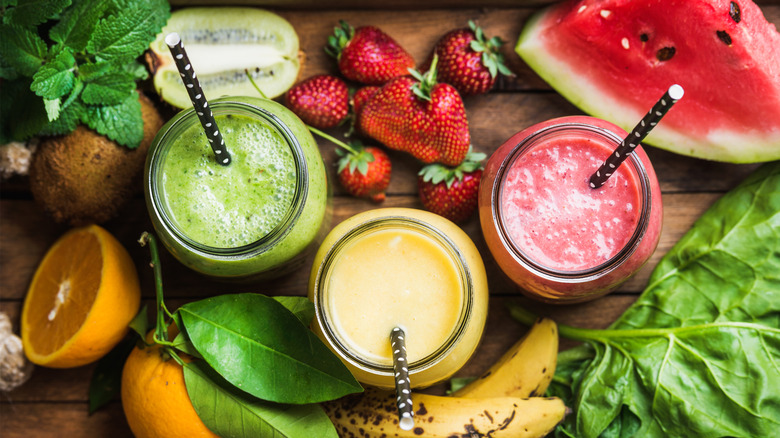
A landmark study published last year is challenging one of the food industry’s most persistent assumptions, that raw is always better. For juice and smoothie producers, the findings could be transformative.
For years, the premium end of the juice and smoothie market has been shaped by a simple consumer belief: the less processing, the better. Cold-pressed, high-pressure processed (HPP), “raw”, these have been the buzzwords commanding shelf space and premium prices. But a study published in June 2025 in the Journal of Agricultural and Food Chemistry is quietly upending that narrative, with findings that suggest traditional heat-based pasteurisation may actually make your smoothie more nutritious, not less.
“Processing smoothies with high heat could make polyphenols easier for the gut microbiome to absorb — with heat-treated smoothies delivering twice the available polyphenolic compounds of pressure-treated ones.” , Journal of Agricultural and Food Chemistry, 2025
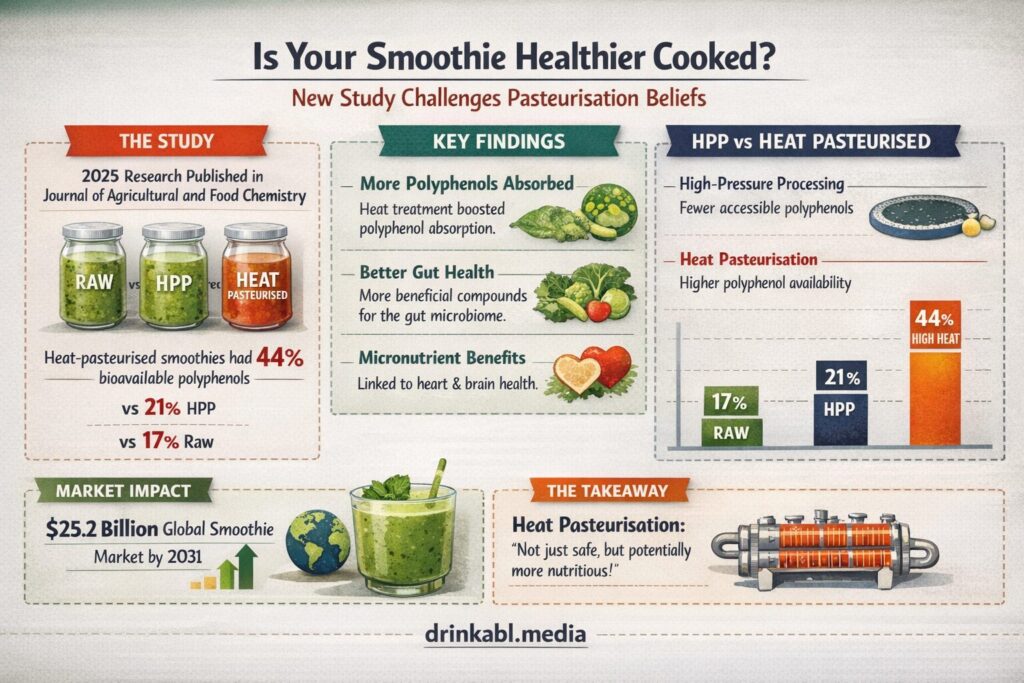
Researchers led by Iziar Ludwig prepared smoothies from Granny Smith apples, green celery, green chicory, peppermint and lemon, then subjected them to either high-pressure pasteurisation (HPP) or high-temperature pasteurisation, alongside an untreated control. They then simulated the full three stages of human digestion, oral, gastric and intestinal, before analysing what compounds were available for absorption.
Post-digestion, pressure- and heat-pasteurised samples had higher amounts of polyphenolic compounds available for absorption, 21% and 44% respectively, compared with the untreated sample at just 17%. Technology Networks The researchers attributed this to pasteurisation softening or rupturing plant cell walls, favouring the release of polyphenols into the body.
The gut microbiome stage of the analysis was equally striking. The gut microbiota converted most polyphenols into smaller derivatives such as phenylpropanoic acids, compounds that have previously demonstrated antidiabetic, anti-inflammatory and chemopreventive effects. The largest microbiota conversions happened in the high-temperature, post-digestion sample because it began fermentation with higher overall polyphenol levels. Foodprocessing
Polyphenols are micronutrients found across fruit and vegetables linked to protection against heart disease and neurodegenerative disorders. Getting them absorbed efficiently is therefore not a trivial matter.
“Contrary to popular belief, traditional heat-based pasteurisation can actually improve some aspects of product nutrition.”
The HPP Question
The findings land at an awkward moment for the high-pressure processing sector. Over the past two decades, HPP has been positioned as the sophisticated alternative to thermal treatment, preserving colour, taste and nutrients while still delivering food safety. Many premium brands have built entire identities around it.
But the science has always been more mixed than the marketing. Studies have shown that while HPP can improve the sensory quality of orange juice, it can have a negative effect on apple juices. Separately, research published in 2021 found that pressure-treated smoothies lost more phenols and carotenoids during storage than heat-treated equivalents. The new study adds another dimension: even at the point of consumption, HPP delivers fewer bioaccessible polyphenols than heat treatment.
None of this makes HPP redundant, it remains a valid and effective food safety tool, but it does raise legitimate questions about whether it deserves its premium positioning on nutritional grounds.
A Market Worth Getting Right
The commercial stakes are substantial. Juices hold the highest purchase penetration of any soft drink category globally, with 57% of consumers worldwide buying juices, juice drinks or smoothies in the past year, and nearly two-thirds doing so weekly. Growth markets now extend well beyond traditional Western consumers, with Canada, Spain, Germany, Mexico and Poland among the countries seeing the biggest increases in juice consumption.
The smoothie segment alone is forecast by Mordor Intelligence to grow from US$16.65 billion today to US$25.21 billion by 2031, driven particularly by plant-based smoothies, which are projected to expand at a 9.65% compound annual growth rate. In a market this competitive and this nutritionally literate, the question of which pasteurisation method delivers the most bioavailable nutrition is not merely academic.
What This Means for Manufacturers
For producers, the practical implications go beyond nutrition science into equipment strategy. Delicate fruit and vegetable products require careful handling to avoid splitting or shearing, while precise temperature control is critical to prevent undesirable off-flavours developing during heat treatment. Getting heat pasteurisation right, efficiently and consistently, requires the appropriate technology.
For straightforward fluids, corrugated multi-tube heat exchangers handle the task well. For more viscous or complex products, tube-in-tube or annular space designs offer greater control. At the most demanding end, products with high viscosity or particulate matter that must be preserved, scraped surface heat exchangers are the industry standard.
The broader point is that heat pasteurisation, done properly with modern equipment, need not be the compromise it was once assumed to be. The science increasingly suggests it may be the smarter choice.
The study, “Pasteurizing Fruit Smoothies Could Improve Digestion of Beneficial Polyphenols,” was published in the ACS Journal of Agricultural and Food Chemistry in June 2025, with funding from the Government of Navarre.