In the biggest Japanese investment ever made in African beverages, Asahi Group Holdings is taking the wheel at East African Breweries, and a continent-sized growth story is just getting started.
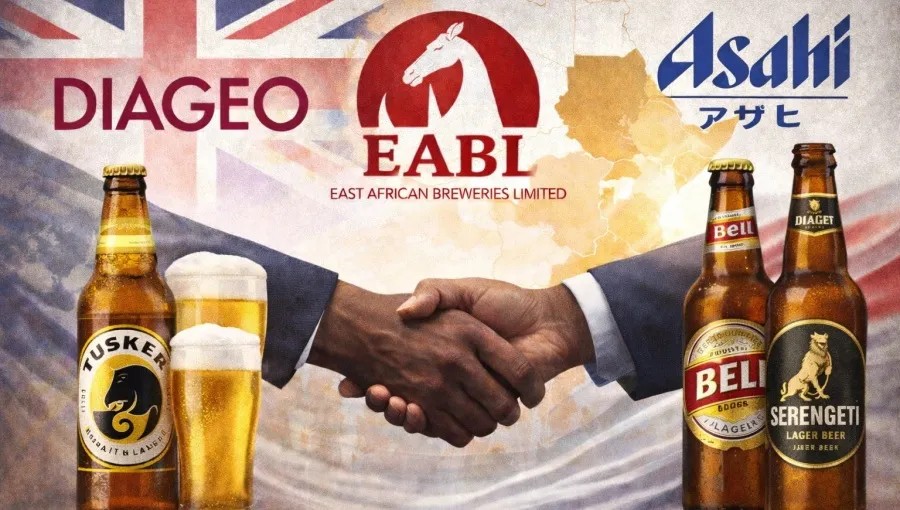
A seismic shift is underway in East Africa’s drinks landscape. as penultimate 2025, Japan’s Asahi Group Holdings entered into an agreement to acquire Diageo’s 65% shareholding in East African Breweries Limited (EABL) and its shareholding in Kenyan spirits business UDVK, marking the first time a major Japanese brewing group has made an investment of this size in an African alcoholic beverage business.
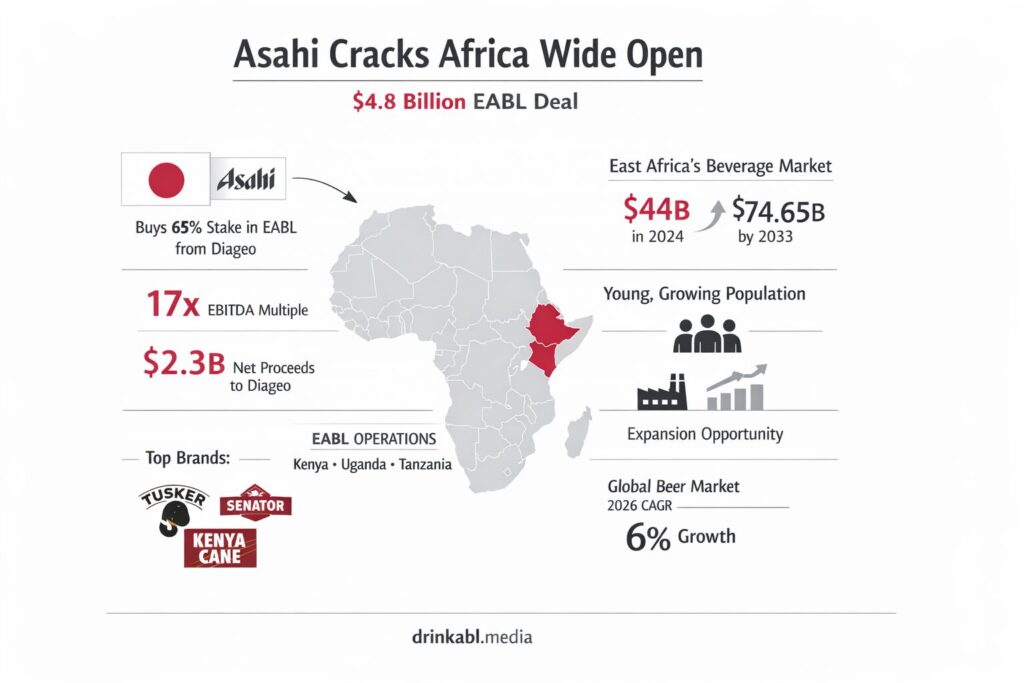
The deal delivers estimated net proceeds of $2.3 billion to Diageo after tax and transaction costs, at a multiple of 17x adjusted EBITDA, resulting in an implied enterprise value for 100% of EABL of $4.8 billion. For context, the global brewing industry average multiple sits at 9 to 11x, a premium that speaks volumes about how the market views Africa’s long-term potential.
Why Africa? Why Now?
Africa has one of the youngest populations globally. Rapid urbanisation is driving young professionals into cities with increased disposable incomes, and a rising middle class is seeking premium and branded products. Beer consumption per capita remains relatively low compared to other markets, meaning there is significant runway for growth. The African beer market is estimated at $44 billion in 2024, growing at a CAGR of 6% through to 2033, and projected to nearly double to $74.65 billion by 2033.
For Asahi, already dominant in Japan with around a 40% domestic market share and European crown jewels including Peroni, Pilsner Urquell and Grolsch, as well as Australia’s Carlton & United Breweries acquired in 2020, Africa is the missing piece in a genuinely global portfolio. The transaction lifts the proportion of Asahi’s sales outside Japan to about 40%, as the company seeks to counter a stagnant domestic market.
Asahi President and Group CEO Atsushi Katsuki was unambiguous about his intentions:
“This business is a high-quality, leading company in Kenya, Uganda, and Tanzania, with an unrivalled brand portfolio and marketing capabilities, state-of-the-art production facilities and strong market shares. Together with its excellent management team and employees, we will pursue sustainable growth and medium- to long-term enhancement of corporate value, while contributing to the development of the local economies.”
EABL: A Century-Old Crown Jewel
EABL is the largest beer business in East Africa, with a heritage dating back over a century, founded as Kenya Breweries Limited in 1922, and top beer brands including Senator, Tusker and Serengeti, alongside spirits brands Chrome and Kenya Cane. In the fiscal year ended June 30, 2025, EABL reported net sales of $996 million, $258 million EBITDA and net income of $94 million.
In its most recent half-year results to December 2025, EABL reported net revenue growing 11% to KShs 75.5 billion and profit after tax up 38% to KShs 11.2 billion, a business firing on all cylinders ahead of the ownership transition. The Board declared a record interim dividend of KShs 4.00 per share, the highest in the company’s history.
EABL MD & Group CEO Jane Karuku framed the deal as a growth springboard:
“This acquisition marks a significant step in accelerating our growth ambition of becoming the most celebrated beverage business in Africa. The new majority owner brings significant knowledge and expertise in innovation and growing successful brands globally that will help us achieve that ambition.”
Locally owned brands such as Tusker and Kenya Cane will remain owned by EABL, while Diageo has committed to long-term licensing agreements ensuring continued production and distribution of Guinness, Johnnie Walker, Smirnoff Ice and Captain Morgan within East African markets. There are no changes expected in the operations of EABL and its subsidiaries, and no jobs will be impacted by the transaction.
Diageo’s Calculated Retreat
For Diageo, this is the capstone of a deliberate continental restructuring. The company previously exited Ghana, selling its 80.4% Guinness Ghana Breweries stake to Castel Group for $81 million, as well as Nigeria, where it divested Guinness Nigeria to the Tolaram Group in 2024, and its Guinness brewing business in Cameroon in 2022, also to Castel.
Diageo interim CEO Nik Jhangiani was candid:
“This transaction delivers both significant value for Diageo shareholders and accelerates our commitment to strengthen our balance sheet. We remain committed to returning the group to well within our target leverage ratio range of 2.5–3.0x through disposals of non-strategic, non-core assets.”
The EABL divestment forms part of Diageo’s broader Accelerate programme, unveiled in May 2025, which targets $500 million in cost savings over three years.
What’s Next
Once the acquisition is finalised, Asahi is expected to introduce international brands such as Asahi Super Dry, Peroni Nastro Azzurro and Pilsner Urquell to East African consumers, deepening competition in a market where Heineken has also been expanding aggressively following its Distell integration. The transaction is expected to be finalised in the second half of 2026, pending regulatory approvals across Kenya, Uganda and Tanzania. EABL will maintain its cross-listing on all three countries’ stock exchanges.
For drinkers across the region, the transition should be seamless. The Tusker will still flow, the Guinness licence stays firmly intact, and a new owner with deep pockets, a $19 billion global revenue base, and serious continental ambitions has just walked through Africa’s front door.
📖 Further reading on Drinkabl.media: