Nigeria Distilleries Limited doubles down on value chain strategy as a newly merged, digitally-enabled company navigating one of the country’s toughest economic climates
Nigeria Distilleries Limited (NDL), the country’s largest manufacturer of spirits and wines, has unveiled an ambitious 2026 roadmap centred on tightening its distribution networks, upgrading supply chain coordination, and embedding greater commercial discipline across its expanded operations, moves analysts say reflect an increasingly strategic private-sector response to Nigeria’s deepening macroeconomic pressures.
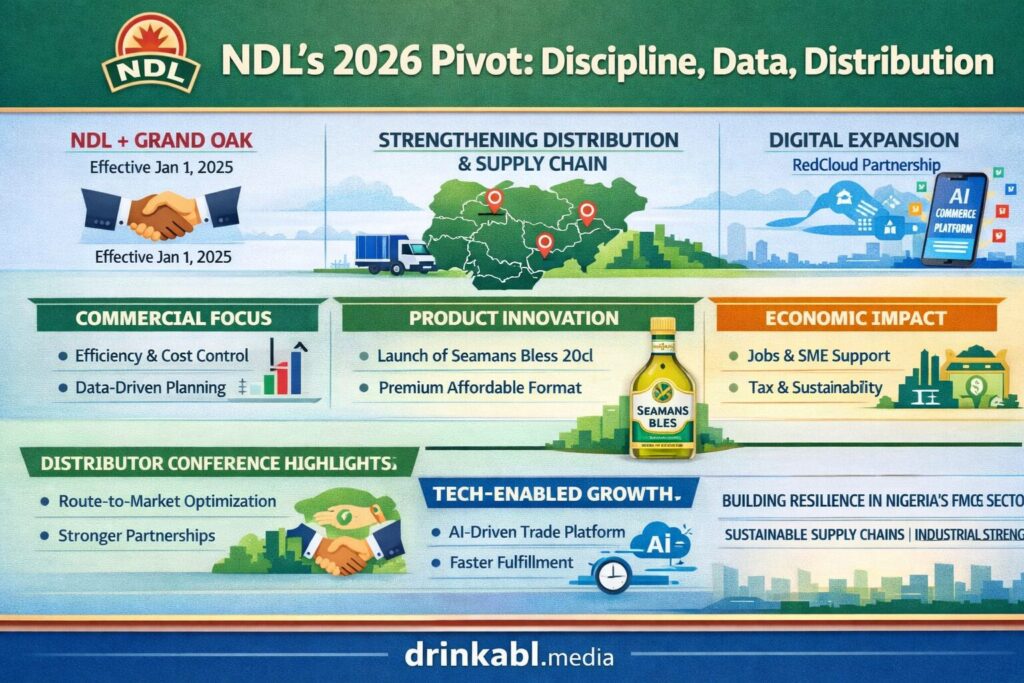
The priorities were laid out at NDL’s annual Distributor and Commercial Conferences in Lagos, where senior executives, trade partners, and distributors reviewed performance benchmarks and set operational targets for the year. The gatherings carry added significance in 2026: NDL enters the year as a newly consolidated entity, having completed its merger with Grand Oak Nigeria Limited , effective January 1, 2025, combining the portfolios of two of Nigeria’s most storied beverages companies under one roof.
“Our distributors remain a critical pillar of our business. Sustainable progress will depend on stronger systems, disciplined execution, and closer collaboration across the value chain.” — Adekunle Rosiji, Group Executive Director, Nigeria Distilleries Limited
From Conference Rooms to the Last Mile
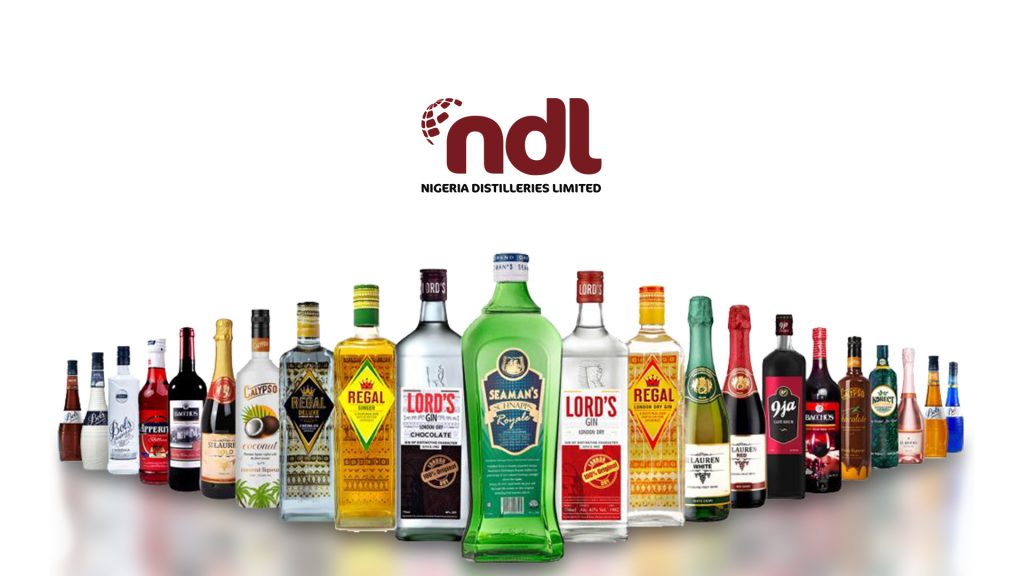
The Distributor Conference zeroed in on route-to-market efficiency, logistics planning, and accountability across distribution networks , perennial pressure points in Nigeria’s sprawling FMCG landscape. For a company whose brands, including Seaman’s Aromatic Schnapps, Lord’s Dry Gin, Regal Deluxe, and Bacchus Tonic Wine, reach consumers across all 36 states, the strength of its distribution ecosystem is not merely a commercial question but an operational lifeline.
Industry observers say stronger manufacturer-distributor coordination is increasingly critical to reducing the supply bottlenecks, price instability, and uneven product availability that have long undermined Nigeria’s consumer goods sector, particularly as foreign exchange volatility, high input costs, and infrastructure deficits continue to squeeze manufacturers.
At the Commercial Conference, leaders across sales, marketing, and supply chain functions assessed performance metrics and mapped measures to improve cost efficiency and execution. Sessions stressed productivity optimisation, data-driven planning, and cross-functional collaboration as non-negotiable tools for navigating the country’s evolving economic terrain.
Digital Distribution Takes Centre Stage
NDL’s supply chain ambitions are being backed by tangible technological investment. In a partnership announced in mid-2025 with RedCloud Holdings, the company moved to list more than 60 of its products on RedCloud’s AI-powered open commerce trading platform. The alliance connects over 130 existing NDL distributors — and new wholesalers and retailers, through hubs in Lagos, Abuja, and Port Harcourt, with orders fulfilled within two to five business days.
NDL’s digital push is designed to “penetrate new demographics at scale while retaining the go-to-market approach of modern retail.” — Valentine Dibia, E-Commerce Lead, NDL
The platform promises near real-time stock visibility, improved inventory management, and access to rich market data , capabilities that, if fully realised, would represent a significant leap beyond the manual coordination that has historically characterised Nigeria’s spirits distribution.
Product Innovation as a Market Signal
NDL’s strategic recalibration is also playing out at the product level. The company recently launched Seamans Bless in a new 20cl premium bottle, a format designed to fill the gap left by the gradual phase-out of sachet alcohol across Nigeria. The move is widely read as a calculated response to evolving regulatory conditions and shifting consumer preferences, particularly among urban and semi-urban consumers seeking affordability without sacrificing brand quality.
Executive Director Wale Majolagbe described the launch as a defining moment in NDL’s consumer engagement strategy, emphasising the company’s intent to deepen grassroots connections while maintaining premium positioning. The new format features enhanced labelling, improved shelf visibility, and greater portability — attributes trade partners say give it strong potential for increased turnover and broader demographic appeal.
Why It Matters Beyond the Balance Sheet
Economic analysts caution that the stakes of supply chain performance in Nigeria’s manufacturing sector extend well beyond corporate profit margins. Improved coordination within FMCG supply chains contributes directly to employment retention, tax generation, and the sustainability of the small and medium-scale enterprises that populate distribution networks nationwide.
Nigeria’s manufacturing sector has faced mounting structural headwinds, including persistent infrastructure gaps and the lingering effects of naira depreciation on input costs. Against this backdrop, the kind of structured engagement NDL is pursuing between producers and distributors is increasingly regarded as a necessary mechanism for sustaining industrial output ,not just a commercial best practice.
Analysts say improved FMCG supply chain coordination contributes directly to employment, tax generation, and SME sustainability, making NDL’s strategy as much a development story as a business one.
Incorporated in 1961 and now operating as the combined successor to both NDL and Grand Oak, the company brings decades of market experience to what is shaping up as one of its most consequential strategic pivots. As Nigeria’s private sector searches for a credible response to macroeconomic turbulence, NDL’s 2026 playbook , built on distribution discipline, digital infrastructure, and value chain integration, offers one model of what industrial resilience might look like in practice.
Additional reading: Seamans Bless 20cl: Innovation meets regulation