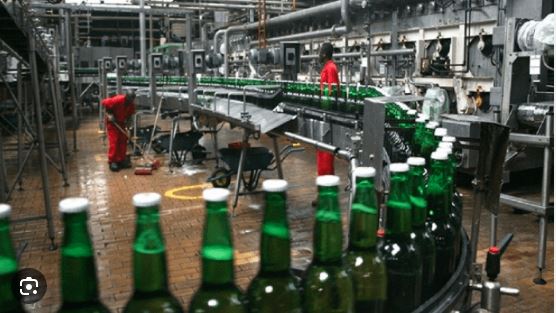

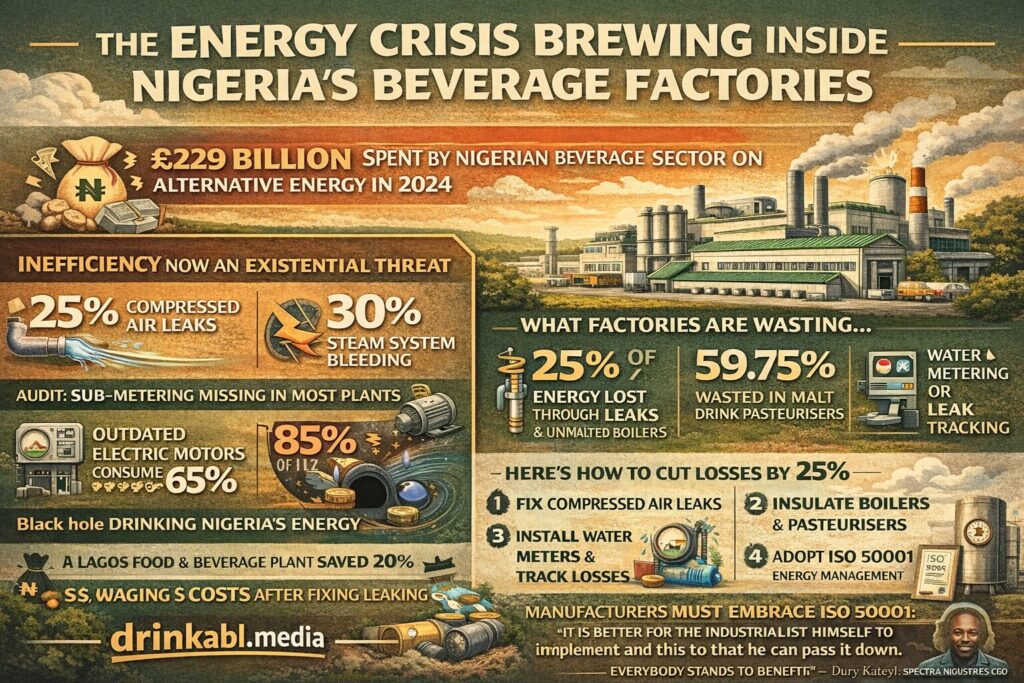
A national industry audit has found that Nigerian factories are wasting up to a quarter of their energy through leaking pipes, idle equipment, and uninsulated boilers. For a beverage sector that spent ₦229 billion on alternative energy in 2024 alone, the message is unmistakable: inefficiency is now an existential threat.
The numbers should alarm every drinks manufacturer in Nigeria: compressed air leaks account for 25% of electricity losses across surveyed facilities. Steam systems bleed another 30%. And most plants have no sub-metering to detect where losses are happening.
These findings come from a Cleaner Production Assessment across 42 industries in four geopolitical zones, presented last week in Lagos by the Manufacturers Association of Nigeria (MAN) under the GEF-UNIDO IEE/RECP Project.
For beverage producers navigating grid failure and naira volatility, it is a direct assault on margins, the Food, Beverage & Tobacco sector spent ₦229.41 billion on alternative energy in 2024, up from ₦182.76 billion in 2023.
The Pasteuriser Problem Nobody’s Talking About
The beverage sector’s vulnerability runs deeper than most operators realise. Research in the peer-reviewed journal Energy found that in Nigerian malt drink production, the pasteuriser alone accounts for 59.75% of total system inefficiency in orange juice processing, that figure exceeds 90%. Yet thermal losses from poor boiler insulation remain widespread and unaddressed.
A separate audit found that electric motors — consuming over 65% of all electrical energy in the sector — routinely operate below peak efficiency, with outdated units quietly draining budgets.
“There is a big gap between where we should be and where we are at the moment. A lot of industries have not really plugged into it.” — Obafemi Adejumo, IEE & RECP National Expert
What One Lagos Plant Proved
A Lagos food and beverage facility cut compressed air leaks by 20% after a targeted system review, in some plants, similar optimisations allowed operators to shut down an entire compressor. The CPA estimates that integrated efficiency measures can deliver 20–25% energy reduction, roughly 500 megawatt-hours in annual savings per plant.
With diesel generators supplying 87–89% of electrical energy needs in Nigerian beverage plants, every wasted unit costs twice, once in lost output, again in diesel spend.
“If you can reduce energy consumption, your cost of production will be reduced. You boost sustainability and make your organisation competitive.” — Obafemi Adejumo, IEE & RECP National Expert
Water: The Ingredient Nobody’s Measuring
The audit also exposed a water blind spot. Plants draw freely from boreholes with no metering, consuming and discarding water with no idea of daily volumes used or lost.
“If you are producing and you don’t know the volume of water you are using, how will you know the volume of water that you are wasting?” — Jacob Oladipo, GEF-UNIDO National Project Coordinator
For breweries, soft drink makers, and bottled water producers, this is a governance gap that ESG investors and international buyers are increasingly unwilling to overlook.
The Fix: ISO 50001
MAN is pushing manufacturers to adopt ISO 50001 and ISO 14001 — the same standards beverage multinationals already demand from Nigerian supply chain partners. Duro Kuteyi, CEO of Spectra Industries, urged industry leaders to get certified themselves, not delegate it.
“It is better for the industrialist himself to understand this so that he can pass it down. Everybody stands to benefit.” — Duro Kuteyi, CEO, Spectra Industries Ltd
With Nigeria’s food and drink market projected to nearly double to $98.97 billion by 2033, the stakes have never been higher. The question is no longer whether beverage manufacturers can afford to act. It is whether they can afford not to.
Also on Drinkabl
On the industry this story is about:
- These Are the 20 Nigerian Beverage Companies to Watch in 2026 : The brands shaping Nigeria’s drinks space, from boardroom moves to bottle sales. If you’re tracking where the sector is headed, start here.
- Nigeria’s Brewers Sound the Alarm on Three-Year Excise Plan, With ₦425bn on the Line : Energy costs aren’t the only pressure squeezing Nigerian brewers. Read about the looming tax battle that could reshape the entire industry.
- Coca-Cola Nigeria Bets Big on Consumer Rewards as Economy Shows Signs of Recovery : How the world’s biggest beverage brand is playing the Nigerian market as economic headwinds begin to ease.
Zooming out — the bigger picture:
- Africa’s Drinks Industry Has a Sober Problem, & a Bigger Opportunity : A continent-wide lens on the structural challenges and the enormous growth potential sitting just underneath them.
- Who Is Silencing South Africa’s Sugar Warning? Inside the ARB’s Conflict of Interest Crisis : A sharp investigation into how industry lobbying is shaping health policy across the region.
Something different — for the curious sipper:
- Is Your Smoothie Actually Healthier Cooked? New Science Is Rewriting the Rules on Pasteurisation : Science is challenging everything we thought we knew about heat and nutrition. A great read for anyone in the drinks business — or just anyone who drinks.
- Kim Kardashian Enters the Energy Drink Market With Update : Celebrity-backed beverages are reshaping the competitive landscape globally. Here’s the latest move you may have missed.