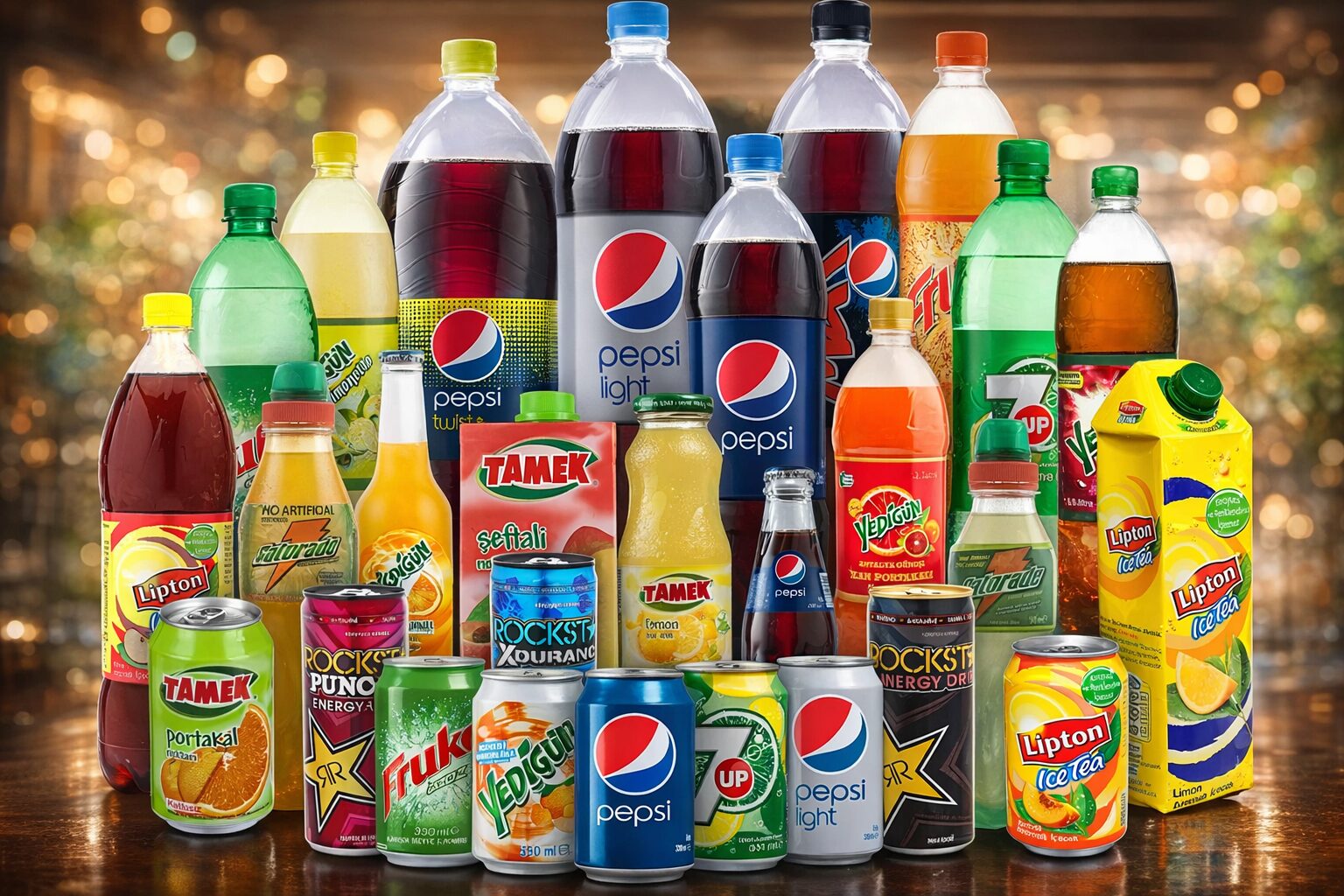
Nigeria’s soda war has had the same two winners for 70 years. A king just announced he wants to change that. History says he should be worried. His balance sheet says otherwise.
When Drinkabl.media first reported OJAJA Drinks’ entry into Nigeria’s beverage market, it called the royally-backed brand the most intriguing debut of 2026, a wildcard capable of becoming genuinely iconic, or a cautionary tale about the gap between concept and execution. The stakes, as it turns out, are much older than the brand. Nigeria’s $33bn carbonated soft drink market has been a war zone for over seven decades, and every challenger that dared to enter left with battle scars.
Every decade or so, something enters Nigeria’s carbonated soft drink market convinced it will dethrone the giants. Every decade, the giants adapt, absorb, and endure. But February 2026 may have introduced the most culturally loaded challenger yet.
The Ooni of Ife, His Imperial Majesty Adeyeye Enitan Ogunwusi, CFR, Ojaja II, formally unveiled OJAJA Soft Drinks, a 12-flavour indigenous CSD line built on local ingredients, African taste profiles, and a deliberate rejection of excessive artificial additives. Tamarind. Chapman. Ginger Lemon. These are not flavours designed to mimic Coca-Cola. They are a direct cultural counter-offer.
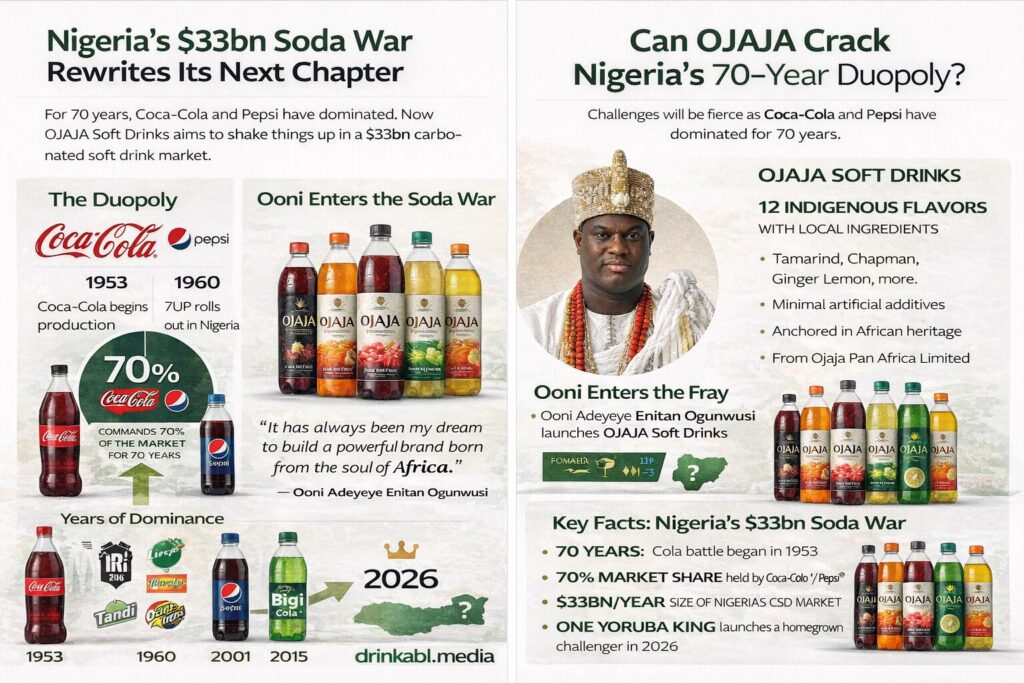
“It has always been my dream to build a powerful brand born from the soul of Africa — one that rises from our continent to command a confident place on the global stage.” — Ooni Adeyeye Enitan Ogunwusi, Ojaja II
The launch is the latest act in a rivalry with deep roots. Nigerian Bottling Company began producing Coca-Cola in 1953 at a facility in Ebute-Metta, Lagos , the first of eight plants it now operates nationwide. Then, on October 1, 1960, the exact morning Nigeria gained independence, the first bottle of 7UP rolled off the production line at Seven-Up Bottling Company’s Ijora factory. Two giants. One nation. A rivalry that has defined Nigerian consumer culture for over six decades.
The 1980s and 90s brought the first wave of would-be disruptors: Afri-Cola, Dr Pepper, Tandi Guaraná, Limca, and Gold Spot. They arrived with fanfare and left quietly, some driven out, others acquired by the very duopoly they sought to challenge. As Drinkabl.media’s 20 Nigerian Beverage Companies to Watch in 2026 documents, the score of that era was unambiguous: a clear winner emerged, and the duopoly entered its most entrenched period.
The first genuine crack appeared not in the 2010s, but in 2001. La Casera Apple launched in November of that year as the first carbonated soft drink in Nigeria packaged in a PET bottle, obliterating the returnable glass bottle as the only route to market and forcing the duopoly to follow with their own PET lines by 2004. LaCasera proved the giants’ walls were not impenetrable. Innovation, not imitation, could buy shelf space.
By 2015, the next wave had arrived. Big Cola, and then Bigi Cola, deployed a new insurgent playbook: giant volumes, aggressive pricing, and variant proliferation. A 65cl Bigi for less than the price of a 50cl Pepsi rewired consumer expectations permanently. These brands did not win the war, but they became fixtures, democratising the category and forcing the duopoly into a sustained and costly response.
Today, Nigerian Bottling Company and Seven-Up Bottling Company still command roughly 70% of the CSD market. OJAJA arrives into that market not with Bigi’s volume playbook, but with something no predecessor attempted: a premium cultural identity anchored in African heritage, backed by Ojaja Pan Africa Limited, a conglomerate that recently completed full repayment of a ₦9.2 billion commercial paper from internally generated resources.
“This is more than a beverage. It is a symbol of cultural renewal and a commitment to economic transformation driven by indigenous enterprise.” — Ooni Adeyeye Enitan Ogunwusi, Ojaja II
As Drinkabl Media notes, OJAJA is 2026’s most intriguing new entrant, a wildcard capable of becoming an iconic brand, or a cautionary tale about the distance between concept and execution. The war is old. The weapon is new. And the duopoly, as always, is watching.
📖 Further Reading on Drinkabl.media: