An industry already battered by naira devaluation and record losses is pushing back hard against what it warns could be a fiscal framework that kills jobs, drives consumers to illicit drinks, and ultimately costs the government itself billions in lost revenue.
Nigeria’s brewing sector has escalated its campaign against the proposed 2026–2028 excise duty framework, with the Beer Sectoral Group (BSG) , the industry body representing Nigerian Breweries, Guinness Nigeria, and International Breweries, taking its case directly to the Federal Ministry of Industry, Trade and Investment. The group engaged Minister of State John Owan Enoh in Abuja, flanked by tax and policy specialists from PwC Nigeria, in what observers described as one of the most substantive brewery-government engagements in recent years.
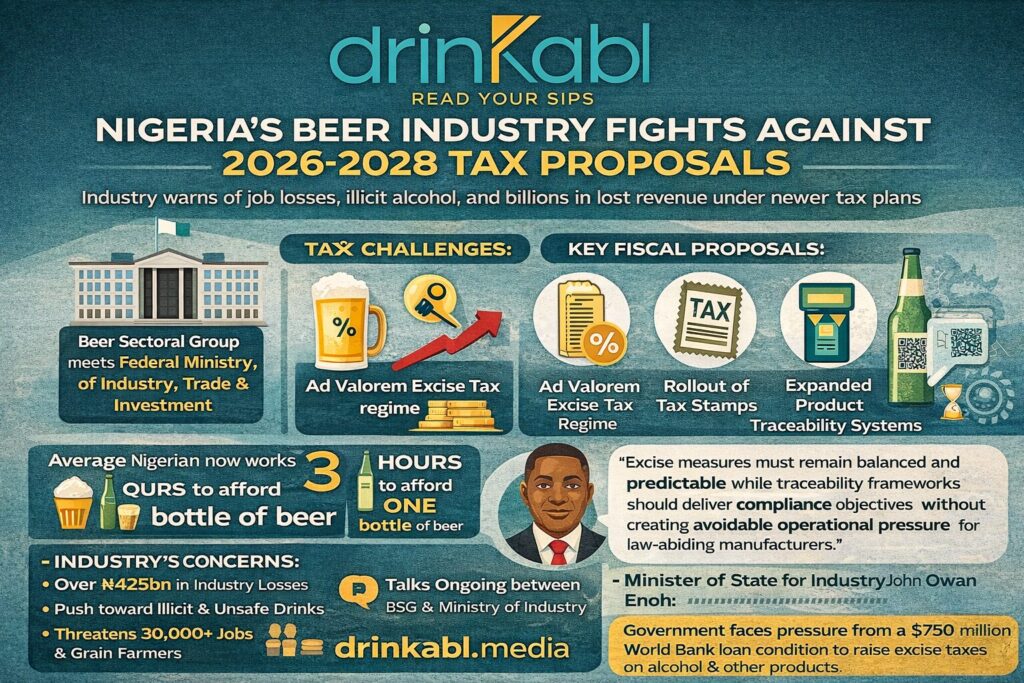
At stake are three interlocking fiscal proposals: the continuation of the ad valorem excise tax regime on beer, the rollout of tax stamps, and the expansion of product traceability systems. Industry executives say the combination piled atop macroeconomic headwinds that have already pushed the sector to combined losses of ₦364.8bn in 2024, risks tipping a fragile recovery into a full-scale contraction.
“Three Hours of Work for a Bottle of Beer”
The most striking data point from the BSG’s PwC-prepared briefing: the average Nigerian consumer must now work up to three hours to afford a single bottle of beer. That affordability crisis, the industry argues, is not just a commercial problem, it is a public health one. PwC’s analysis warned that the current tax regime could push consumers toward unsafe, unregulated alternatives THISDAYLIVE, the sort of illicit homebrew that has historically been associated with poisoning incidents across West Africa.
The PwC report also quantified what is at risk if the proposed framework proceeds unchanged: potential losses of over ₦425 billion for the industry, a significant shortfall in government revenue, and further strain on a sector that supports over 30,000 jobs and sources approximately 300 metric tonnes of grains locally Brand Times, an agricultural value chain that feeds into sorghum and barley farmers across multiple Nigerian states.
A Sector Still Climbing Out of a Hole
The urgency of the BSG’s lobbying effort is inseparable from the industry’s recent financial history. Following the 2023 naira devaluation, all three major brewers reported sustained losses. Despite a 71.8 per cent year-on-year surge in revenue to ₦1.9 trillion in 2024, the sector recorded its second consecutive annual Loss Before Tax, this time of ₦364.8 billion, with the cost of goods sold rising faster than revenue due to the naira’s 46.2 per cent depreciation and elevated petrol costs. Punch
There were green shoots by year-end: for the first time since Q1 2022, all major players posted a combined Profit After Tax of ₦7.4 billion in Q4 2024, a momentum that extended into Q1 2025 with PAT rising 148.2 per cent year-on-year to ₦81.9 billion. Punch That nascent recovery is precisely what the BSG says a poorly calibrated excise hike could snuff out.
This is not the industry’s first rodeo with excise-driven pressure. Each major duty revision since 2018 — escalating through the 2022 fiscal policy measures and the 2023 rate revisions that set beer excise at ₦75 per litre, rising to ₦100 by 2024 — has prompted a similar cycle: price increases, volume compression, and margin erosion that ultimately undercuts the government’s own revenue targets.
Government’s Balancing Act
Minister Enoh acknowledged the consultations already conducted with the Tariff Review Board but stopped short of any commitment to revise the framework. His response, nonetheless, signalled an awareness that blunt fiscal instruments can be self-defeating.
“Excise measures must remain balanced and predictable to support long-term business planning, while regulatory tools such as traceability frameworks should deliver compliance objectives without creating avoidable operational pressure for law-abiding manufacturers.” — John Owan Enoh, Minister of State for Industry
The minister also used the meeting to press the brewing sector to play a larger role in the 18-month Made in Nigeria campaign, framing the government’s industrial policy ambition as a shift away from an extractive economic model toward value-added manufacturing.
The broader fiscal context adds another layer of complexity: the World Bank has separately urged Abuja to issue a presidential order raising excise duties on alcohol, tobacco, and sugary drinks as a disbursement condition tied to a $750 million non-oil revenue reform loan, meaning the government faces external pressure to raise taxes at the very moment the industry is pleading for restraint.
The Traceability Question
Beyond the headline duty rates, industry players flagged the proposed expansion of traceability systems as a specific operational concern. Tax stamps on beverage packaging , while designed to curb illicit trade and improve compliance, add cost and logistical complexity at the point of production. The BSG’s argument is that these systems, if introduced too rapidly or without adequate lead time, create friction for compliant manufacturers while doing little to curb the informal sector they are designed to target.
Enoh’s response on this point was notably measured: he accepted that traceability tools must deliver compliance outcomes without generating “avoidable operational pressure” for manufacturers working within the law, language the industry will hope translates into a phased, consultative implementation timeline.
What Comes Next
The engagement is not a one-off. Both sides framed it as part of a continuing dialogue, with further consultations expected before any framework is finalised. Given the World Bank’s conditions, the government’s revenue targets under the Nigeria Tax Act 2025, and the industry’s fragile recovery, the next twelve months of negotiations will likely determine whether Nigeria’s brewing sector enters 2026 on the front foot, or facing another grinding cycle of losses.
Further Reading | From Drinkabl.media
- Rising Costs, Brand Switching, and Public Health Risks: The Triple Threat of Inflation — A deep-dive analysis of how inflationary pressure is reshaping consumer behaviour and pushing drinkers toward cheaper, often unregulated alternatives. Essential context for understanding the affordability crisis facing Nigeria’s formal brewing sector.
- How Health, Innovation, and Youthful Demands Are Driving Africa’s Beverage Industry in 2026 — A sweeping look at the structural forces reshaping Africa’s drinks market, from Lagos to Nairobi — and why getting fiscal policy wrong could choke off the continent’s most dynamic consumer growth story.
- Beta Glass Changes Hands as Helios Bets Big on Nigeria’s Booming Beverage Sector — A €100 million private equity bet on Nigeria’s packaging industry signals sustained investor confidence in the beverage value chain — confidence the Beer Sectoral Group says the excise framework must not undermine.
- NDL’s Seamans Bless 20cl Launch Tests Innovation & Regulation — How one drinks company is navigating Nigeria’s shifting regulatory environment through product innovation — a microcosm of the broader industry tension between compliance and commercial survival.
- Major Alcohol Producers Face Historic Inventory Crisis as Global Demand for Premium Spirits Drops — Nigeria’s challenges are not isolated: a $22bn global inventory glut among the world’s biggest alcohol groups shows how macro headwinds are squeezing the industry on every front.
- 2025 Business Performance: Nigerian Breweries Celebrates and Rewards Trade Partners — A closer look at Nigerian Breweries’ recovery momentum and its downstream distribution network — the same network that stands to contract sharply if the proposed excise framework lands without adjustment.