A quiet ingredient in your favourite juice or dairy drink is becoming the centre of a billion-dollar green chemistry race, and beverage manufacturers may soon be sourcing it very differently.
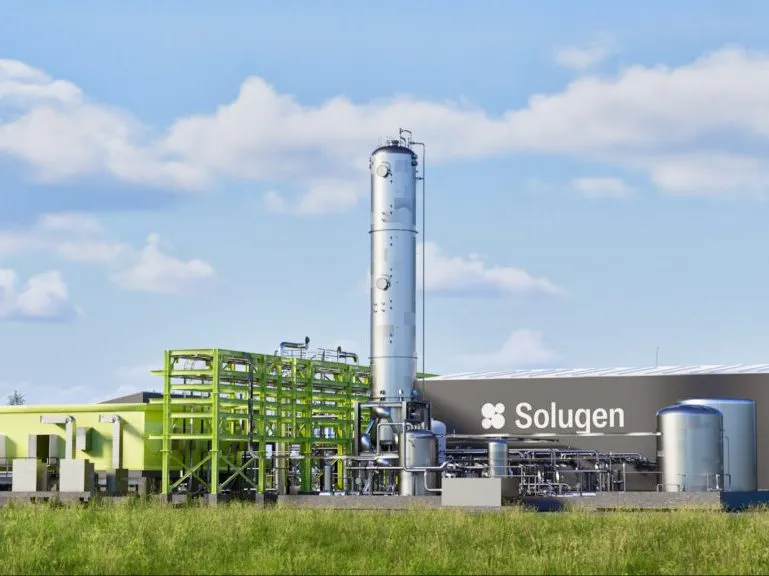
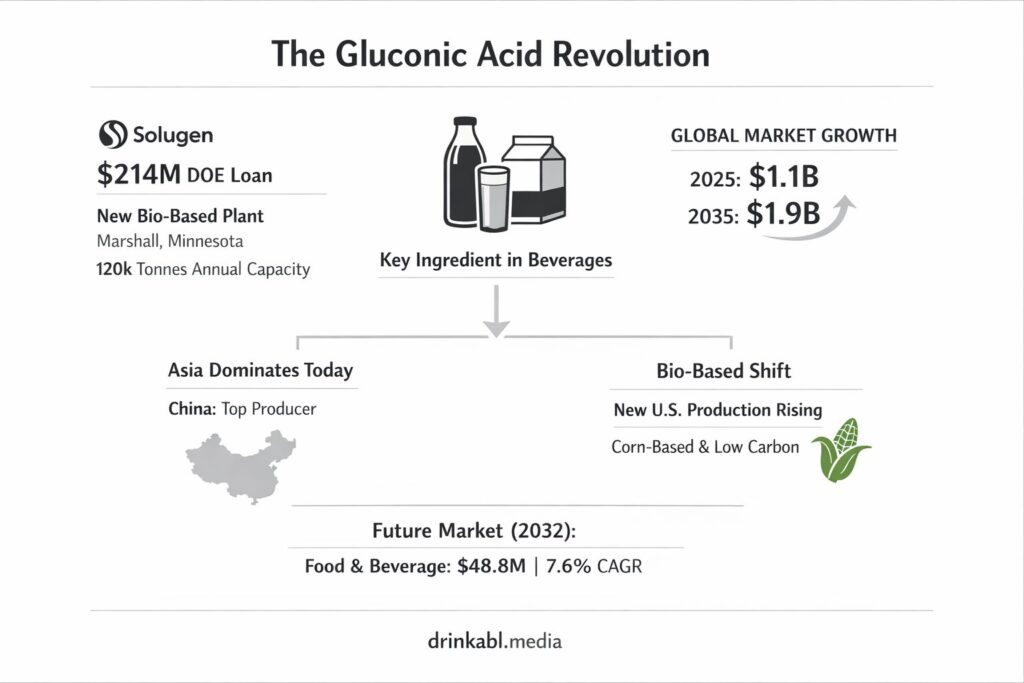
Biomanufacturing firm Solugen secured a $214 million loan backed by the US Department of Energy to finance a biobased chemical plant in Minnesota, where enzymatic and chemical processes will convert dextrose into glucaric acid, gluconic acid, and hydrogen peroxide. Solugen broke ground on the Marshall facility in April 2024, with a projected production capacity of 120 kilotonnes per annum and an estimated 50 manufacturing jobs at full production.
The ingredient you’ve never heard of is having a moment. Gluconic acid, the mild, naturally-derived organic acid hiding inside your fruit juice, fortified dairy drink, and functional beverage, is at the heart of a fast-growing global market projected to climb from USD 1.1 billion in 2025 to USD 1.9 billion by 2035, according to a new industry report. And a flurry of investment activity, including a landmark government-backed bet on bio-based production, is set to reshape where the beverage industry gets it.
Solugen CEO Gaurab Chakrabarti framed the moment as transformative for the whole industry, saying:
“We’re not going to be the first and last company that does this.”
Why Beverage Makers Are Paying Attention
For drink formulators, gluconic acid is a workhorse. Beverage producers leverage its tasteless buffering qualities to refine mouthfeel and shelf stability, while dairy processors employ it to enhance calcium fortification and pH regulation. It also carries that golden regulatory credential: FDA recognition as GRAS, Generally Recognized as Safe — and long-established use in food and beverage applications as an acidity regulator, a status also affirmed by EFSA.
But the bigger commercial tailwind is the clean label movement. According to Beverage Industry Magazine:
“Clean label has become a key driver of purchase decisions across food and beverage categories,”
with media coverage around ultra-processed products intensifying and shoppers increasingly seeking natural, recognizable ingredients. Gluconic acid, derived from the oxidation of glucose, fits that brief. It’s natural, mild, and functional, a rare trifecta in food science.
By 2032, the food segment of the gluconic acid market is estimated to reach USD 48.8 million, growing at a CAGR of 7.6%. Meanwhile, new research is reframing gluconic acid not just as a functional additive, but as a biologically active substrate capable of influencing gut microbiome networks, opening fresh doors for formulators in the functional beverage and gut-health drink categories.
Asia Pacific Leads, But Bio-Based Supply Is Shifting the Map
The Asia-Pacific region stands as the undisputed leader in the global gluconic acid market, with China serving as both the largest producer and consumer globally, supported by readily available raw materials, particularly glucose derived from corn.
But the Solugen Minnesota plant, strategically positioned next to an ADM corn processing complex, signals that North American bio-based supply is scaling up fast. Solugen’s process uses dextrose derived from corn, which absorbs carbon dioxide as it grows, positioning bio-based gluconic acid as both a supply chain and sustainability play for beverage companies. Read the full C&EN breakdown here.
Challenges Remain
The market isn’t without friction. Production still relies heavily on microbial fermentation, which is expensive to scale. Geopolitical tensions, particularly US-China trade dynamics, have raised tariffs on glucose-derived raw materials, complicating supply chains for manufacturers sourcing from Asia. And competition from citric and lactic acid remains a constant pressure.
Still, the convergence of clean-label consumer demand, gut-health science, and green chemistry investment is giving gluconic acid a profile upgrade it has long deserved. For beverage brands building next-generation formulations, the question may soon be not whether to use gluconic acid, but where they source it.
Further Reading from Drinkabl: