
The Brands Shaping the Sip — From Boardroom Moves to Bottle Sales
Nigeria’s beverage industry enters 2026 with its sleeves rolled up. The bloodbath of 2023 and 2024, naira devaluation, sky-high input costs, and a sector that bled ₦364.8 billion in combined losses, is now, cautiously, in the rearview mirror. The brewers are profitable again. Challenger brands are grabbing shelf space. A royally-backed indigenous premium drink just launched. And somewhere in Abuja, industry lobbyists and government officials are locked in a high-stakes negotiation over an excise framework that could define the next three years.
This is not a moment for a passive rankings list. It’s a moment to ask: who are the companies actually worth watching, and why? Which players are executing bold bets that could reshape the competitive landscape? Whose stories will matter most before the year is out?
We’ve identified 20 Nigerian beverage companies that answer that question. Some are established giants navigating their next chapter. Others are insurgents growing too fast to ignore. A few are names you may not have heard of yet, but won’t forget by December. These are the ones to watch.
Why 2026 Is Different
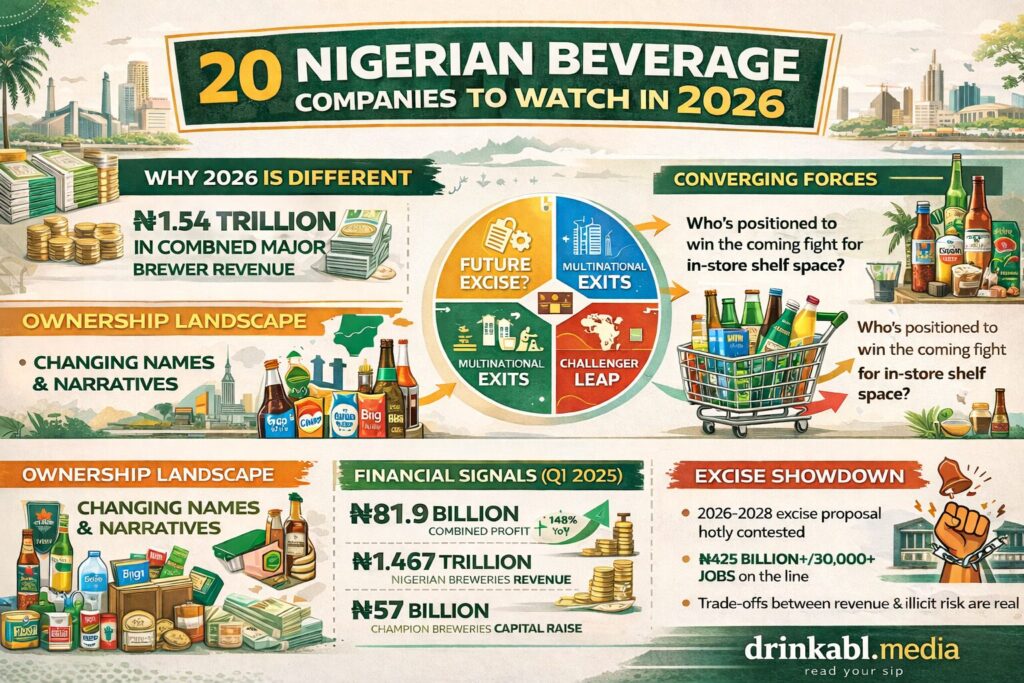
The numbers set the scene. In the first nine months of 2025, combined revenues from Nigeria’s four major listed brewery firms alone exceeded ₦1.54 trillion, a figure that would have seemed improbable two years ago when foreign currency losses were obliterating bottom lines. The sector clawed back to a combined Profit After Tax of ₦7.4 billion in Q4 2024, the first collective profitability since Q1 2022, and accelerated hard into 2025 with Q1 PAT rising 148% year-on-year to ₦81.9 billion.
But this isn’t simply a recovery story. 2026 is an inflection year shaped by several converging forces: a proposed 2026–2028 excise overhaul that the industry is fighting tooth and nail; a completed multinational ownership exit that has redrawn the Guinness Nigeria chapter; a challenger brewer making an audacious pan-African leap; and a growing wave of indigenous brands positioning themselves at the intersection of culture, taste, and commercial ambition.
The competitive landscape blends large, publicly listed conglomerates with nimble regional manufacturers. Global players maintain deep nationwide distribution networks, while local producers are innovating faster than they ever have in flavoured malt, juices, RTDs, and energy drinks. The top tier is consolidated, but the companies moving with the most purpose right now are not all at the top.
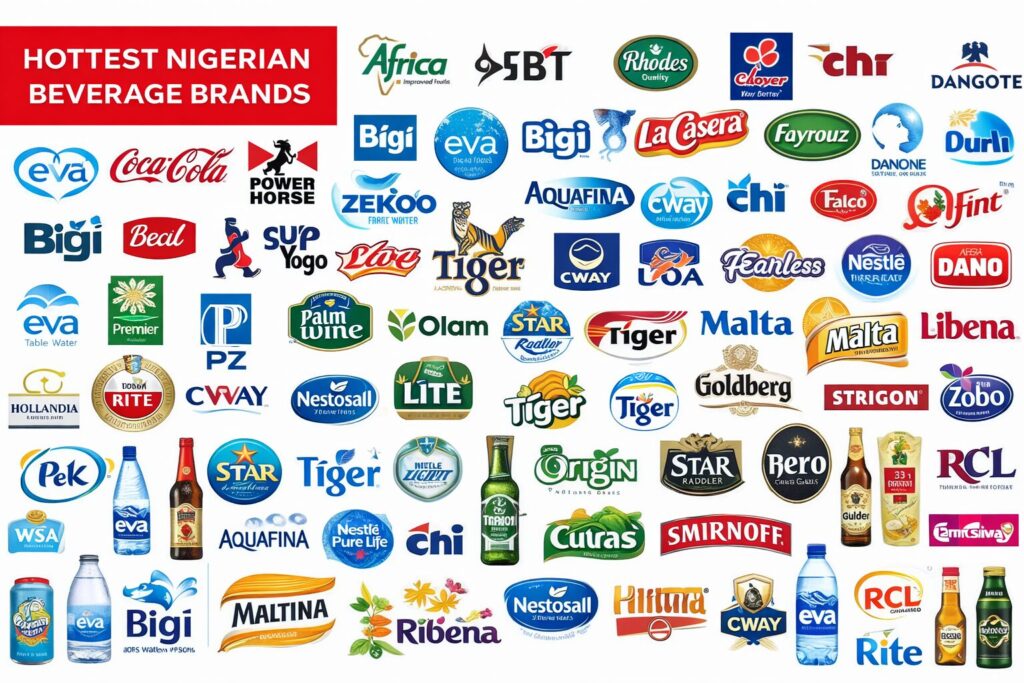
The 20 Nigerian Beverage Companies to Watch in 2026
Counting Down: #20 to #1
20. OJAJA Drinks — The New Name You Need to Remember
The most intriguing debut on this list, and a fitting place to start the countdown. OJAJA Drinks launched with the backing of the Ooni of Ife, positioning itself at the intersection of cultural identity, tradition, and premium beverages. It’s an interesting bet, that Nigerian consumers are ready for a premium indigenous drink brand that wears its heritage proudly rather than trying to mimic international aesthetics. It’s early days, but the cultural tailwinds are real and the backing is serious. OJAJA is the one wildcard on this list capable of becoming a genuinely iconic brand — or a cautionary tale about the gap between concept and execution. Either way, it’s 2026’s most compelling new entrant. Read more: OJAJA Drinks Debuts as Ooni Backs Nigeria’s Beverage Industry — Drinkabl.media
19. Cadbury Nigeria (Bournvita) — An Institution, Facing Modern Questions
Bournvita is as close to a beverage institution as Nigeria has. The Cadbury-backed cocoa-based fortified drink has shaped breakfast tables and school tuck boxes for generations. In 2026, it faces the same scrutiny that has confronted Bournvita globally: growing consumer and regulatory attention on sugar content in children’s beverages. How Cadbury Nigeria navigates this conversation, reformulation, marketing pivot, or both — is one of the more quietly important brand stories of the year.
18. FrieslandCampina WAMCO Nigeria (Peak) — Trusted, Penetrated, and Watching Its Flanks
Peak is one of those rare brands that has achieved near-universal household recognition across income levels. FrieslandCampina’s fortified dairy beverages have genuine nutritional equity with Nigerian consumers, and that trust is hard to buy. In 2026, the watch point is competitive pressure from both premium imports and domestic dairy alternatives, as health-conscious consumers increasingly interrogate ingredient labels. Peak has the brand heritage, can it refresh its relevance for a younger, more discerning consumer?
17. Fearless Energy Drinks — The Local Energy Champion
If Monster is the premium story, Fearless is the volume story. Nigeria’s leading local contender in the energy drink category frequently outsells imported alternatives at the point of sale, built on aggressive pricing and locally-resonant marketing. In 2026, the watch point is whether Fearless can sustain volume leadership as Monster pushes harder and new entrants crowd into a category that everyone now recognises as high-growth.
16. Monster Beverage (via Coca-Cola Bottling Network) — Premium Energy, Growing Fast
Distributed through the Coca-Cola bottling infrastructure, Monster is the most visible signal of premiumisation in Nigeria’s energy drink segment. Its urban consumer base is brand-aware, aspirational, and growing. In 2026, the watch point is whether Monster can penetrate beyond Lagos and Abuja’s premium retail corridors into broader distribution, and whether it can hold price in a segment where local challengers are investing heavily.
15. Promasidor Nigeria Ltd (Cowbell) — The Household Staple That Never Slips
Cowbell’s retail saturation is the kind of thing that keeps competitors awake at night. Promasidor’s powdered milk and dairy-adjacent beverages are embedded deeply across income segments, and the brand has outlasted economic shocks that have felled less resilient consumer goods propositions. In 2026, as inflationary pressure begins to ease, watch whether Promasidor uses the breathing room to reinvest in product innovation or simply consolidates its formidable existing position.
14. Akwa Ibom Breweries Ltd — Southern Market Strength
Strong regional resonance and distribution infrastructure in Southern Nigeria give Akwa Ibom Breweries a durable base. Watch for whether the broader Southern market recovery, partly driven by Champion Breweries’ Bullet ambitions and NDL’s distribution push, creates competitive pressure or simply lifts the category tide for all players. In 2026, it could be a bit of both.
13. ABC Breweries Plc — Eastern Nigeria’s Enduring Anchor
There’s a lesson in ABC Breweries’ resilience: in Nigeria’s geographically diverse market, regional dominance carries real commercial weight. ABC commands deep brand loyalty and tight distribution relationships in Eastern Nigeria, and in a year when the national brewers are focused on their own recovery and expansion, ABC’s relative stability in its core geography makes it a steady watch. It won’t surprise anyone with a 9,000% profit jump, but don’t bet against its staying power.
12. Planet Bottling Company / Monarch Beverages — The Next Generation Mid-Tier
Planet Bottling represents what the next wave of mid-tier Nigerian beverage operators looks like, diversified across cola, energy, and fruit-flavoured drinks, competing aggressively for shelf space without the legacy cost structures of the multinationals. In 2026, mid-tier operators like Planet face a genuine inflection point: consolidate distribution gains or risk being squeezed between the returning giants above and the price insurgents below.
11. Farm Pride (Niyya Foods & Drinks) — Riding the Health Wave
Health-conscious beverage consumption is a real and growing trend in urban Nigeria, and Farm Pride is better positioned than most to benefit from it. Its natural juices and yoghurt-based drinks occupy a niche that is punching above average growth rates. In 2026, with consumer interest in functional and better-for-you products accelerating, Farm Pride’s watch point is distribution scale , whether it can get beyond its current footprint and into the national modern retail channel in a meaningful way.
10. Mamuda Beverages — The Value-Segment Insurgent
Mamuda doesn’t make many headlines outside of the trade, but in price-sensitive consumer segments, which is most of Nigeria, it is building something real. Agile pricing and regional distribution have enabled rapid expansion among consumers who have been squeezed by inflation and are looking for quality at accessible price points. In 2026, as the formal beverage sector grapples with excise reform and rising costs, Mamuda’s positioning becomes even more relevant. One to watch carefully.
9. Nigeria Distilleries Ltd (NDL) — The Heritage Brand Rewiring Itself
NDL is one of Nigeria’s most established indigenous producers in the wines and spirits segment, and it enters 2026 with a genuine strategic renovation underway. The company has restructured its route-to-market approach to deepen retail penetration, and its recent 20cl Seamans Bless launch shows it’s willing to innovate within a tightly regulated environment. For a heritage brand, that instinct for reinvention is encouraging. Watch how its new distribution engine performs through the year, and whether it can convert brand loyalty into actual volume growth. Read more: NDL Rewires Its Distribution Engine for 2026 — Drinkabl.media
8. Rite Foods Group — Bigi Keeps Growing Up
Bigi is arguably the most disruptive beverage brand Nigeria has produced in recent memory. Rite Foods built market share through blunt, effective price-competitiveness, but the brand is maturing, and in 2026 the story is about whether it can hold volume share while also moving upmarket. Bigi’s aggressive SKU expansion and distribution reach have made it one of the most consequential Nigerian challenger brands of the past five years. The question now is whether Rite Foods has the organisational capability to manage a brand that’s outgrown its “scrappy challenger” positioning.
7. CHI Limited (Chivita | Hollandia) — Under New Ownership, Watching for New Energy
The market leader in packaged juices and dairy-based beverages is now part of the UAC of Nigeria stable, following its acquisition. The Chivita and Hollandia brands have strong consumer equity, Chivita dominates packaged juices, Hollandia owns flavoured dairy beverages. The watch point in 2026 is whether UAC’s conglomerate backing translates into meaningfully expanded distribution and category innovation, or whether integration friction slows things down. If UAC gets this right, the combined entity is a very different competitive force in non-alcoholic beverages.
6. Seven-Up Bottling Company Ltd — The Quiet Giant with Something to Prove
Nigeria’s PepsiCo bottler is one of the most recognised beverage operators in the country, and in 2026 it faces a pivotal question: how does it respond to the pressure from both above (Coca-Cola’s intensified investment) and below (the value-segment insurgency led by Rite Foods)? Pepsi, 7Up, Mirinda, and Lipton Ice Tea give it breadth, but breadth alone doesn’t win share wars. Seven-Up’s distribution depth across modern retail and informal trade remains a formidable asset. How it activates that asset in 2026 will tell us a lot about the company’s strategic direction.
5. Nigerian Bottling Company (Coca-Cola HBC Nigeria) — Distribution Dominance, Redoubled
The primary bottler of Coca-Cola, Fanta, and Sprite in Nigeria isn’t going anywhere, and that’s precisely why it belongs in the top five. In a year when macroeconomic pressures are easing and consumer confidence is tentatively returning, NBC is the vehicle through which Coca-Cola’s reported $1 billion investment commitment to Nigeria gets expressed on the ground. The company has doubled down on consumer reward programmes and retail activation in early 2026. Watch for how it responds to the rising competitive pressure from domestic challengers like Bigi, who have been eating into volume share with aggressive pricing.
4. Champion Breweries Plc — The Most Exciting Company in Nigerian Beverages Right Now
Say the name loud, because Champion Breweries deserves every bit of the attention it’s about to receive. The Uyo-based brewer delivered a 9,662% increase in after-tax profit for the nine months ended September 2025, posting ₦2.05 billion PAT on revenues 53% higher at ₦21.44 billion. Its acquisition of Bullet, Nigeria’s leading RTD alcoholic brand, distributed across 14 African markets, sets up a projected fivefold revenue growth. A ₦15.91 billion rights issue and a ₦42 billion public offer are funding the buildout. The share price was the best-performing brewery stock on the NGX in 2025, gaining over 246% year-to-date. In 2026, the question isn’t whether Champion is worth watching, it’s whether the execution can keep pace with the ambition. Everything suggests it can.
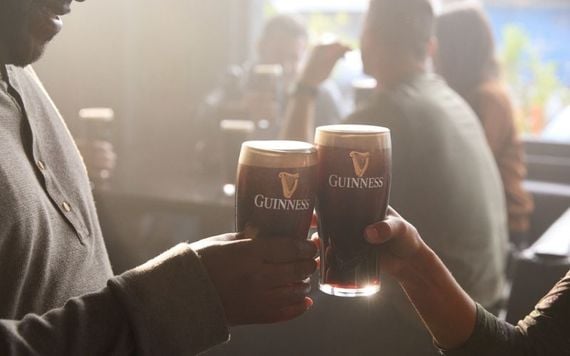
3. Guinness Nigeria Plc — A New Chapter Under Tolaram
The stout icon has been handed to new owners, and 2026 is the year we begin to see what Tolaram actually does with it. Diageo completed the sale of its majority stake in early 2025, transferring equity control to Tolaram, a pan-African conglomerate with deep Nigerian consumer goods roots, while retaining brand exposure through licensing. Tolaram brings serious distribution muscle and local market instincts. The key watch point in 2026 is whether the operational integration translates into the kind of commercial aggression that the Guinness brand has arguably been waiting for. A locally-anchored Guinness with a motivated new owner could be a very different competitive force.
2. International Breweries Plc — The Comeback Kid
If Nigerian Breweries is the market anchor, International Breweries is the most dramatic comeback story of the cycle. The company swung from a ₦89.3 billion pre-tax loss in Q1 2024 to a ₦35 billion pre-tax profit in Q1 2025, while revenue rose 68% to ₦173.6 billion. Its share price gained over 176% year-to-date through mid-2025. The structural question for 2026 is whether this momentum is durable, or whether margin pressures and excise risk will complicate the trajectory. Either way, this is a company worth watching every quarter.
1. Nigerian Breweries Plc — The Giant Finds Its Footing Again
The sector anchor. The benchmark. The name every serious conversation about Nigerian beverages starts, and ends, with. Nigerian Breweries recorded revenues of approximately ₦1.04 trillion for the first nine months of 2025, a 48% year-on-year increase, before closing out the full year at ₦1.467 trillion, a 35% uplift on 2024. The 2024 rights issue that eliminated foreign currency debt exposure was the strategic masterstroke that made this recovery possible. In 2026, the question is whether Nigerian Breweries can now shift from recovery mode to genuine growth mode, expanding portfolio, deepening distribution, and integrating its recently completed Distell Wines and Spirits Nigeria acquisition into a broader premium offering. The biggest company on this list, with the most to build on. Watch this space.
The Bigger Picture: What Will Define the Sector in 2026
The Excise Standoff Will Set the Tone Everything else is secondary to how the 2026–2028 excise duty framework gets resolved. The Beer Sectoral Group, representing Nigerian Breweries, Guinness Nigeria, and International Breweries, has gone to the Federal Ministry of Industry, Trade and Investment with PwC analysis warning that the proposed framework puts over ₦425 billion of industry value at risk, alongside 30,000+ jobs and the agricultural supply chains that feed into it. The government faces countervailing pressure from the World Bank, which has tied a $750 million non-oil revenue reform loan partly to excise increases on alcohol and sugary drinks. Whoever blinks first in this negotiation shapes the profitability ceiling for the entire sector through 2028. Read more: Nigeria’s Brewers Sound the Alarm on Three-Year Excise Plan, With ₦425bn on the Line — Drinkabl.media
Ownership Transitions Are Reshaping the Landscape Diageo out, Tolaram in. UAC absorbs CHI. Champion makes its pan-African move. These aren’t footnotes, they are structural changes to who controls what, and how those assets get deployed. The ownership map of Nigerian beverages looks materially different in 2026 than it did in 2023, and the full commercial implications are still playing out.
The Illicit Trade Risk Is Real and Underreported Here’s a story that doesn’t get enough column space: as formal beverage prices rise under the combined weight of taxation and input cost inflation, consumers don’t disappear — they migrate. Some trade down to cheaper legitimate brands. But some move into unregulated, informal alternatives that carry genuine public health risks. PwC’s modelling for the BSG flagged this explicitly. If excise reform lands badly, the winners won’t be the government’s revenue targets, they’ll be the illicit producers. That’s a policy failure nobody wants to own.
The Insurgents Are Getting Stronger The most underappreciated theme of 2025 was how much ground challenger brands gained while the multinationals were nursing their balance sheets. Bigi is bigger than ever. Mamuda is building. Fearless dominates energy drink volume. OJAJA enters the premium space. The established players have recovered, but they’re recovering into a market where the competitive field is materially more crowded than when they were last operating at full strength.
Financial Signals to Keep on Your Radar
The sector’s combined Q1 2025 PAT of ₦81.9 billion, up 148% year-on-year, confirms the recovery is structural, not cosmetic. Nigerian Breweries’ full-year 2025 revenue of ₦1.467 trillion signals the scale of the rebound. Champion Breweries’ capital raise north of ₦57 billion signals the scale of the ambition. And the proposed excise framework signals the scale of the risk. All four numbers deserve to be in your head as you watch this sector through 2026.
Signals to Watch Before the Year Is Out
Whether Champion Breweries’ Bullet integration delivers the fivefold revenue projection, or reveals the gap between deal logic and operational reality , will be the most important single story in Nigerian beverages this year.
How Guinness Nigeria performs under Tolaram’s first full year of ownership will show whether a completed multinational exit is a beginning or an ending.
Whether any of the mid-tier operators, Planet Bottling, Farm Pride, Mamuda, make moves toward formal capital markets access or strategic partnerships, signaling the next wave of sector consolidation.
How the major bottlers respond to the continuing erosion of volume share by value-segment challengers in a market where consumer purchasing power, while improving, remains constrained.
And whether OJAJA Drinks becomes the story that finally proves Nigerian consumers are ready for a premium indigenous beverage brand built on cultural pride.
The sip economy is alive, evolving, and never boring. These are the 20 companies that will write the next chapter.
Further Reading | From Drinkabl.media
- Nigeria’s Brewers Sound the Alarm on Three-Year Excise Plan, With ₦425bn on the Line — The full story behind the BSG’s government engagement, the PwC modelling, and what a poorly calibrated excise hike could mean for jobs, revenue, and public health.
- NDL Rewires Its Distribution Engine for 2026 — How Nigeria Distilleries is restructuring its route-to-market strategy for a new economic reality.
- OJAJA Drinks Debuts as Ooni Backs Nigeria’s Beverage Industry — The full story on the most culturally compelling beverage launch of the year.
- 2025 Business Performance: Nigerian Breweries Celebrates and Rewards Trade Partners — Inside Nigerian Breweries’ recovery momentum and its downstream distribution network.
- Coca-Cola Nigeria Bets Big on Consumer Rewards as Economy Shows Signs of Recovery — How the country’s dominant soft drinks bottler is activating consumers as macroeconomic conditions stabilise.
- Data Story: Brewery Firms With The Highest Revenue Generated In H1 2024 — The numbers behind the sector’s revenue concentration, visualised.
- How Health, Innovation, and Youthful Demands Are Driving Africa’s Beverage Industry in 2026 — The structural forces reshaping the continent’s drinks market and why Nigeria sits at the centre of the opportunity.
Drinkabl Media connects the dots between drinks, brands, and people. From water to wine, beer to spirits — whatever you sip, you can read it on Drinkabl. Subscribe at drinkabl.media for weekly insights and trends on Africa’s beverage industry.