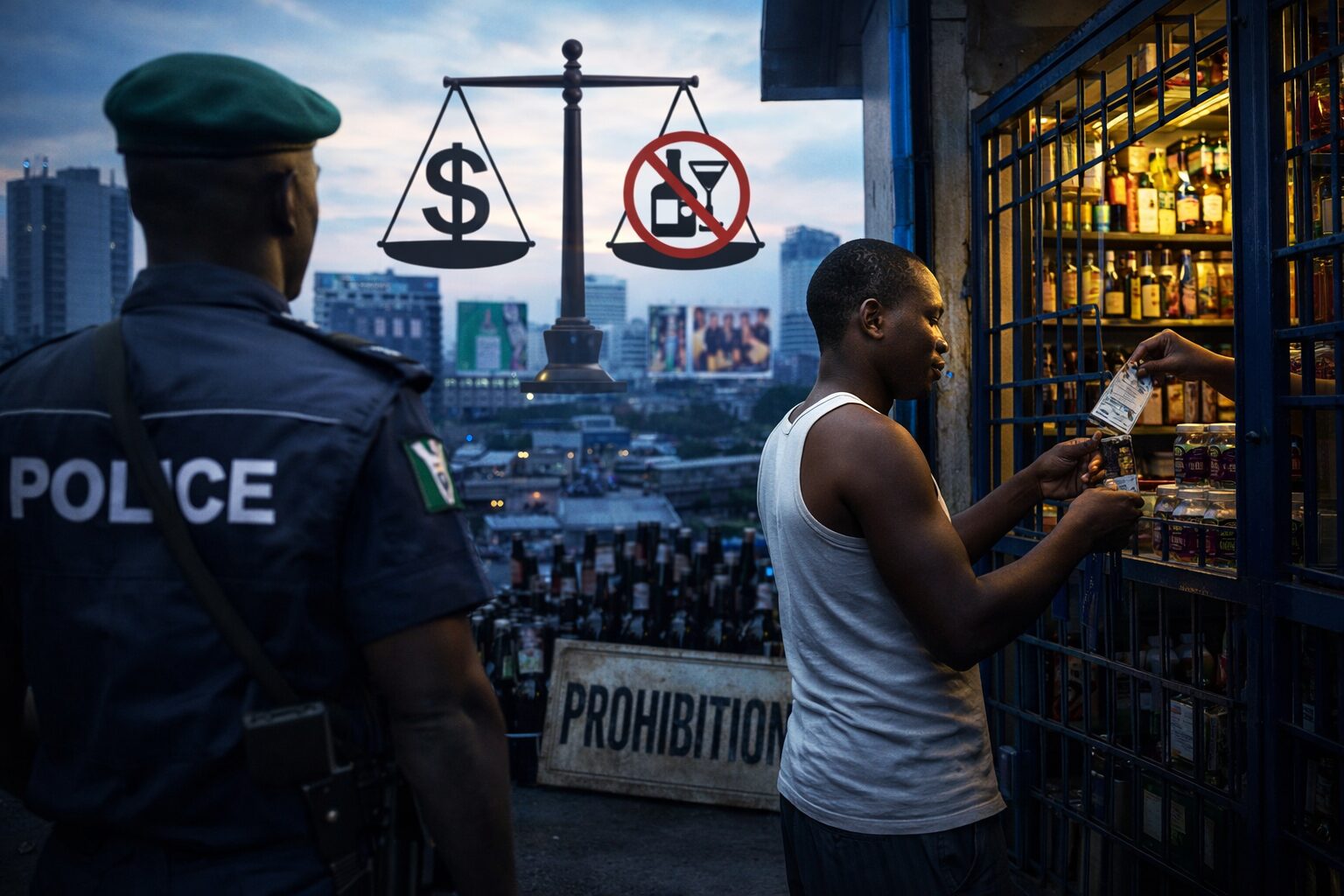
Though Nigeria has suspended its crackdown and implementation of its ban on sachet alcohol, coupled with African governments grappling with rising youth consumption rates, the beverage industry is facing what experts call a familiar dilemma, which is how to balance public health imperatives with economic realities.
The answer may lie in examining America’s failed experiment with total prohibition a century ago. This is conversely because this isn’t the first time governments have attempted to solve alcohol-related social ills through prohibition. Between 1920 and 1933, the United States embarked on what would become one of history’s most consequential regulatory experiments: the complete ban on the manufacture, sale, and transportation of alcoholic beverages under the 18th Amendment. The lessons from that era remain strikingly relevant as African nations navigate their own complex relationship with alcohol regulation.
This isn’t the first time governments have attempted to solve alcohol-related social ills through prohibition. Between 1920 and 1933, the United States embarked on what would become one of history’s most consequential regulatory experiments: the complete ban on the manufacture, sale, and transportation of alcoholic beverages under the 18th Amendment. The lessons from that era remain strikingly relevant as African nations navigate their own complex relationship with alcohol regulation.
The Prohibition Precedent: Unintended Consequences at Scale
The Volstead Act, which enforced Prohibition in the United States, was intended to reduce crime, improve public health, and strengthen families. Instead, it catalyzed the opposite. According to research published by the Cato Institute, the ban spawned a massive underground economy controlled by organized crime syndicates, with annual illegal alcohol sales estimated at $3 billion during the 1920s, equivalent to roughly $50 billion in today’s dollars.
“Prohibition didn’t eliminate the demand for alcohol; it simply transferred that demand to unregulated, often dangerous channels,” explains Dr. Sarah Mitchell, a public health economist at Johns Hopkins University who has studied alcohol policy across multiple continents. “We saw adulterated spirits causing mass poisonings, criminal enterprises gaining unprecedented power, and government revenue from legitimate alcohol taxes evaporating overnight.”
The beverage industry experienced devastation. Thousands of breweries, distilleries, and associated businesses shuttered permanently. According to the Brewers Association, the number of U.S. breweries plummeted from approximately 1,300 in 1919 to effectively zero by 1933. When Prohibition ended, the industry required decades to rebuild, and many heritage brands never recovered.
For governments, the fiscal impact proved equally catastrophic. Federal tax revenue from alcohol, which had contributed nearly 30 percent of government income before Prohibition, vanished entirely, forcing lawmakers to implement the first peacetime income tax to compensate for the shortfall.
Africa’s Modern Regulatory Challenge
Fast-forward to 2026, and African policymakers face remarkably similar pressures. The World Health Organization reports that while overall alcohol consumption in Africa remains below global averages, harmful drinking patterns, including heavy episodic drinking among youth—pose significant public health challenges. In Nigeria, where approximately 40 percent of the population lives below the poverty line, cheap sachet alcohol has become associated with problem drinking, violence, and health complications.
“The sachet alcohol market emerged to serve low-income consumers, but it’s created accessibility issues we can’t ignore,” says Professor Oluwaseun Akinyemi, a public health researcher at the University of Lagos. “Children can purchase these products for less than the cost of a soft drink, and the packaging makes consumption easy to conceal from parents and authorities.”
Nigeria’s ban follows similar restrictive measures across the continent. Kenya imposed higher taxes on alcohol in recent years and restricted trading hours, while South Africa implemented some of the world’s strictest alcohol advertising regulations. Ghana banned sachet alcohol in 2018, though enforcement has proven challenging.
Yet the parallels to Prohibition extend beyond intent. In Nigeria, industry analysts estimate that the sachet alcohol ban affects a market segment generating approximately ₦150 billion ($200 million) annually and supporting thousands of jobs in production, distribution, and retail. The Nigerian Breweries Sector Report indicates that major beverage companies derive significant revenue from affordable alcohol formats popular in informal settlements and rural areas.
The Illicit Market Problem
The most concerning parallel involves unintended consequences. Ghana’s experience with sachet alcohol prohibition offers a cautionary tale. Despite the 2018 ban, reports from the Ghana Health Service indicate that sachet alcohol consumption continued largely unabated, with products now sourced through informal channels and neighboring countries where production remains legal. Meanwhile, incidents of methanol poisoning from unregulated homemade spirits have increased, according to local health authorities.
“When you ban a product without addressing the underlying demand drivers, poverty, lack of recreation alternatives, social factors, consumption doesn’t disappear; it goes underground,” explains Marcus Adenuga, a beverage industry analyst with Euromonitor International. “We’ve documented this pattern across multiple African markets. The informal alcohol sector actually grows stronger because it operates outside regulatory oversight entirely.”
Research from the International Alliance for Responsible Drinking suggests that complete bans on specific alcohol categories often prove counterproductive in emerging markets lacking robust enforcement infrastructure. Their data indicates that countries with comprehensive regulatory frameworks—including taxation, licensing, age verification, and quality control, achieve better public health outcomes than those relying primarily on prohibition.
Economic Realities and Public Health Goals
The tension between economic interests and public health objectives remains acute. The formal beverage industry contributes substantially to African economies through taxation, employment, and agricultural supply chains. In Nigeria, the alcohol sector generates over ₦200 billion in annual tax revenue and supports approximately 500,000 jobs directly and indirectly, according to Manufacturers Association of Nigeria estimates.
“Policymakers must recognize that we’re not choosing between public health and economic development, we need both,” argues Dr. James Okonkwo, an economist with the African Development Bank. “The question is how to design policies that protect vulnerable populations, particularly youth, while preserving legitimate economic activity and preventing worse alternatives from emerging.”
The World Bank’s 2020 report on alcohol taxation in Africa recommends a graduated approach: higher taxes on lower-cost products to reduce affordability among at-risk populations, strict age verification requirements, limitations on marketing and availability, and reinvestment of alcohol tax revenue into public health and education programs.
This evidence-based approach contrasts sharply with the all-or-nothing framework that characterized Prohibition and now shapes some African alcohol policies. Countries like South Africa have implemented sophisticated regulatory systems that include minimum pricing, restricted trading hours, comprehensive advertising limitations, and robust age verification, without outright category bans.
What the Industry Must Learn
For beverage companies operating in African markets, the lessons from Prohibition and contemporary policy debates are clear. The industry cannot afford to position itself as opposing all regulation or dismissing legitimate public health concerns. The Prohibition era demonstrated that intransigence and resistance to reasonable oversight ultimately provoke extreme governmental responses.
“Smart beverage companies recognize that responsible regulation is actually in their long-term interest,” says Jennifer Walsh, a corporate strategy consultant specializing in emerging markets. “It creates a stable operating environment, prevents the worst excesses that trigger draconian crackdowns, and maintains social license to operate.”
Leading multinational beverage corporations have begun investing in responsible drinking programs, supporting enforcement of age restrictions, and developing products that address African consumer needs without compromising public health. Diageo, Heineken, and AB InBev have all launched African initiatives focused on reducing harmful drinking patterns while maintaining commercial presence.
Looking Forward: 2026 and Beyond
As Nigeria’s sachet alcohol ban enters its implementation phase and other African nations consider similar measures, policymakers and industry leaders would do well to remember that Prohibition’s ultimate lesson wasn’t that alcohol regulation fails, but that poorly designed, extreme policies produce outcomes worse than the problems they intended to solve.
The path forward requires nuance that Prohibition lacked: evidence-based regulation that acknowledges both public health imperatives and economic realities, enforcement capacity that matches policy ambition, and industry cooperation in designing sustainable frameworks. Most critically, it demands addressing root causes, poverty, youth unemployment, inadequate healthcare access, that drive problematic consumption patterns.
For the beverage industry, the choice is clear: be part of constructive solutions or risk facing the modern equivalent of the 18th Amendment. History suggests the latter option benefits no one.
As African markets continue growing and evolving, the alcohol sector’s future depends on finding this balance, one that eluded policymakers a century ago in America but remains achievable today with better data, stronger institutions, and lessons learned from past failures. The question is whether all stakeholders can demonstrate the wisdom to apply them.