Cloud coffee got us here. Now we’re knee-deep in pistachio lattes, adaptogenic brews, and a generation that turns its morning cup into content before it’s even had a sip. Here’s the full timeline, and what it means.
There is a reliable formula for a TikTok coffee trend. Take a familiar base of an espresso, a cold brew, a latte swap out one standard ingredient for something unexpected, film the pour in natural light, add trending audio, and post between 7 and 9am. If the colour contrast is good and the cascade effect is there, you have a shot at the For You Page. Whether it tastes good is, at best, secondary.
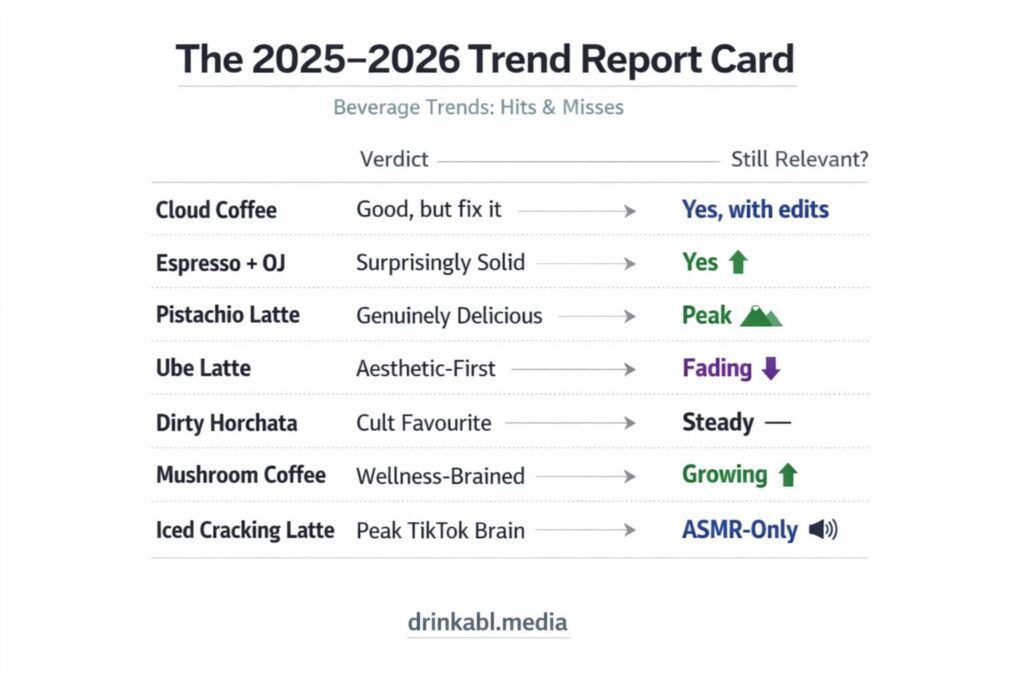
Cloud coffee was the trend that forced a reckoning with this formula. When the coconut water americano started circulating in mid-2025, it was easy to dismiss as another visual-first gimmick, a drink designed to perform rather than to please. What nobody expected was that, stripped of the alt milk float and fixed with a squeeze of lime, it was actually quite good. Not Instagram-good. Just good.
That created a problem for the content cycle. A drink that tastes good but needs editing is harder to evangelise than one that photographs well and you only need to make once. Cloud coffee survived anyway, but the pipeline had already moved on. By late 2025, the trend machine had delivered pistachio lattes, ube espresso drinks, dirty horchata, and the iced cracking latte, each one more algorithmically optimised than the last.
“Cloud coffee was the trend that forced a reckoning. Nobody expected it to actually taste good.”
The anatomy of a TikTok coffee trend
The mechanics are worth understanding because they explain both why these drinks keep coming and why so many of them disappoint off-camera. Research into the 2025 viral coffee pipeline is consistent on this point: the platforms are not rewarding taste, they are rewarding visual grammar. The cascade. The colour contrast. The ASMR crack of a chocolate shell. The satisfying purple of ube. These are cinematic cues, not culinary ones.
The iced cracking latte is the clearest example. A chocolate shell that shatters when you stir, there is almost no other reason this drink exists. Its virality is built almost entirely on ASMR mechanics rather than flavour, and its durability as a menu item outside social media has been limited accordingly. Drinks that survive the content cycle tend to have one thing in common: they taste good enough that people keep ordering them even when they’re not filming.
Pistachio coffee is the most interesting case study here. Originating from the Dubai Chocolate trend that swept TikTok in late 2024, the pistachio latte brought strong visual credentials, that pale green, the fine-grained foam, but also happened to be genuinely pleasant to drink. Nutty, not sweet, with a richness that complemented espresso without the cloying quality of its hazelnut predecessor. It has sustained longer than almost any other trend in the pipeline because it passed the reorder test: people who made it once wanted to make it again.
“Drinks that survive the content cycle tend to have one thing in common: they taste good enough to order again.”
The wellness pivot, and why it’s different
Alongside the flavour-driven trends, a separate and more durable shift has been underway. Mushroom coffee, espresso blended with adaptogenic fungi like lion’s mane and chaga, has moved from niche wellness circles into mainstream menus. Unlike most TikTok coffee trends, its growth is characterised by sustained upward trajectory rather than viral spikes, reflecting something closer to a genuine behavioural shift than a content moment.
The claims attached to it are worth treating with scepticism, the language around cognitive enhancement and stress reduction is rarely backed by the kind of clinical rigour that would satisfy a sober reading. The science on functional beverages remains contested territory, particularly where adaptogens are concerned. But the consumer intent behind the trend is real: people are increasingly asking their morning cup to do more than caffeinate them.
This intersects with a broader shift in how the beverage industry is positioning functional drinks. At Natural Products Expo West 2026, gut-health beverages rose 16% in dollar sales and mood support drinks surged 42%, figures that point to a consumer willing to pay a premium for drinks that claim health adjacency, regardless of whether the evidence fully supports it.
The honest version of mushroom coffee’s appeal is simpler: it tastes smoother than regular coffee, it carries the cultural signifier of “clean caffeine,” and it photographs well. That combination is enough to sustain a trend even without peer-reviewed backing.
What actually survives
The question worth asking about any viral coffee trend is not whether it will go viral but whether it will survive the hangover. Most do not. Ube’s journey is instructive: the Filipino purple yam exploded on TikTok in late 2023, briefly became unavoidable, and by 2025 had settled into the category of “available everywhere, ordered by fewer people than you’d expect.” The visual novelty wore off faster than the supply chains could adapt.
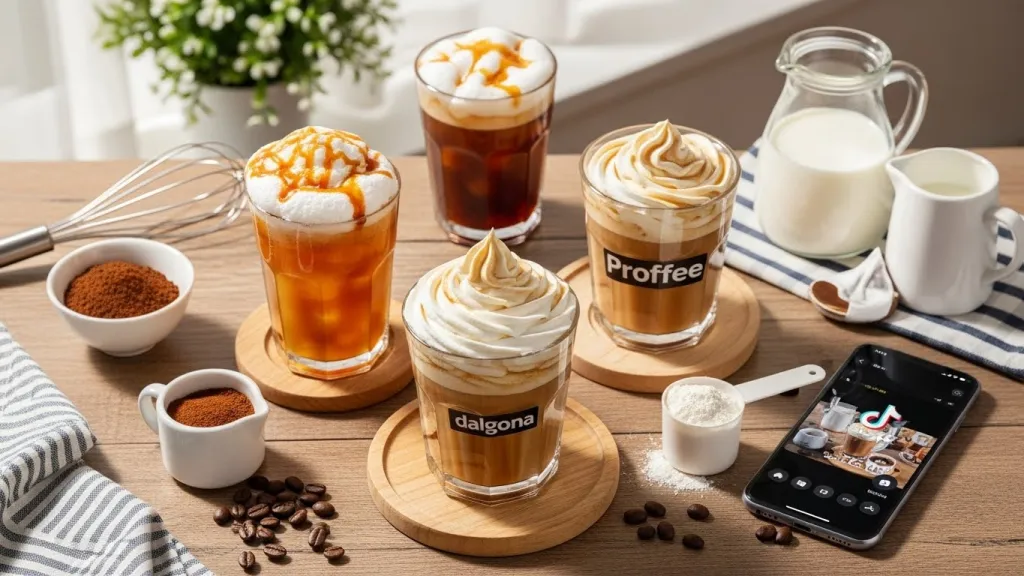
Cloud coffee is in a similar position, present on enough menus to have achieved a kind of permanence, but no longer generating content. That is not failure. That is what the lifecycle looks like when a trend is absorbed rather than discarded. The drinks that disappear entirely tend to be the ones that were only ever content: the cracking shell, the bucket-sized iced coffees that trended briefly in early 2025, the whipped variations that circled back to Dalgona nostalgia without adding anything new.
What is genuinely interesting about this moment is that the algorithm has started to produce drinks that are good, not by design, but as a side effect of volume. When enough people experiment with espresso and unusual ingredients, some of those combinations are going to work. Cloud coffee with lime. Pistachio with oat milk. Dirty horchata for anyone who grew up with cinnamon and coffee in the same kitchen.
“The algorithm has started to produce drinks that are good, not by design, but by the sheer volume of experimentation.”
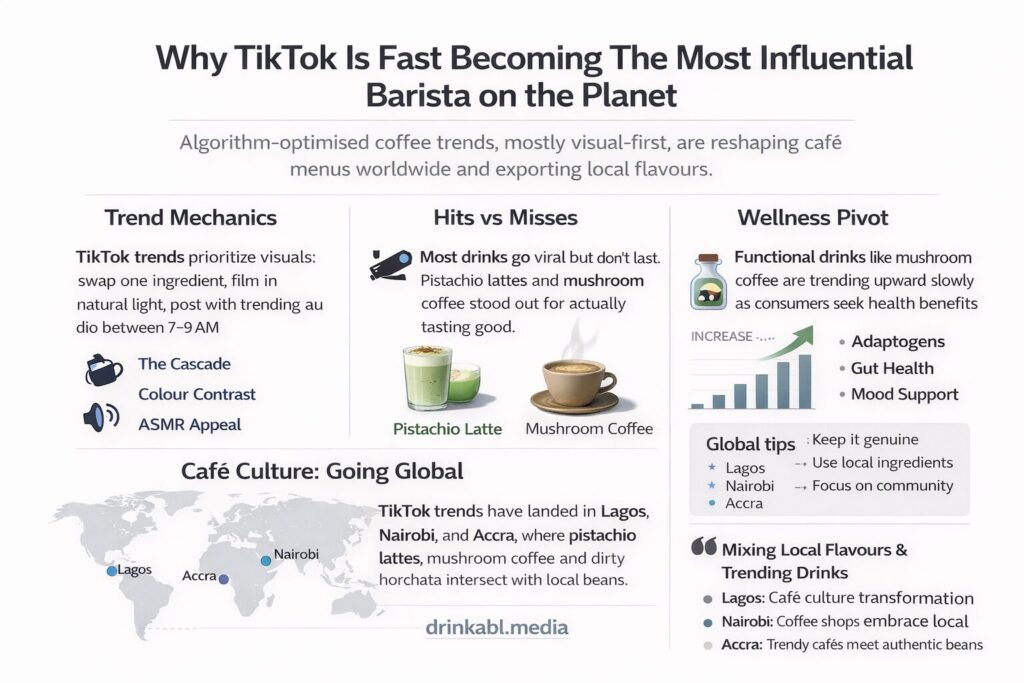
Lagos, Nairobi, Accra: where global trends meet local identity
Here is the part of the conversation that most global beverage media skips entirely: these trends are not landing only in Brooklyn and Shoreditch. They are landing in Lagos, Nairobi, and Accra, and what happens to them there is far more interesting.
Lagos is undergoing a genuine café culture transformation, driven by a younger, cosmopolitan demographic that sees coffee shops less as caffeine delivery systems and more as lifestyle spaces, places to work, build community, and yes, create content. Venues like Café Neo, The Coffee Society NG, and Everyday People Coffee are not fringe operations; they are busy, design-conscious spaces where a TikTok coffee trend lands on the same morning it trends in London or Los Angeles.
In Nairobi, domestic coffee consumption has grown 19% in a single financial year, driven by an expanding urban café scene that is simultaneously connecting with Kenya’s deep coffee-producing heritage and reaching toward global specialty culture. The 2025 Kenya Barista Champion described Nairobi’s coffee café culture as “growing fast and becoming more vibrant”, which is another way of saying that the same young consumer scrolling TikTok in Seoul or São Paulo is also scrolling it in Westlands and Kilimani.
The nuance is in what gets adapted and what gets adopted wholesale. African cafés increasingly combine traditional brewing methods with contemporary design, heritage and innovation in the same cup. A pistachio latte at a Lagos café is likely to arrive alongside locally sourced Nigerian beans from Taraba or Cross River State. A cloud coffee in Nairobi might use coconut water that didn’t travel far at all. The TikTok format is global; the ingredients and the context are local. That tension is where the most interesting coffee culture is being made right now, and it is almost entirely unreported by the publications chasing the next viral drink.
TikTok’s own 2026 Discover List included African food creators for the first time, among them Trevor Were from Nairobi, a self-taught chef who has built a global audience through cinematic food storytelling, and Wayne Chang from South Africa, bringing bold culinary content to international screens. African creators are not just consuming global food culture trends. They are beginning to set them.
The coffee shop party: TikTok’s logical endpoint
The strangest development in the viral coffee pipeline is not a drink at all. The #CoffeeShopParty trend, TikTok-driven events that transform cafés into social hubs with live music and themed experiences, represents the logical conclusion of a generation that has never separated coffee from content. The drink is no longer the product. The atmosphere is.
This is not necessarily cynical. Cafés have always been social spaces as much as beverage delivery systems, and there is something honest about making that explicit rather than pretending the latte art is incidental. The risk is that it accelerates a dynamic already underway: cafés that optimise for content rather than coffee, where the drink is a prop and the barista is a supporting character.
In African urban markets, where café culture is still being written rather than inherited, this tension is especially live. The café as community hub has deep roots, Ethiopia’s coffee ceremony has functioned as exactly that for centuries. The question is whether the TikTok-era version of that gathering space preserves the substance or just captures the aesthetic.
For the industry, the more interesting question is whether functional beverage trends now competing for the same consumer, mushroom coffee, adaptogenic lattes, gut-health drinks, will eventually pull spending away from espresso-based drinks entirely, or whether espresso will simply absorb them. The early evidence suggests absorption: pistachio lattes and mushroom cortados are espresso drinks. They just have better thumbnails.
FURTHER READING
Which Is Better Between Green Tea & Coffee? Science Has a Verdict · Health & Nutrition
Sipping Toward Wellness: How the Beverage Sector Is Reinventing Women’s Health · Deep Dive
How Health, Innovation & Youthful Demands Are Driving Africa’s Beverage Industry in 2026 · Special Report
Africa’s Ginger Drinks Are Brewing a Billion-Dollar Boom · Beverage Categories
Africa’s Drinks Industry Has a Sober Problem, & a Bigger Opportunity · Features
Beet Juice Beats Blood Pressure & New Science Explains Why It Works Better as You Age · Health & Nutrition