
The Seventh Annual Abridge Wine & Spirits Competition opens March 3 in France’s wine capital, and the compliance challenges at its centre mirror exactly what African producers and importers are navigating right now.
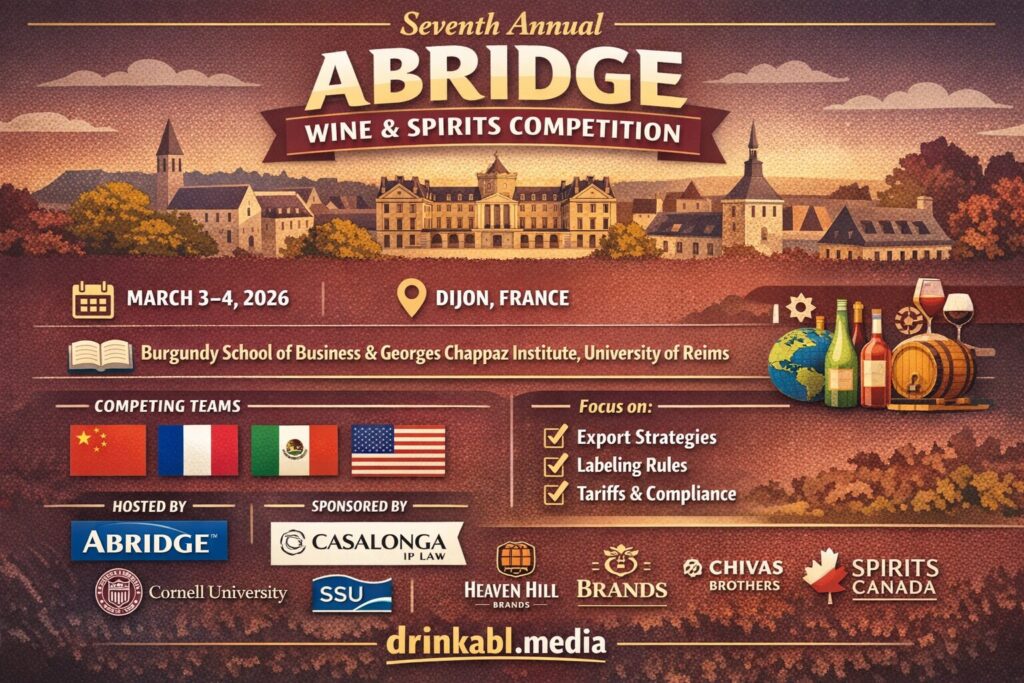
This Tuesday and Wednesday, one of the wine industry’s most practically relevant events gets underway in Dijon, France. The Seventh Annual Abridge Wine & Spirits Competition, hosted at the Burgundy School of Business and co-organised with the Georges Chappaz Institute at the University of Reims, challenges student teams from China, France, Mexico, and the United States to solve a real-world-mirroring crisis: a private equity-owned California winery navigating export expansion, tariff exposure, labeling compliance, excise duties, and packaging mandates across multiple international markets.
The judging panel draws from Cornell University, Sonoma State University, Heaven Hill Brands, Chivas Brothers, Wine Australia, and Spirits Canada. IP law firm CASALONGA sponsors the event, reflecting the growing intersection between trade compliance and intellectual property protection in cross-border wine exports.
Why This Moment, Why Dijon
The competition arrives at an inflection point for global wine trade. A landmark EU-India deal signed in January slashed India’s wine import tariffs from 150% to as low as 20%, reshaping the export landscape overnight. A 15% US baseline tariff remains in effect across global markets. European sustainability and e-labeling mandates are tightening. In this environment, regulatory literacy is no longer a back-office function, it is a frontline competitive advantage.
“Understanding the international regulatory landscape has become a competitive necessity.”— Bennett Caplan, President, Abridge™
The African Stakes
Strip the case study of its California setting and the scenario maps directly onto decisions facing African wine producers and importers today. South Africa’s wine sector learned this painfully, a 30% US tariff imposed in August 2025 drove export volumes to America down 21% and dollar value down 23%. The sector has since pivoted toward continental markets, with exports to Kenya, Zambia, and Uganda all growing in double digits in 2025. But intra-African trade brings its own compliance maze.
For importers and distributors building premium wine portfolios in Nigeria, Ghana, and Côte d’Ivoire, the labeling and excise standards being debated in Dijon are the same standards their European suppliers must already satisfy. Africa’s alcoholic beverages market is on a strong growth trajectory, the continent’s beer market alone is forecast to reach $74.65 billion by 2033, with premium wine’s share rising. Knowing how global compliance frameworks work is increasingly the price of entry for anyone building seriously in this space.
The Abridge competition does not set policy. But the thinking it trains and the talent it connects will shape how international wine trade is conducted for years to come. For Africa’s wine investors and enthusiasts, watching this week’s outcome closely is not an academic exercise, it is market intelligence.
📖 Read Your Sips, Further Reading on Drinkabl.Media
- Africa’s Drinks Industry Has a Sober Problem, & a Bigger Opportunity
- South Africa’s Wine Industry Faces Existential Reckoning As US 30% Tariff Hits Harder
- Nigeria’s Brewers Sound the Alarm on Three-Year Excise Plan, With ₦425bn on the Line
- Alcohol-Free Beer Is No Longer the Odd One Out
- These Are the 20 Nigerian Beverage Companies to Watch in 2026
- How Health, Innovation & Youthful Demands Are Driving Africa’s Beverage Industry in 2026