Federal agencies at loggerheads as beverage sector unions demand reopening of sealed factories amid conflicting directives
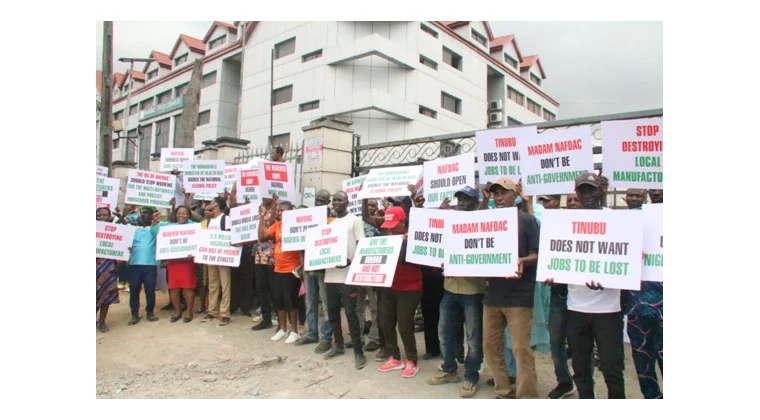
Tensions escalated in Lagos on Thursday as workers from Nigeria’s food and beverage sector shut down the National Agency for Food and Drug Administration and Control’s (NAFDAC) office complex in Isolo, demanding the immediate reopening of production facilities sealed during enforcement of the controversial sachet alcohol ban.
Members of the National Union of Food, Beverage and Tobacco Employees (NUFBTE) and the Food, Beverage and Tobacco Senior Staff Association (FOBTOB) barricaded the office entrance, chanting solidarity songs and carrying placards as security forces maintained heightened presence around the facility. The protest marks the latest flashpoint in a deepening standoff between federal regulators, industry stakeholders, and government agencies over who has the final say on the alcohol packaging policy.
Conflicting Signals Fuel Industry Chaos
At the heart of the dispute lies a fundamental question: Has the Federal Government ordered NAFDAC to suspend its enforcement, or hasn’t it?
Union leaders insist that directives from both the Office of the Secretary to the Government of the Federation (OSGF) and the Office of the National Security Adviser (ONSA) have called for a suspension of all enforcement actions pending the full operationalization of the National Alcohol Policy. According to statements from the SGF’s Special Adviser on Public Affairs, Terrence Kuanum, the government acknowledged receiving concerns from the House of Representatives and emphasized that “until the policy is fully operationalised and further guidance is issued by the Office of the SGF, NAFDAC must refrain from all enforcement actions.”
“The Federal Government, through the SGF and the Office of the National Security Adviser, has given a directive. The Director-General should respect that directive and immediately reopen all factories and depots that were sealed.”
— Comrade Lanre Yusuf, National Deputy President, FOBTOB
However, NAFDAC has categorically denied receiving any such instruction, describing circulating reports as “false, misleading, and a misrepresentation of government position.”
In a strongly worded statement, NAFDAC Director-General Prof. Mojisola Adeyeye declared: “At no time has the Agency received any formal directive ordering the suspension of its regulatory or enforcement activities in respect of sachet alcohol products.”
The agency reaffirmed its commitment to enforcing the ban in line with existing regulations and public health objectives, insisting it operates “strictly within the ambit of its statutory mandate.”
A Policy Seven Years in the Making
The current enforcement crisis comes after years of industry preparation. NAFDAC first announced plans to phase out sachet and small-volume alcohol packaging in December 2018, when it signed a five-year Memorandum of Understanding with the Federal Ministry of Health, the Federal Competition and Consumer Protection Commission, and industry associations.
The original deadline of January 2024 was extended to December 2025 following intense lobbying from manufacturers who cited the scale of investment involved and potential job losses. But when the Senate in November 2025 ordered strict enforcement with no further extensions, NAFDAC moved forward with implementation in late January 2026.
The regulatory agency maintains that the ban targets only two categories: spirit drinks in sachets and bottles smaller than 200ml—not entire companies or larger alcohol volumes.
Public Health vs. Economic Survival
NAFDAC has consistently framed the ban as a protective measure against underage drinking and alcohol abuse. Prof. Adeyeye has emphasized that cheap, easily concealed sachet alcohol fuels addiction among minors, commercial drivers, and vulnerable populations.
“This ban is not punitive; it is protective. It is aimed at safeguarding the health and future of our children and youth.” — Prof. Mojisola Adeyeye, NAFDAC Director-General
Health advocates and some community groups have rallied behind NAFDAC, lauding the policy as essential for reducing alcohol-related social harms including road accidents, domestic violence, and school dropouts.
But industry stakeholders paint a starkly different picture. The Manufacturers Association of Nigeria (MAN) has warned that the ban could result in the loss of over ₦1.9 trillion in investment, mass retrenchment of more than 500,000 direct employees, and approximately five million indirect jobs.
Workers at Thursday’s protest echoed these fears, warning that some employees had already been laid off and might not receive salaries. They disputed NAFDAC’s claims that sachet alcohol directly drives underage drinking, insisting there was no publicly available data linking packaging format to consumption by minors.
Security and Supply Chain Concerns
The involvement of the National Security Adviser’s office signals that the dispute has transcended regulatory matters. Government statements have warned that premature enforcement without a harmonized policy framework could “pose wider security risks, especially within informal distribution networks across the country.”
The OSGF cautioned that continued sealing of factories and warehouses “without a harmonised policy framework had begun to create economic disruptions” that could destabilize communities and worsen unemployment.
As of Thursday afternoon, security presence remained heavy around the Isolo office complex, while mediation efforts between the union and NAFDAC continued. The standoff shows no signs of immediate resolution, with both sides digging in on their positions.
The Federal Government has promised that “a final, balanced and lawful decision would be communicated in due course after comprehensive consultations,” but provided no timeline.
For now, Nigeria’s beverage sector remains in limbo, caught between competing federal directives, regulatory enforcement, and the livelihoods of hundreds of thousands of workers who fear they may become casualties of a policy meant to protect public health.
NAFDAC has begun evacuating what it terms “violative sachet alcohol and alcohol in PET bottles less than 200ml” from various companies, while protesters vow to continue their action until sealed facilities are reopened.
The question remains: In a country where policy implementation has historically been inconsistent, who ultimately has the authority to decide when a ban becomes reality?