
South Africa shipped 2.9 million tons of citrus to international markets in 2025, overtaking Spain to claim the title of world’s largest exporter by volume, the Citrus Growers’ Association of Southern Africa confirmed this week.
The milestone is an export record, not a production one. China, Brazil, and Spain remain larger producers by volume, but each serves substantial domestic markets. South Africa’s edge comes from the opposite approach: roughly two-thirds of local citrus production goes straight to export, with the industry generating an estimated $2.47 billion in foreign revenue in 2025, according to CGA data. That export orientation, combined with sustained compliance with international plant health standards and deepening logistics integration, is what puts South Africa on top of the rankings.
Spain’s position has also become more complicated in recent years. Producers there have had to manage increasingly difficult climatic and production conditions, which tightened its export availability. The CGA was careful to frame this as a supply balance story rather than a straight-out competitive win: Spain anchors the Northern Hemisphere season, while South Africa fills the summer gap when European growers are out. Northern Hemisphere supply is expected to recover as growing conditions improve. That dynamic means the two countries are, in commercial terms, partners as much as rivals.
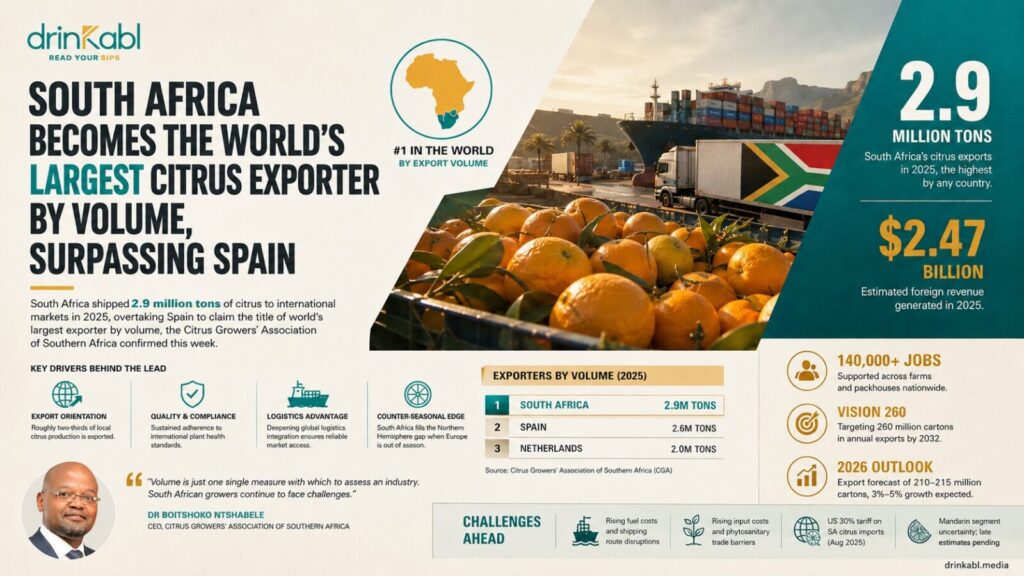
The employment stakes behind these volumes are considerable. “The citrus industry in South Africa supports at least 140,000 jobs on farm and packhouse level alone,” said Dr Boitshoko Ntshabele, CEO of the CGA, in a statement issued alongside the 2025 figures. “It forms the heart of many rural economies throughout the country, from Letsitele in Limpopo to Addo in the Eastern Cape to Citrusdal in the Western Cape.” The industry also underpins Vision 260, the CGA’s long-term programme targeting 260 million cartons in annual exports by 2032.
Getting there, however, depends on resolving pressures that do not disappear with a record season. “Volume is just one single measure with which to assess an industry,” Ntshabele said. “South African growers continue to face challenges. Currently, the impact of the situation in the Middle East on fuel costs and shipping routes is a concern, which is placing significant pressure on grower margins.” The quote was contained in the CGA’s official statement.
“Volume is just one single measure with which to assess an industry. South African growers continue to face challenges.” — Dr Boitshoko Ntshabele, CEO, Citrus Growers’ Association of Southern Africa
Rising input costs and unscientific phytosanitary barriers in certain markets compound the shipping problem. And one specific trade risk is worth watching closely: the United States imposed a 30% tariff on South African citrus imports in August 2025. Its timing, late in the export season, limited the damage last year as growers accelerated shipments before the deadline. But with the 2026 season now underway, the tariff’s full effect on US-bound volumes, which historically account for between 5% and 6% of South Africa’s citrus exports and generate more than $100 million annually per CGA estimates, is yet to play out. Oranges have since received a tariff exemption, but mandarins have not, leaving part of the product mix still exposed.
The CGA’s export forecast for 2026 projects growth of between 3% and 5%, targeting 210 to 215 million cartons. Lemons are expected to lead category growth at around 45.9 million cartons, a 10% increase year-on-year, supported by new orchards coming into production. Grapefruit is forecast to rise 16%. The mandarin segment, which makes up the bulk of the crop, carries the most uncertainty, with late mandarin estimates still to be released. Whether the industry converts this volume into margin will depend, more than anything, on what happens to the US tariff situation in the months before the mid-year peak of the export window.
READ MORE