

Varun Beverages commissioned a $40 million Cheetos manufacturing plant and juice and dairy blend facility in Harare on May 13, deepening India’s most aggressive consumer play on the African continent under billionaire Ravi Jaipuria.
The complex, launched in the presence of Zimbabwean President Emmerson Mnangagwa, comprises a $20 million Cheetos snacks facility now in full operation and a juice and dairy blend plant whose foundation stone was laid the same day. Together they mark the latest capital deployment by Jaipuria’s PepsiCo franchise empire across a continent where his company has quietly become one of the most consequential foreign investors in consumer goods.
Varun entered Zimbabwe eight years ago with a single production line churning out 10 million bottles monthly and an initial investment of approximately $30 million, according to the company. It now runs six production lines with capacity approaching 120 million bottles per month, directly employing about 2,000 people and supporting roughly 13,000 indirect livelihoods across logistics, retail, distribution, and farming.
Mnangagwa praised the expansion at the commissioning ceremony: “The added US$20 million investment by Varun Beverages marks industrial diversification, creation of employment opportunities for our people and manufacturing sector integration into both regional and global value chains.”
“The added US$20 million investment by Varun Beverages marks industrial diversification, creation of employment opportunities for our people and manufacturing sector integration into both regional and global value chains.”
— Emmerson Mnangagwa, President of Zimbabwe
The Zimbabwe commissioning arrived weeks after Varun completed its $125 million acquisition of South African beverage producer Twizza through its subsidiary BevCo, with all regulatory approvals from South Africa, Botswana, and Eswatini confirmed in March 2026. The deal gives Varun three Twizza manufacturing facilities in Cape Town, Middelburg, and Komani, plus an established distribution network across five Southern African countries.
The broader Africa opportunity is one this publication has been tracking since the continent’s investment inflection sharpened in 2025. The pattern Varun is executing, sequential acquisitions married to greenfield builds, mirrors what analysts across the region have flagged as the most durable entry model for consumer goods players unwilling to bet on a single-country story.
Jaipuria’s Africa ambitions now run considerably deeper than beverages. At the Harare ceremony, he announced a $650 million investment programme for Zimbabwe over the next five years, spanning renewable energy, recycling, beverages, and industrial manufacturing. A 130-megawatt green energy project in Matobo is already underway, with projected costs of between $300 million and $350 million. “We are putting up a recyclable PET plant. After putting that plant, imports will reduce substantially, and we will be exporting to other countries from here,” Jaipuria said.
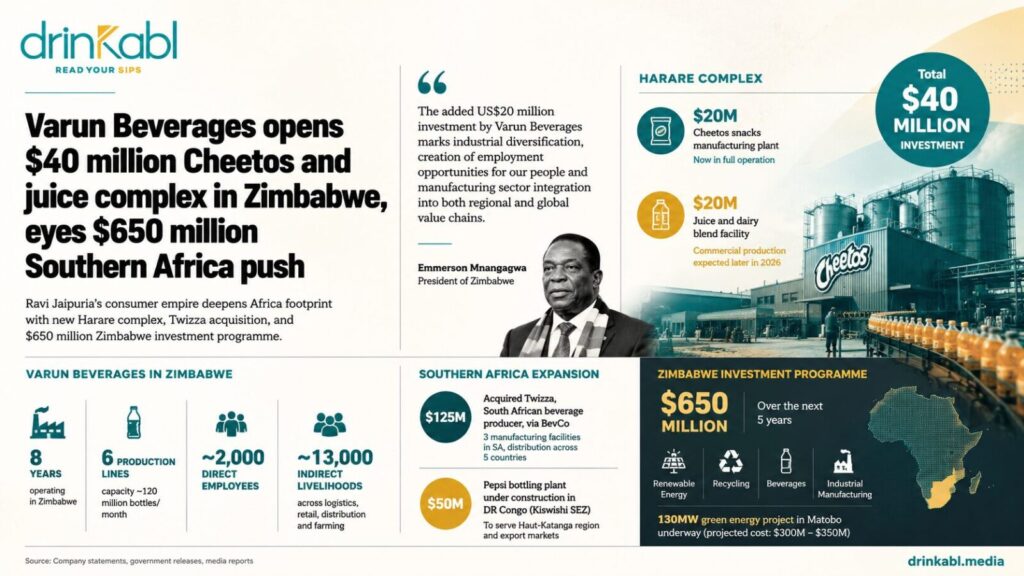
The company has also moved into Central Africa. In June 2025, Varun Beverages RDC SAS broke ground on a $50 million Pepsi bottling plant in the Kiswishi Special Economic Zone near Lubumbashi in the Democratic Republic of the Congo, positioned to serve the Haut-Katanga region and, per company projections, neighbouring export markets including the Republic of Congo, Cameroon, and Gabon. Varun is also setting up a subsidiary in Kenya to extend its manufacturing and distribution platform further east.
Jaipuria, 71, chairs RJ Corp, a conglomerate spanning beverages, fast food, healthcare, and education. Bloomberg’s billionaires index pegged his net worth at approximately $12 billion as of mid-May 2026, derived primarily from his controlling stake in Varun Beverages, PepsiCo’s largest bottling franchise outside the United States.
Varun’s Africa push has accelerated as domestic growth in India has softened. International volumes grew roughly 9% during the first nine months of 2025, according to company filings, even as India volumes came under pressure from adverse weather patterns. Africa is doing most of that heavy lifting.
The juice and dairy blend facility commissioned in Harare is expected to reach commercial production later this year, per Varun’s statement, with supply chain linkages to Zimbabwean dairy farmers, fruit growers, and packaging suppliers. Exactly when it hits commercial scale, and how quickly Twizza’s integration under BevCo ramps up Southern African distribution, are the near-term numbers to watch.
READ MORE: