

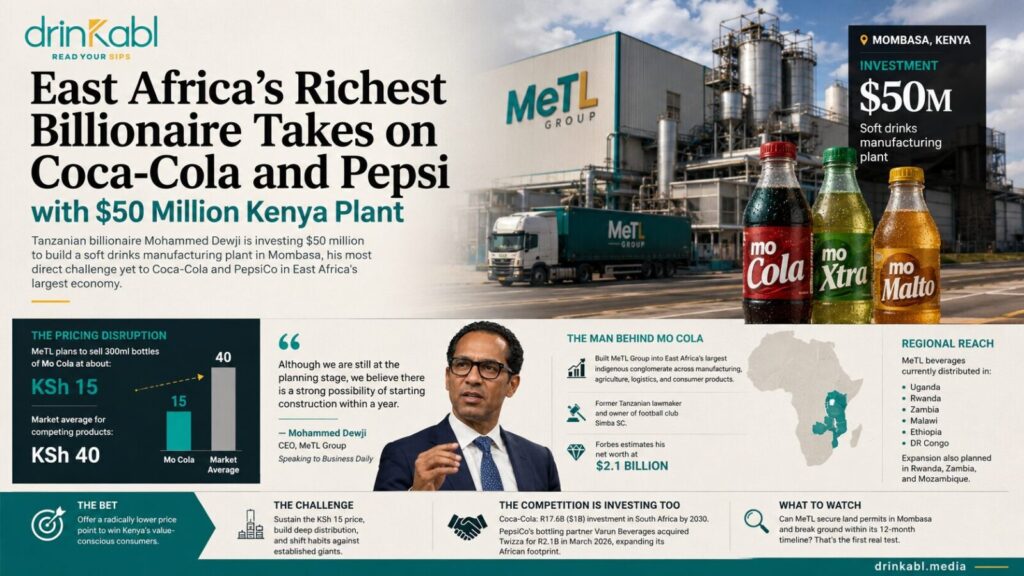
Tanzanian billionaire Mohammed Dewji is investing $50 million to build a soft drinks manufacturing plant in Mombasa, his most direct challenge yet to Coca-Cola and PepsiCo in East Africa’s largest economy.
The facility, being developed through Dewji’s conglomerate MeTL Group, will produce the company’s flagship beverages: Mo Cola, Mo Xtra, and Mo Malto. The pricing logic is the whole point. According to Business Daily, MeTL plans to sell 300-millilitre bottles of Mo Cola at about 15 Kenyan shillings, against a market average of around 40 shillings for competing products. That is not a discount play. It is a different consumer category entirely.
Dewji made the announcement after attending the Africa Forward Summit in Nairobi, telling Business Daily the project is already at the planning stage. Construction could begin within the next 12 months.
“I’m setting up a plant in Uganda, and I now have land in Mombasa. I’m also looking into establishing a carbonated soft drinks plant,” he said. “Although we are still at the planning stage, we believe there is a strong possibility of starting construction within a year.”
The man behind Mo Cola
Known across East Africa as “Mo,” Dewji built his business through palm oil, rope, consumer goods, and beverages before transforming MeTL into the region’s largest indigenous conglomerate, spanning manufacturing, agriculture, logistics, and consumer products. He previously served as a Tanzanian lawmaker and owns football club Simba SC. Forbes puts his net worth at about $2.1 billion.
“Although we are still at the planning stage, we believe there is a strong possibility of starting construction within a year.”
— Mohammed Dewji, CEO, MeTL Group, speaking to Business Daily
The Mo Cola brand was built on the same affordability logic now headed for Kenya. In Tanzania, that strategy challenged established market leaders by consistently undercutting their prices. Dewji is betting that Kenyan consumers, squeezed by inflation and rising living costs, are ready for the same offer.
Kenya’s soft drinks market has swallowed would-be disruptors before. Softa Bottling Company came close to breaking Coca-Cola’s dominance in the late 1990s before eventually collapsing. Industry analysts say MeTL’s success will depend on holding the Sh15 price point without sacrificing margin, building distribution infrastructure beyond Nairobi and Mombasa, and sustaining enough marketing investment to shift consumer habits against brands with decades of presence in the market.
Regional ambitions, intensifying competition
The Mombasa plant is part of a broader MeTL expansion across East and Southern Africa, including a planned facility in Uganda and wider distribution in Rwanda, Zambia, and Mozambique. MeTL beverages already move through Uganda, Rwanda, Zambia, Malawi, Ethiopia, and the Democratic Republic of the Congo.
Mombasa is attracting serious capital across sectors. Nigerian billionaire Aliko Dangote told the Financial Times in May that he was leaning toward the coastal city as his preferred location for a proposed $15–$17 billion East African oil refinery, citing its deeper port and larger consumer market relative to Tanzania’s Tanga, where the project had originally been floated.
On the multinational side, Coca-Cola and its authorised bottlers announced a R17.6 billion ($1 billion) investment in South Africa through 2030 at the South Africa Investment Conference in Johannesburg in March. Varun Beverages, PepsiCo’s largest bottling partner outside the United States, completed its R2.1 billion acquisition of South African drinks maker Twizza in March 2026, adding three manufacturing plants and a five-country distribution network to its existing African footprint in Morocco, Zambia, Zimbabwe, and the DRC.
Whether Dewji’s price advantage built in the factory can survive what happens on the street is the question every regional challenger in Kenya has ultimately failed to answer. The next data point to watch is whether MeTL can secure land permits in Mombasa and break ground within its stated 12-month window, a timeline that will tell the market how serious this move really is.
Read More: